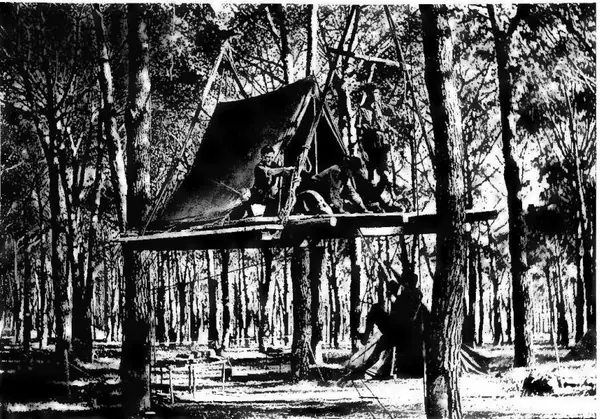
CATHOLIC EXPLORERS. - A movement for physical education and the moral formation of character, created by Robert Baden-Powell and perfected by adapting it to Catholic educational thought.
I. THE CREATION OF R. BADEN-POWELL
1. Origin
R. Baden-Powell, considering on the one hand his own experiences during the colonial war of the Transvaal, where he had admired the energy and strength of spirit of the small free men, who managed to give great help to their parents in the operations of war, and on the other hand the inadequacy of the formative work of the family and of the school in the lower districts of London, devised a movement that would gather together and train boys and educate them by appealing to the sense of initiative and responsibility that each one must have. Hence his boy scout movement, in which the term scout (explorer) indicates that every boy or young man of the movement must possess all the qualities of the explorer.
2. Principles and method
"Scouting" seeks to develop in the young: character and intelligence; manual work and dexterity; health and strength; help of one's neighbor. The "technical means" for achieving this aim are not listed in an orderly exposition, because Baden-Powell, a pre-eminently practical man, did not devise them all at once, but tested them by intuiting and applying them as opportunity presented itself.
The "scout" technique, by instilling full confidence in the pupil and calling him to overcome concrete difficulties, proportioned to his age and his abilities, contributes to the education of judgment and intelligence. Life in the open air and the constant care that every boy must to set out to be healthy and strong, have a beneficial influence on his moral formation. The resolve to be "always ready" to serve one's neighbor is also a means of educating the young man's heart to become a generous and useful man. Play, which, different according to age, is always as serious as work, is the natural means of training the boy in those skills that will allow him, in life, to overcome every obstacle, and at the same time offers the leader an opportunity to examine his boys to see what they are capable of doing. The specialties that are proposed to the already experienced scout are means of testing his vocation and of helping him find the path on which he will be able to make himself most useful in society.
3. The promise and the law
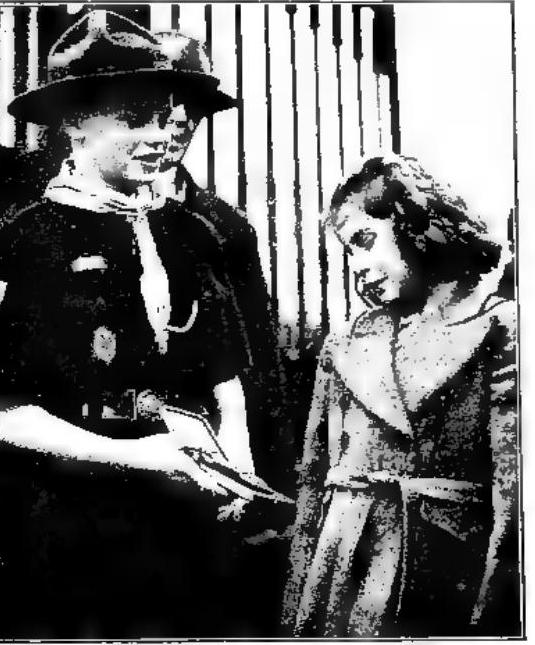
At the moment of his official enrollment, the scout recites the following formula: "I promise on my honor to do my best: 1st to do my duty to God and to the King; 2nd to help others in every circumstance; 3rd to observe the scout law."
This law, which contains the seeds of the moral education proper to the movement, is made up of ten articles: 1) "The scout places his honor in deserving trust; 2) the scout is loyal; 3) the scout is always ready to serve his neighbor; 4) the scout is a friend to all and a brother to every other scout; 5) the scout is courteous and chivalrous; 6) the scout sees God in nature, respects plants and animals; 7) the scout obeys orders; 8) the scout smiles and sings in difficulties; 9) the scout is hardworking and thrifty; 10) the scout is pure in thought, word and deed." Furthermore, the duty of the so-called daily good turn falls upon him; that is, he must not let a day pass without being conscious of having performed a good work, whether toward himself, or toward others, or toward animals.
"Scouting" is therefore a system of life, which must be joined with a formative technique and pedagogy that aims to make one acquire a sense of responsibility, a tone of manliness, a spirit of initiative and inventiveness, a firm and strong discipline in self-mastery; and this not through the teaching of precepts, or theory, but through the power and awareness of personal effort. Formation, however, partial, of not too high a spiritual perfection; one could even call it simply naturalistic, however much it is permeated by a sense of warm humanity and fatherliness. Nevertheless, were it observed, it would already elevate for many the tone of civilized living.
II. THE MOVEMENT OF CATHOLIC EXPLORERS
The novelty of the institution, the disciplined military aspect that it presents, although it is by no means intended to train little soldiers, its eminently practical character, its purpose of restoring and improving youth, attracted the attention and favor of all classes, and naturally of the young and the boys, who feel the dynamic instinct of the soldier, following the maxims of the volunteer soldier, for play, for amusement, and met with a marvelous success. Catholic boys too felt drawn to it; but in Catholic circles there also arose justified mistrust of a method that disregarded too many elements which are nonetheless considered of capital importance in the Catholic educational concept. Hence arose the groups and associations of Catholic scouts only, in which care was taken to permeate the deficient law of Baden-Powell with the supernatural element, which preserves in life the sense of service; a service, however, that consists in knowing, loving, and serving God in a climate of supernatural Grace. This happened quite early in England, in Belgium, in France, in Germany, and also in Italy.
III. THE MOVEMENT OF CATHOLIC EXPLORERS IN ITALY
In Genoa, in 1905, Prof. Mario Mazza had established an association of young people which was given the name "Iuventus iuvat" because in their idea being young meant knowing and wanting to be of service to one's neighbor; each group was called a "Gioiosa" and the first was opened in the semi-abandoned oratory of S. Nicolosio. When the news appeared (Nov. 1910) concerning the scout movement, the R. E. I. (Ragazzi Esploratori Italiani) was founded that same year, in which the first members were the members of the various "gioiose." Having realized that certain elements were compromising the apolitical character of the work, the "gioiosi" returned to their original institution (1912). Meanwhile, in 1911, the G. E. I. (Corpo nazionale dei Giovani Esploratori Italiani) was founded by Prof. Carlo Colombo under the high protection of the government and of various ministries. But the G. E. I. did nothing other than add to the naturalism proper to the Protestant institution the laicism that was then professed in Italy; two elements that harmed true education and that Catholics could not approve. Hence the necessity of forming a separate association of Catholic scouts, which would safeguard young people from every danger against their faith and their practices of piety and would prevent a dangerous and unjust monopolizing on the part of the G. E. I. Thus was born, on 28 Jan. 1916, the Associazione Scoutistica Cattolica Italiana (A.S.C.I.), in which the indefectible Catholic principles are protected and defended, and to the promise and the laws of the scout movement, above all to the sentiment of honor, its entire supernatural Christian meaning is given, which is awareness of the nobility and greatness that derives to the soul from the state of grace and from the intrinsic perfection of virtue, from the thought that every service rendered to others is a service rendered to God and every even humblest "duty" fulfilled is an act of the most exquisite devotion. The Christian sense of the sentiment of honor is also clearly indicated by the patron chosen, St. George, patron of the ancient knights without stain and without fear. The Catholic principles, then, are promoted in practice through religious instruction, the exact fulfillment of the precept of hearing Mass on holy days and of the other duties of charity, and through frequent reception of the Sacraments. Every group, moreover, has its own ecclesiastical assistant, as does every region and every nation.
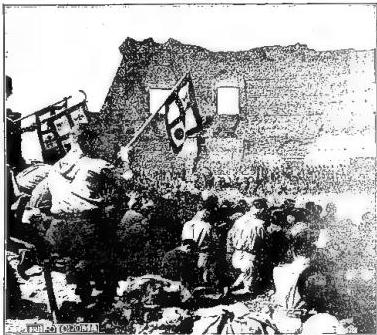
The A.S.C.I. continued and increased its flourishing and vigorous life until 1927, when fascism declared all the units existing in towns with fewer than 20,000 inhabitants dissolved. The following year, owing to a series of political incidents entirely extraneous to the Association, all the other units still in existence were also to have been dissolved; but to forestall the action of the dictatorial decree the Central Commissariat urged all Catholic scouts to suspend every activity. Some units continued a limited clandestine activity. The movement resumed on 7 March 1944, and on 8 Dec. the female section was also founded, likewise under the name "Guide Cattoliche Italiane." In 1945 the first issue of the Esploratore came out, the Italian scout magazine.
IV. ORGANIZATION OF CATHOLIC EXPLORERS
The method requires following the boy's development, forming a suitable "environment" for each of his stages. Thus for the child from eight to twelve years old, living in the golden world of dreams, there is the "pack life" centered on imaginative play; for the boy from twelve to seventeen years old, wholly intent on adventure, troop life will be an "adventurous" game that will end with exploits marking the adolescent's first achievements; while for the young man of eighteen, the ascent to the "clan" will mark his contact with life and his preparation for the hearth.
The "scout" units are therefore: the pack, divided into "sixes" of six boys with a sixer who must set an example for the others; the troop, of 4 "patrols" made up of six to nine boys and led da un caposquadriglio che ne ha la responsabilità effettiva;
il « clan », formato di a o più pattuglie composte di un
numero da 4 a 6 rover. E formano, riunite insieme, il
« gruppo », che rappresenta l'unità completa per tutto il
ciclo educativo. Branco, reparto, clan vivono però, come
is easy to understand, a life of their own, directed by the pack leader in the first case, by the court of honor composed of the
capi del reparto e dai caposquadrighi, nel secondo, dal
« capitolo del clan » nel terzo. I gruppi residenti in una lo-calità fanno capo ad un commissariato di settore, e questi
with others from the same diocese or province, to a zone commissariat. The zone commissariats of one and the same region are overseen by the respective commissariat
regionale. In campo nazionale vi è un « commissariato
centrale » formato da 12 commissari eletti biennalmente
dai commissari e assistenti regionali. - Vedi tav. XLII.