
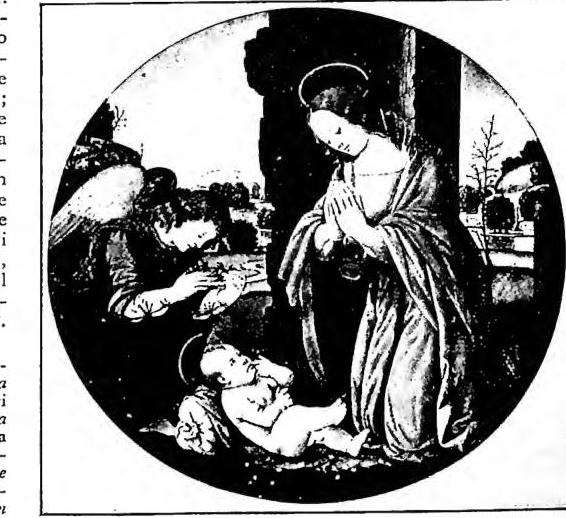
LORENZO di CREDI. - Painter, sculptor and goldsmith, b. in Florence in 1456 or in 1459-60, d. there on 12 Jan. 1537.
Among his earliest works are the Self-Portrait (1488) of the Widener Collection in Philadelphia, the Venus (the only profane painting to escape the bonfire of vanities of 1497, through the influence of Savonarola's preaching) and the youthful Annunciation (both in the Uffizi), which can give the measure of his possibilities and of his derivations from the Verrocchio circle and from that beyond the Alps; Leonardo himself also had a great influence on his formation, and certain works (such as the Portrait of Ginevra de' Benci, in the Liechtenstein Gallery in Vienna) have often wavered in their attribution between the one and the other.
Not a great artist and at times monotonous, especially in the repetition of the schemes of his Madonnas, he nevertheless knew how to infuse into his paintings a sense of composure, an expression of his seriousness and his honesty of craft. Among the best-known paintings are the Madonna between St. Julian and St. Nicholas (now in the Louvre), executed ca. 1503 for the church of Cestello; the Madonna and 4 Saints in S. Maria delle Grazie in Pistoia, for which he was paid in 1510, and, at approximately the same time, the St. Bartholomew on a pier in Orsanmichele and the Adoration of the Shepherds for S. Chiara (now in the Uffizi); in 1523 he signed the St. Michael, in the sacristy of the cathedral of Florence. His enamel-like colour and his wholly personal particularism earned him the praises of Vasari; and he is often found taking part in commissions, such as that of 1491 for the examination of the project for the facade of S. Maria del Fiore, that of 1498 for that of the dome and that of 1504 for the placement of Michelangelo's David.
Bibliography4 works
Gilberto Ronci