
BECOMING. – In the strict sense, it is the coming into being of a being or of any of its determinations, in opposition to perishing or dissolution; in the broad sense, every form of change, in opposition to unaltered persistence.
The fact of becoming has, at all times, constituted one of the most important themes of philosophical reflection. In Indian thought, the view of becoming as the condition of existence suffering and fallen from its true reality is characteristic. The effort to overcome this condition governs reflections on becoming even where they appear in the form of ontological speculation. The doctrine of the Upanisads and of the systems of Vedānta is based on a monistic or pluralistic spiritualism, combined with a phenomenalism of the external world and of empirical personality. In Buddhism, which at its beginnings adhered to an agnostic attitude, expressions of a universal phenomenalism later arose, and still later various forms of idealism with an actualist orientation.
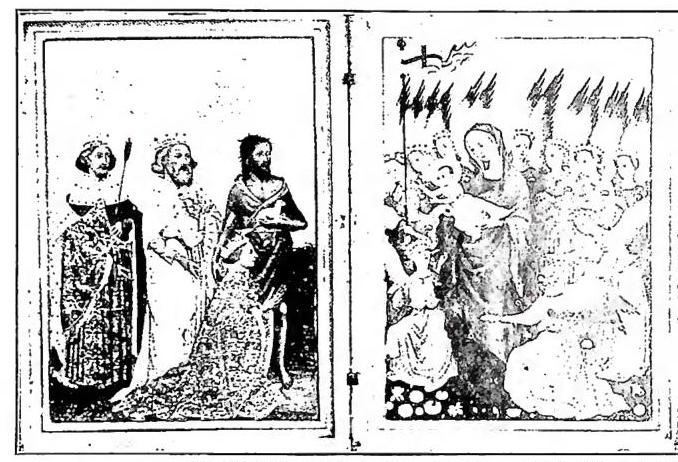
(from Milanges Halia de Loo, Brussels – Perige, 1901, plate 12)
DITTICO - Wooden d. of Wilton, Madonna with the Child and Angels; Riccardo II presented to the Virgin by s. Edmondo, s. Edoardo il Confessore and s. Giovanni Battista. English school of the 14th century. - London, National Gallery.
a doctrine that remained isolated in ancient philosophy, according to which cosmic realities arise from the encounter of contrary processes and are unstable combinations of opposites. The insertion of becoming as a real fact into the philosophy of being is the work of Aristotle (Phys., V, IX; Met., X, XII). The foundation of the solution is the theory of act and potency; becoming is the imperfect actualization of a real possibility and finds its ultimate principle in the pure actuality of the divine Being, the first and unmoved mover of all things. Already in Plato there appears occasionally (Soph., 247, 248 and 249 d) another conception of becoming. Life is self-motion, and life must be attributed to the more perfect beings. This positive aspect of becoming, insofar as it is spiritual or vital productivity, gains predominance from the time when, in the Neoplatonic current, personal being becomes the key to the understanding of being in general (cf. Plotinus, Eun., VI, 8).
The biblical doctrine of the living and active God compelled Christian theologians to take account of the positive value of productivity and to seek harmony between the requirements of ontology and the activism of spiritual existence. The synthesis was achieved in the great classical systems, although with different emphases on one or the other of these two moments. In certain later medieval Neoplatonic-mystical currents (Eckhart, Nicola da Cusa), the transition took place toward a philosophy in which the productive and creative act has primacy over being, first in speculation on God and then, as a consequence of a latent pantheism, also in psychology and cosmology.
The philosophies of dynamism (Leibniz, Kant) draw inspiration from the same motives, while seeking to preserve the reality of substances. Their extreme consequences appear in modern actualist systems, for which reality is resolved into a continuous emergence of fleeting acts that do not presuppose but produce everything. In this sense Fichte developed an actualism of free action; Hegel, a system of the dialectical self-motion of the idea; and Gentile (Teoria generale dello spirito come atto puro, chaps. 3 and 4), an actualism of «thinking thought». The philosophers of life (Nietzsche, Bergson) defend a doctrine of becoming that is purposeless and irrational.
The various problems that emerged in this development, which concern different parts of philosophy, may be grouped as follows: 1) the relation between being and becoming; the clarification of the nature and presuppositions of becoming on the basis of the supreme ontological concepts and principles (act-potency, substance, time). 2) The problem of the actualization of active potencies through self-motion, a problem studied by the Scholastics especially with regard to free will. 3) The relation between the immutability of absolute being and its supreme immanent and creative activity (v. CREAZIONE; DIO). 4) The teleological problems of becoming (v. INABILITÀ).