
CATHOLIC SCOUTS. — A movement for physical education and the moral formation of character, created by Roberto Baden-Powell and perfected by adapting it to Catholic educational thought.
I. THE CREATION OF R. BADEN-POWELL. — 1. Origin. — R. Baden-Powell, considering on the one hand his own experiences during the Transvaal colonial war, where he had admired the energy and courage of the young free boys, who were able to give their parents great assistance in military operations, and on the other the inadequacy of the formative work of the family and school in the poorer districts of London, conceived a movement that would gather and train boys and educate them by drawing upon the sense of initiative and responsibility that each person must possess. Hence his boy scout movement, in which the term scout (explorer) indicates that every boy or young person in the movement must possess all the qualities of an explorer.
2. Principles and method. — “Scouting” seeks to develop in young people: character and intelligence; manual work and skill; health and strength; assistance to one’s neighbor. The “technical means” for attaining this purpose are not set out in an orderly exposition, because Baden-Powell, a supremely practical man, did not devise them all at once, but discovered and applied them experimentally, as opportunities arose.
Scout “technique,” by instilling complete confidence in the pupil and calling upon him to overcome concrete difficulties proportionate to his age and abilities, contributes to the education of judgment and intelligence. Life in the open air and the constant care that every boy must
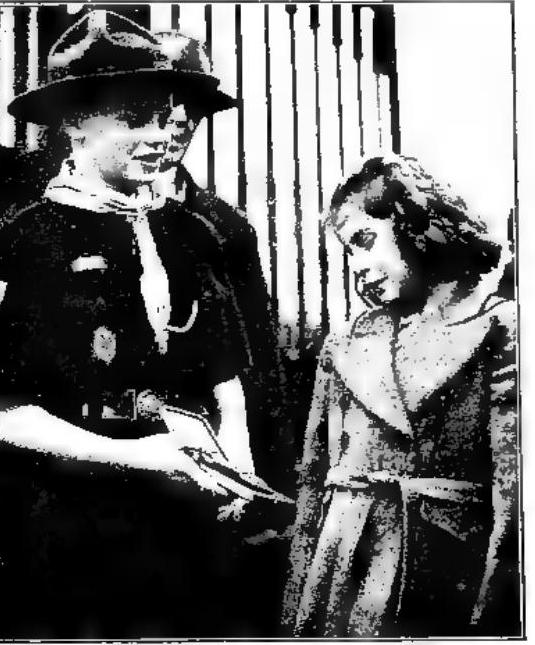
ESPLORATORI - The Scout Davide Carlo Western (of the Derwentwater School, Acton, London) shows his little sister the “Albert Medal” received from the King at Buckingham Palace (2 Nov. 1948), for rescuing two companions who had fallen into the frozen lake at Osterley Park.
The constant care which every boy must take in order to be healthy and strong benefits his moral formation. The resolve to be “always ready” to serve one’s neighbour is also a means of educating the young man’s heart to become generous and useful. Play, which varies according to age but is always as serious as work, is the natural means of training the boy in those skills that will enable him, in life, to overcome every obstacle; at the same time, it gives the leader an opportunity to examine his young charges and see what they are capable of doing. The specialities proposed to the already experienced Scout are means of testing his vocation and helping him find the path along which he will be able to make himself most useful in society.
3. The Promise and the Law. - Upon his official enrolment, the Scout pronounces the following formula: “On my honour I promise to do my very best: 1° to do my duty towards God and the King; 2° to help others on every occasion; 3° to observe the Scout Law.”
This law, which contains the seeds of the movement’s distinctive moral education, consists of ten articles: 1) “A Scout places his honour in deserving trust; 2) a Scout is loyal; 3) a Scout is always ready to serve his neighbour; 4) a Scout is a friend to all and a brother to every other Scout; 5) a Scout is courteous and chivalrous; 6) a Scout sees God in nature and respects plants and animals; 7) a Scout obeys orders; 8) a Scout smiles and sings in difficulties; 9) a Scout is industrious and thrifty; 10) a Scout is pure in thought, word and deed.” He is also bound by the duty of the so-called daily good deed; that is, he must not let a day pass without being conscious of having performed a good deed either for himself, or for others, or for animals.
“Scoutism” is therefore a way of life, combined with a formative technique and pedagogy aimed at developing a sense of responsibility, a manly bearing, a spirit of initiative and inventiveness, and a firm and vigorous discipline in self-mastery; and this not through the teaching of precepts or theory, but through the virtue
and consciousness of personal effort. It is, nevertheless, a partial formation, of not particularly high spiritual perfection; indeed, it might simply be called naturalistic, although permeated by a sense of warm humanity and fatherhood. Nevertheless, were it observed, it would already raise the standard of civil life for many.
II. THE CATHOLIC SCOUT MOVEMENT
The novelty of the institution, the military and disciplined aspect that it presented, although it was in no way intended to produce little soldiers, its eminently practical character, and its purpose of restoring and improving the condition of the young, attracted the attention and favor of all classes, and naturally of young men and boys, who feel the dynamic instinct of the soldier, especially of the volunteer soldier, and who, for play and amusement, came to know it with marvelous success. Catholic boys, too, felt drawn to it; but in Catholic circles there also arose justified misgivings about a method that disregarded too many elements which are nevertheless regarded as of capital importance in the Catholic conception of education. Hence arose groups and associations composed solely of Catholic scouts, in which care was taken to permeate Baden-Powell’s deficient method with the supernatural element, which preserves in life a sense of service—service, however, consisting in knowing, loving, and serving God in a climate of supernatural Grace. This took place very soon in England, Belgium, France, Germany, and also in Italy.III. THE MOVEMENT OF THE CATHOLIC EXPLORERS IN ITALY
In Genoa, in 1905, Prof. Mario Mazza had formed an association of young people which was given the name «Iuventus iuvat», because in their view being young meant knowing and wishing to benefit one’s neighbor; each group was called a «Gioiosa», and the first was opened in the semi-abandoned oratory of S. Nicolosio. When news appeared (November 1910) concerning the movement of the explorers, the R. E. I. (Ragazzi Esploratori Italiani) was founded that same year, its first members being drawn from the various «gioiose». Realizing that certain elements were compromising the apolitical character of the work, the «gioiosi» returned to their original institution (1912). Meanwhile, in 1911, Prof. Carlo Colombo founded the G. E. I. (Corpo nazionale dei Giovani Esploratori Italiani) under the high protection of the government and various ministries. But the G. E. I. did nothing more than add secularism to the naturalism proper to the Protestant institution, secularism then professed in Italy—two elements harmful to true education and which Catholics could not approve. Hence the need to form a separate association of Catholic explorers, which would safeguard young people from every danger threatening their faith and their practices of piety, and prevent a dangerous and unjust monopolization by the G. E. I. Thus, on 28 January 1916, the Associazione Scoutistica Cattolica Italiana (A.S.C.I.) was founded. In it the immutable Catholic principles are protected and defended, and to the promise and laws of the Catholic explorer, above all to thesense of honor, is given its full supernatural Christian meaning: the consciousness of the nobility and greatness that derive to the soul from the state of grace and from the intrinsic perfection of virtue; the thought that every service rendered to others is a service rendered to God, and that every, even the humblest, «duty» fulfilled is an act of the most refined devotion. The Christian meaning of the sense of honor is also clearly indicated by the patron chosen, s. Giorgio, patron of the ancient knights without blemish and without fear. The Catholic principles, moreover,
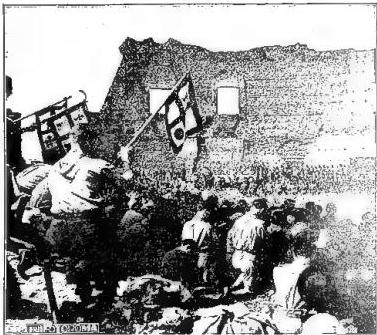
The A.S.C.I. continued and increased its flourishing and vigorous activity until 1927, when Fascism declared all units existing in cities with fewer than 20,000 inhabitants dissolved. The following year, because of a series of political incidents entirely unrelated to the Association, all the other units still in existence were also to have been dissolved; but, in order to forestall the action of the dictatorial decree, the Central Commissariat invited all Catholic e. to suspend every activity. Some units continued a limited clandestine activity. The movement resumed on 7 March 1944, and on 8 December the women’s section was also founded, under the name “Italian Catholic Guides.” In 1945 the first issue of L’Esploratore, an Italian scouting magazine, appeared.
IV. ORGANIZZAZIONE DEGLI E. C. - Il metodo vuole che si segua lo sviluppo del ragazzo, formando per ogni suo periodo un «ambiente» adatto. Così per il fanciullo dagli otto ai dodici anni, vivente il dorato mondo dei sogni, vi è la «vita di branco» imperniata sul gioco fantasioso; per il ragazzo dai dodici al diciassette anni, tutto proteso verso l'avventura, la vita di reparto sarà un giuoco «avventuroso» che terminerà con imprese segnanti le prime realizzazioni dell'adolescente; mentre per il giovane diciottenne, la salita al «clan» segnerà il contatto con la vita e la preparazione al focolare.
Le unità «scouts» sono quindi: il branco, diviso in «sestiglie» di sei ragazzi con un caposestiglio che deve essere di esempio agli altri; il reparto, di 4 «squadriglie» composte di un numero da sei a nove ragazzi e dirette
da un caposquadriglio che ne ha la responsabilità effettiva;
il « clan », formato di a o più pattuglie composte di un
numero da 4 a 6 rover. E formano, riunite insieme, il
« gruppo », che rappresenta l'unità completa per tutto il
ciclo educativo. Branco, reparto, clan vivono però, come
è facile a capirsi, una loro vita propria, diretta dal capo-
branco, nel primo caso, dalla corte d'onore composta dai
capi del reparto e dai caposquadrighi, nel secondo, dal
« capitolo del clan » nel terzo. I gruppi residenti in una lo-
calità fanno capo ad un commissariato di settore, e questi
con altri di una medesima diocesi o provincia, ad un com-
missariato di zona. I commissariati di zona di una me-
desima regione sono seguiti dal rispettivo commissariato
regionale. In campo nazionale vi è un « commissariato
centrale » formato da 12 commissari eletti biennalmente
dai commissari e assistenti regionali. - Vedi tav. XLII.