
FANATISM. – Fanaticus is customarily connected etymologically with fanana, “temple,” so that fanaticus would be equivalent to “belonging to a sacred temple” (CIL, V, 3924).
F., in its present-day meaning, is the condition of those who, believing themselves invested with a religious, civil, or social mission, in addition to displaying a singular pertinacity in their ideas, resort to every means, including violence, to make them triumph.
The first, as far as is known, to be called fanatici in Latin were the priests of Bellona (CIL, VI, 490, etc.), who on certain days of the year danced furiously, lacerated their flesh, and finally, having fallen into a delirium, foretold the future to those present. The same title was subsequently attributed to the Galli of Cybele (Juvenal, Sat., 2, 112), and of other divinities (CIL, IV, 2155; VI, 2234). The term was then also applied to indicate one who was possessed by some deity or subject to divine inspiration (Cicero, De divin., 2, 57).
As a consequence of the alleged divine inspiration, it follows that these persons uphold their ideas to the point of seeking to impose them by force and violence. Thus two concepts converge in the same initial meaning of f.: one essential, the other consequential. Fanatics are essentially those inspired by divinity, visionaries, the enlightened. Fanatics uphold their visions or inspirations by every means at their disposal, going so far as to reach the worst extremes. The strictly religious use of the word broadened in common usage to signify being invaded by an idea, not only in the religious sphere but also in the profane, and acting in accordance with it, whether appropriately or inappropriately.
In the study of this phenomenon, which affects the individual but more often a group of persons or a sect, medicine, history, psychology, and theology meet on common ground.
If one wishes to classify him according to the schemes currently used in forensic medicine, the fanatic is a paranoiac in whom the content of the delusional idea consists of a mystical or generally religious, patriotic, reformist, or revolutionary representation. At the common foundation of all these varieties there is always a delusion of grandeur, megalomania, and egocentrism, from which errors of judgment and conflict with the environment arise; in addition, there is the uncontrolled employment of means to make one’s own idea prevail. In the religious sphere this individual already has his consecrated name in the Gospel, pseudo-prophet, and a recent historical example is the well-known Davide Lazzaretti of Arcidosso (cf. E. Lazzareschi, David Lazzaretti, il Messia dell'Amiato, Brescia 1945).
F. may have historical, environmental, physiological, and psychic causes. But one perennial causal element is alive and powerful in every kind of f., and consists in passion, which is always intolerant in itself.
Even in mental contagion, which often spreads this kind of religious, political, or social delirium, so that f. is more a social than an individual phenomenon, passion can do much, since it has been demonstrated that, after paranoiacs and paranoid individuals, those particularly inclined to contagion are the so-called passionate types, according to Heymans’s characterological classification.
This explains why, when the individual is normal and remains within the truth, the phenomenon is impossible. And even if the Catholic Church has been accused of f. by its adversaries, to the point of making the very development of Christianity during the first three centuries, the martyrs, the great mystics and ascetics, the rise and development of the Crusades, the punishment of heretics through recourse to the secular arm, and other phenomena of the Church’s collective life appear to be products of f. (cf. G. Mascherini, L'intolleranza e i suoi presupposti, Turin 1909, pp. 31, 150, etc.; Dictionary of philosophy and psychology, ed. I. M. Baldwin, I, p. 223), this cannot be explained except by an arbitrary interpretation of the facts, by the abnormality of individuals, or generally by heterodox doctrinal or practical deviations on the part of certain members of the Church.
Sects, secret societies, factions, and particularistic groups, on the other hand, closed to more general ideals and visions and almost mysterious in their procedures, are suitable ground for manifestations of f. This applies not only to religious sects or factions but also to civil and political ones. One kind of f. is chauvinism, a degeneration of patriotism.
(Alinari photograph)
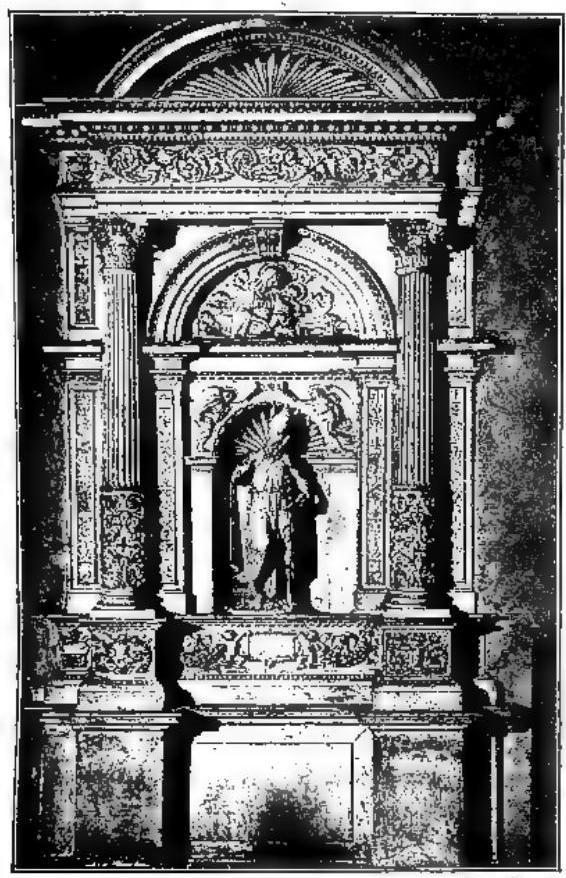
FANCELLI, FAMIGLIA — Altar of S. Biagio, by Pandolfo F., in collaboration with Stagi — Pisa Cathedral.