### GHEZZI, PIER LEONE
Painter and draughtsman, born in Rome on 28 June 1674 and died there on 5 March 1755. He was introduced to art by his father Giuseppe, and like his father he soon ranked among the most celebrated Roman artists of his time, enjoying favours and honours from cardinals and Pope Clement XI; the Duke of Parma made him a count and a knight.
He was a member of the Accademia di S. Luca, of which he was elected a member in 1705. His earliest works were sketches after his father’s paintings and engravings for books (notably those for the *Homilies on the Gospels* and the *Consistorial Orations* of Clement XI), but he was later extremely active in producing numerous paintings for Roman churches, some of which have since been lost. Among those that remain are: in S. Marcello al Corso, a mediocre painting of St Juliana Falconieri and the Vesting of the same Saint in the church of the Archconfraternity of S. Maria dell’Orazione e Monte in Via Giulia; *St Ignatius among Lions* (1715) in S. Clemente; and *The Prophet Micah* (1718) in S. Giovanni in Laterano. He also made cartoons for tapestries, collaborated in the staging of festivals and spectacles, and, like his father, engaged in the restoration (with rather free ideas) of old paintings. The frescoes on the walls of the Villa Falconieri at Frascati, depicting members of the Falconieri family and burlesque scenes full of keen observation, date from 1727. It is this verve and spirit that still make him famous for his numerous caricatures (a rich collection is in the Vatican Library), which besides their artistic value have a particular importance for the social history of 18th-century Rome. The Uffizi hold three of his self-portraits, and another is in the Accademia di S. Luca in Rome.
---
### GIBERTI, LORENZO
In the panel of the Sacrifice of Isaac (Bargello), with which in 1401 he won the competition for the second door of the Baptistery (competing, among others, with Brunelleschi and Jacopo della Quercia), he produced a work of high literary quality rather than poetic inspiration, in the impeccable coherence of a painted bas-relief. In the gilded bronze reliefs of the same door (1403-24) these same qualities are developed almost everywhere more freely through the inspired harmony between the pictorial luminosity of the relief and the most subtle music of the sinuous unfolding of the line, reaching accents of true poetry.
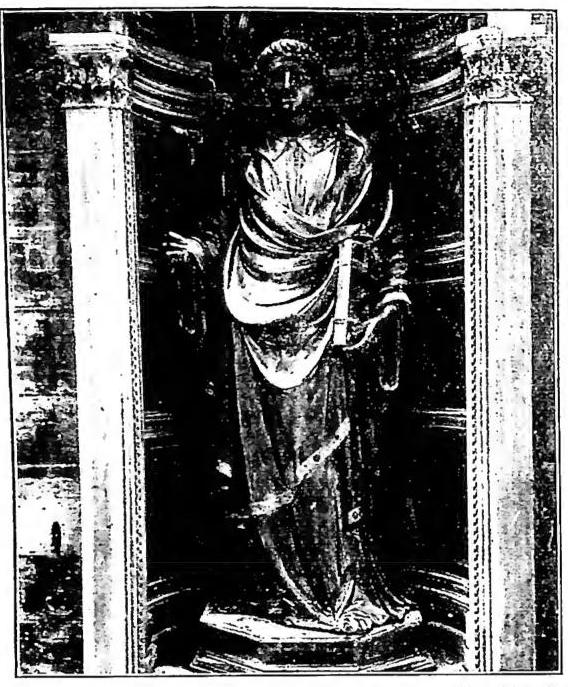
During this period G. executed perhaps the *St James*, certainly the *St John the Baptist* (1414), the *St Matthew* (1419-22) and the *St Stephen* (later) in the external niches of Orsanmichele, as well as two panels for the baptismal font of Siena (1424-27). All these works are somewhat mannered and nobly artisanal, except for the *St Matthew*, a luminous vision of serenity.
In the third door of the Baptistery (1425-52) G. applied, with the system of square compartments, following the example of Donatello, the laws of pictorial perspective to the bas-relief, certainly with the intention of producing a work up to date with the now triumphant taste of the early Renaissance. But his art remained intrinsically tied to late Gothic taste, and it was always within the realm of a fairy-tale vision that he achieved here (as also in the *Ark of St Zanobi* in the Duomo, 1446) the purity of art. The problem debated by recent criticism as to whether G. should always be considered an artist (Schlosser) or always a most noble craftsman (Galassi), or an artist in the second door and a craftsman in the third (L. Venturi), is probably best resolved by recognising that he was always endowed with the highest technical-literary abilities, a surprising and captious skill, but that in all periods of his activity a profound poetic inspiration succeeded at times in breaking through that envelope which both nourished and stifled II.
In his old age he wrote the *Commentaries*, a treatise on artistic technique and theory, with a summary of the history of art of great interest as a source and notable for its sure taste in the part concerning the fourteenth century and in the autobiography. – *See* pl. XXVI.
**Ghibberti, Lorenzo** – *St Stephen*. Bronze on the exterior of the Church of Orsanmichele – Florence.