Machine translation of the 1948–1954 Italian original. The original text is authoritative.
GIOVANNI di CONVERSINO da RAVENNA. – Educator and writer, born in Buda in 1343, died in Venice in 1408. Brought as a child to Ravenna (hence the appellation), he studied there under Donato degli Albanzani; he then went to Bologna to study, leaving as a notary. Chancellor of the Carraresi in Padua (1379–82; 1392–1404) and of the municipality of Ragusa (1383–87), he devoted himself to teaching at various times, and pupils who later became famous emerged from his school (Guarino Veronese, Vittorino da Feltre, P. P. Vergerio).
An admirer of Petrarch, he maintained relations with Boccaccio and with learned contemporaries and gave impetus to the humanist movement in the Veneto. In his school he anticipated
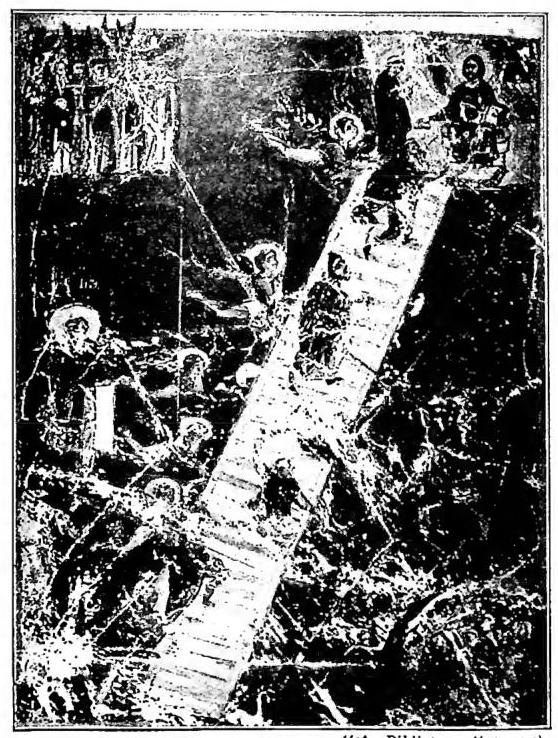
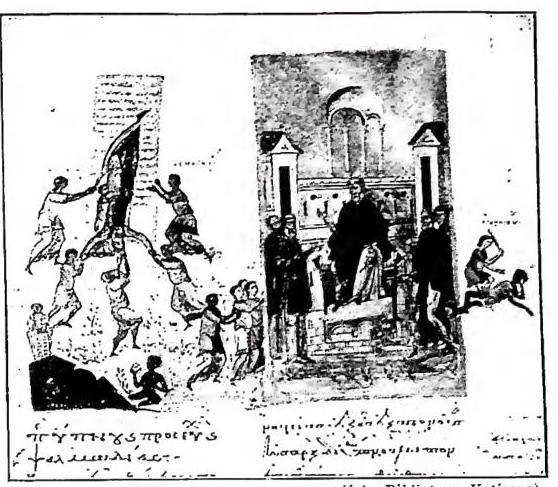
GIOVANNI CLIMACO, saint – Scala Paradiso. Miniature (11th–12th century) – Vatican Library, cod. Vat. gr. 394, inside back cover, first unnumbered folio. (photograph: Vatican Library)GIOVANNI CLIMACO, saint – Scala Paradiso: gradus XVIII. Miniature (11th–12th century) – Vatican Library, cod. Vat. gr. 394, fol. 93. (photograph: Vatican Library)the renewal brought about by Veronese and Vittorino, advocating humane and rational teaching methods, in contrast with the mortifying mnemonic mechanism, and attacking the brutal violence then in use. Despite certain moral lapses, his profound religiosity is revealed in the pamphlets of Stoic-Christian philosophy (De fato; De miseria humanae vitae; Ad Augustinum philosophum de Christi conceptu) and in the hymn to St. John the Evangelist. Of particular literary interest is the Rationarium vitae, an autobiographical account, written in harsh, medieval but candid and vivid Latin, at times crudely lively, which reveals the man and his experiences in their intimate details: the first example of its kind in humanist literature.
BIBL.: R. Sabbadini, G. da R. insigne figura d'umanista, based on unpublished documents, Como 1924 (review by V. Rossi in Giorn. stor. d. lett. it., 86 [1925], pp. 368–69); P. Paschini, G. da R. maestro di grammatica a Udine, in Mem. stor. foroginlessi, 33–34 (1937–38), pp. 206–207; V. Rossi, Il Quattrocento, Milan 1938, pp. 22–23.
Italiano Marchetti
Cite this article
“GIOVANNI DI CONVERSINO DA RAVENNA.” Enciclopedia Cattolica, vol. VI (1951), p. 341. Azione Romana digital edition, https://azioneromana.com/article/giovanni-di-conversino-da-ravenna.