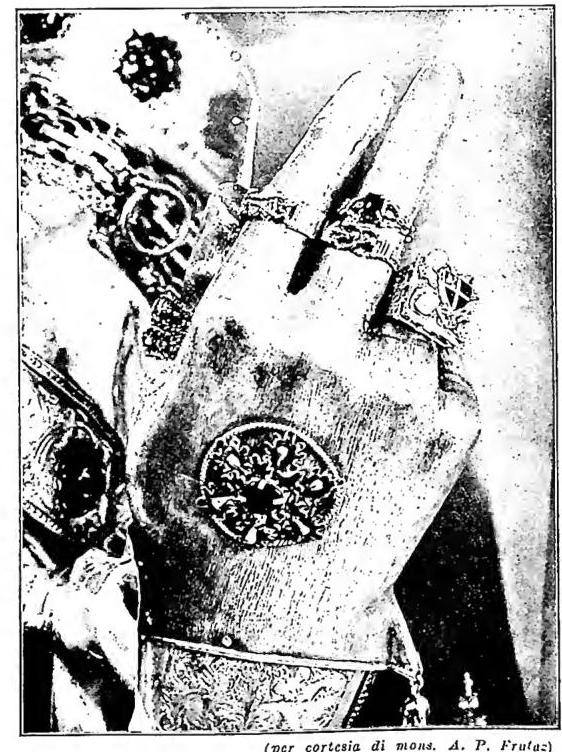
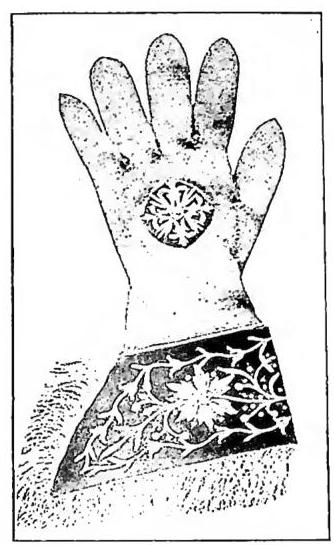
GLOVES. — The introduction of gloves (chiriateca) into the liturgy is due to the desire to make episcopal attire ever more distinct and solemn. Amalarius, at the beginning of the 9th century, says nothing to us about the use of gloves by bishops; however, an inventory of the abbey of St-Riquier from 831 attests to their use: “Wanti castanei auro parati.” Magani (L'antica liturgia romana, III, Milan 1899, p. 170) cites other documents from the 10th century and a precise liturgical attestation in the Sacramentary of Ratold of Corbie (d. 986): “Tunc ministrentur ei (— to the bishop who is preparing for Mass) manicate... postea detur

GUANELLA, LUIGI - Portrait.
He devoted his entire life to this cause, championing it with passion, following closely the development of the social and labor question as outlined by the directives of the popes and in the works of his friend Prof. G. Toniolo (q.v.) and of that other distinguished sociologist, Monsignor G. Sichirollo, whose final hours he attended (cf. F. Giavarini, *Mons. G. Sichirollo*, Rovigo 1936). Under the gaze of the Madonna del Lavoro, he himself reclaimed the malarial plain of Pian di Spagna (Sondrio), transforming it into an active center of life around the church and a shelter for the physically and mentally disabled that he established there. Continuing the work entrusted to the Madonna della Divina Provvidenza, he provided shelter for the victims of the Messina earthquake (1908), whom his beloved friend Fr. G. Beccaro brought in great numbers to his homes, and for those of the Marsica earthquake (1915), which he himself, at the age of seventy-three, gathered and directed to his houses in Rome.
Aware of the formative power of the press, he became its apostle, distributing it freely and writing himself about fifty pamphlets on hagiographic, historical, apologetic, pedagogical, and devotional topics. Mindful of the development of the migratory movement, he first sent a priest to North America to assist the Italians who had emigrated there, and later, after a journey to America, dispatched groups of his priests and sisters.
He partly compensated for the unfulfilled missionary apostolate through his work in Protestant Switzerland, so that the valleys excluded from Catholicism since the "Reformation" might be reopened to its influence. The zeal to extend salvation to all souls led him to conceive the grand idea of uniting the entire world in a vast crusade of prayer for the salvation of the dying, for whom, in various parts of the globe, tens of thousands of priests (Archconfraternity of the Transit of St. Joseph, with 9 million members: q.V. GIUDAIZZANTI) continuously offer to God the sacrifice of propitiation.
For his fruitful life of works and faith, he was revered by Cardinal Ferrari (q.v.) and held in great affection by Pope Pius X (q.v.), who honored him with particular confidence.
No less affection and esteem did St. John Bosco have for him; they worked together for three years (1875–
*ei anulus in dextra manu, desuper manica*. The use therefore appears to have been introduced in France and soon spread to Rome: in 1070 Alexander II granted the privilege to the abbot of San Pietro in Ciel d’Oro in Pavia. At the terms *ventus* and *manica*, the Byzantine term *chiroteca* soon replaced it, and it is still in use today.
In the consecration of a bishop, gloves are delivered at the end of Mass and are used only by bishops and other prelates having the privilege, during pontifical Mass from the beginning to the Lavabo (in the Ambrosian rite until the Offertory) and when, at the end, they give the papal blessing (S. Congregazione dei Riti, 3605, 9). Originally they were white, generally of silk; from the 13th century they were also made in the other liturgical colors, except black, being forbidden in Masses for the dead and on Good Friday. On the upper part they have embroidery with symbols of Jesus Christ. The prayer with which they are delivered to the newly elected indicates that their purpose is not to protect from the cold, but to keep the hands clean.