
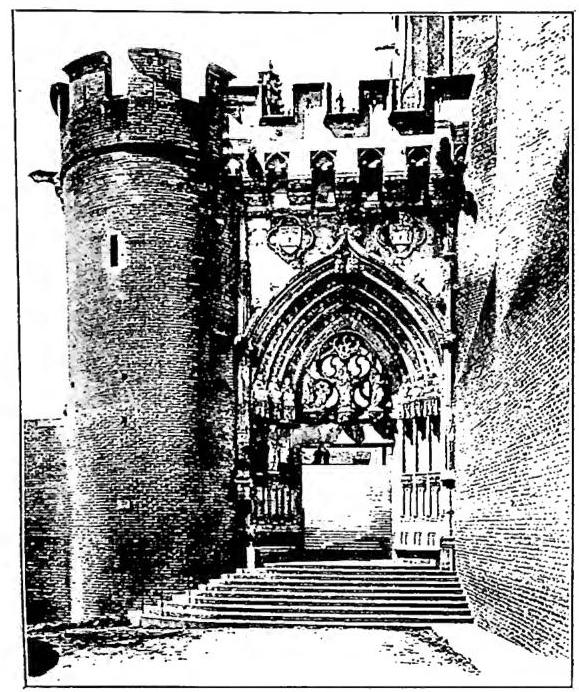
ALBI, Archdiocese of. - Metropolis of southwestern France with its seat at A., a city of 30,000 inhabitants, situated on the left bank of the Tarn, a tributary of the Garonne, northeast of Toulouse, and at the same time the capital of the department of the Tarn (5,780 sq km and 297,800 inhabitants). A., which in classical antiquity was the center of the Celtic tribe of the Albigenses, acquired importance especially in the Middle Ages, from the Carolingian era onward, when it became the seat of a county.
The episcopal see dates back in all likelihood to the 3rd century. St. Clair is honored as its first bishop, but the first name attested by history is that of Dio-
Dio-genianus, of whom Paulinus of Nola speaks in praise as of a contemporary (cf. Epistolae, in CSEL, XXIX, 1, p. 390). Gregory of Tours also mentions him (Hist. Francorum, II, 13). The diocese of A. then formed part of Aquitania Prima; it remained united to it even when John XXII in 1317 separated its southern part to form the diocese of Castres.
A. gave its name to a sect of heretics against whom, in 1209, Pope Innocent III ordered a crusade which defeated them at Murat and at Toulouse in 1213 (v. ALBIGESI). Innocent XI erected A. into a metropolis on 3 Oct. 1678. The concordat suppressed it in 1801. In 1817, a new concordat - whose execution was suspended until 1822 - re-established it and extended its jurisdiction over the ancient dioceses of Castres and Lavaur, whose title it bears from 17 Feb. 1922. The dioceses of Rodez, Mende, Cahors, Perpignan are its suffragans. It numbers 283,000 Catholics, grouped in 507 parishes, with 490 diocesan priests and 118 regulars. Its extent coincides exactly with that of the department of the Tarn.
The principal ecclesiastical monuments are the magnificent fortress-cathedral, dedicated to St. Cecilia (13th-14th century), the church of St. Salvius (12th and 15th centuries) and the old archbishop's palace (end of the 13th century), now a museum.
Bibliography6 works
Antonio Soirat
THE «STUDIUM» OF A. - Its existence is established by the bull Super specula (1 Feb. 1329) with which John XXII, erecting the Studium of Gaillac, withdrew it from the control of the academic authorities of A.: «Rectoris et magistrorum Universitatis Studii Albiensis» (M. Fournier, Les Statuts et Priv. des Universités françaises, II, Paris 1891, pp. 744-45).
Denifle (Die Universitäten des Mittelalters, Berlin 1885, p. 228) indicates that a Studium existed at A. as early as the 13th century; a certain Petrus de Petra taught there in 1285. Later, in a petition for dispensation from residence addressed to Clement VI by Stephanus De Soneto, it is said: «in quocumque Studio Generali, vel Albiae, licet generale non sit». That of A. was therefore a Studium particulare, or local.
Bibliography2 works
Igino Cecchetti