
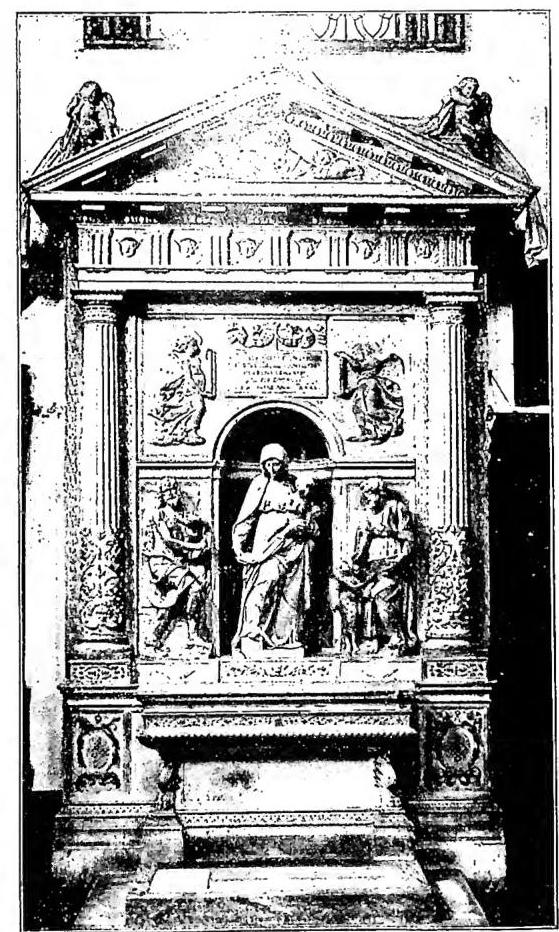
JOHN OF NOLA. - G. Marigliano, or Meriliano, or Meriliano, a sculptor, born at Nola around 1488, died at Naples in 1558, carried on his activity there. In 1508 he was working with the Lombard Pietro Belverte on some wood carvings, according to what Summonte reports, and together with T. Malvito he executed in the same year the doors of the Ospizio dell'Annunziata.
His formation must be sought in the lively figurative milieu of the Aragonese capital, into which Tuscan, Roman and Michelangelesque experiences flowed.
Around 1524 G. da N. carved the tomb of the viceroy don Ramón de Cardona, later sent to Bellpuig in Catalonia, but before those years, according to Summonte's reports, he must have carved the wooden Nativity with full figures of S. Maria del Parto and a Crucifix, now lost, in the church of Monteoliveto. The high altar of S. Lorenzo dates from 1528, of which three bas-reliefs and four statues remain, and two years later the tomb of Antonia Gaudino, who died on 30 Dec. 1530, in S. Chiara. From 1535, on the other hand, was the tomb of Guido Fieramosca at Montecassino, lost with the destruction of the Abbey.
Many other notable works remain, among which may be mentioned a St. Dorothy at S. Agnello, the altar of the Madonna della Neve at S. Domenico, the Sanseverino tomb in the church of SS. Severino and Sossio and that of the viceroy don Pietro di Toledo in S. Giacomo degli Spagnoli (around 1540-46), and a bas-relief with the Deposition in S. Maria delle Grazie at Caponapoli. The part attributable to him in the Caracciolo di Vico chapel, in S. Giovanni a Carbonara, begun in 1516 by the Spanish sculptor Pietro de la Plata and then continued by G. da N. and by his pupils Annibale Caccavello and Girolamo d'Auria, is however controversial.
Great was the influence of G. da N. at Naples and throughout the Mezzogiorno, as far as Calabria. Characteristics akin to his art are revealed by a beautiful Madonna della Neve in the church of S. Leoluca at Vibo Valentia.
Bibliography6 works
Giovanni Carandente