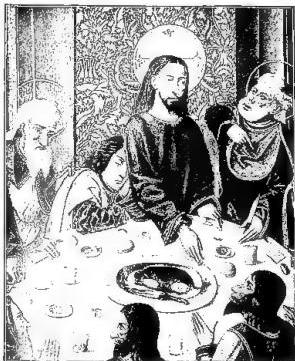
FRANCIA - Last Supper. School of Amisca (ca. 1470) - Chicago, Art Institute.
RAIBOLINI, Francesco, called il Francia. - Painter, b. in Bologna around 1460, d. there on 5 January 1517. He is the best known and most prolific of the Bolognese painters in the so-called Bentivoglio period; but his figure as an artist, devoutly inclined to gentle and demure expressions, has taken on an importance that is more than provincial.
F. made his debut as a highly expert goldsmith, as attested by the two enameled Paci in the Pinacoteca of his native city, and this artisanal origin of his is confirmed by the Crucifixion with St. Cordoma, in the local Museo civico, which must be considered one of his earliest works, still within the orbit of the Ferrarese school. Later, while continuing to produce goldsmith's work, F. became the official painter of the Bolognese court, coming under some influence from Perugino and the Vivarini and, to a greater extent, from the Ferrarese Lorenzo Costa, who in turn imitated his calligraphic ornamental preciousness. Among his numerous works, notable for clear harmony of rhythms or richness of vivid but not jarring enamels, are, in Bologna: the Madonna enthroned with saints (1494) in the Pinacoteca, the other Madonna
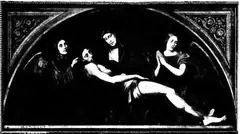
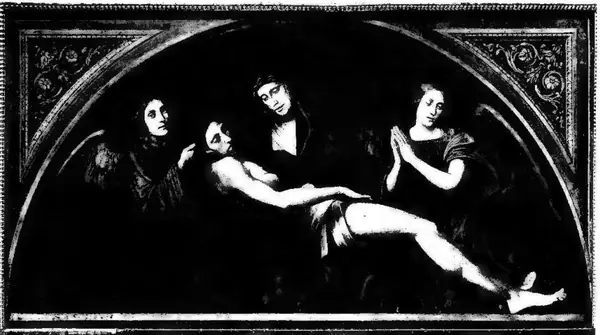
(1499) in the Bentivoglio Chapel at S. Giacomo Maggiore, and the two most chaste frescoed scenes of the Betrothal and the Funeral of St. Cecilia (1506), in the Oratory of the same name; in London: the lunette of the Pietà in the National Gallery; in Rome: the St. Stephen in Prayer, in the Galleria Borghese, and the small, delightful St. George, in the National Gallery, formerly Corsini. Having become affected in the last years of his activity, F. was more than surpassed when he died, leaving a good number of followers among whom, alongside the best, who was Timoteo della Vite da Urbino, are counted his sons: Giacomo (b. around 1486 and d. in 1557) and Giulio (b. in 1487 and d. in 1540), mediocre painters. - See plate CXII.
Plate CXII(id. Jodovino)PIETÀ - London, National Gallery.Bibliography6 worksG. C. Williamson, F. Raibolini detto il F., London 1901; T. Gervich, F. F. nell'evoluzione della pittura balognese, in Rassegna d'arte, 8 (1
BIBL.: G. C. Williamson, F. Raibolini detto il F., London 1901; T. Gervich, F. F. nell'evoluzione della pittura balognese, in Rassegna d'arte, 8 (1908), p. 121 ff., 139 ff.; G. Lipparini, F. Raibolini detto il F., Bergamo 1913; Venturi, VII, III, pp. 832-852; G. Gronau, s. v. in Thieme-Becker, XII, pp. 319-25; R. Longhi, Officina ferricera, Rome 1934, p. 66 ff. Alberto Negoti
Neppi, Alberto. “Francia, raibolini francesco, detto il.” In Enciclopedia Cattolica, vol. V, coll. 1688–1689. Città del Vaticano: Ente per l’Enciclopedia Cattolica e per il Libro Cattolico, 1950. https://azioneromana.com/article/francia-raibolini-francesco-detto-il.
MLA
Neppi, Alberto. “Francia, raibolini francesco, detto il.” Enciclopedia Cattolica, vol. V, Ente per l’Enciclopedia Cattolica e per il Libro Cattolico, 1950, coll. 1688–1689. Azione Romana, https://azioneromana.com/article/francia-raibolini-francesco-detto-il.
BibTeX
@incollection{ec5_francia_raibolini_francesco_de,
  author    = {Neppi, Alberto},
  title     = {Francia, raibolini francesco, detto il},
  booktitle = {Enciclopedia Cattolica},
  volume    = {V},
  pages     = {1688--1689},
  note      = {Cited by column},
  publisher = {Ente per l’Enciclopedia Cattolica e per il Libro Cattolico},
  address   = {Città del Vaticano},
  year      = {1950},
  url       = {https://azioneromana.com/article/francia-raibolini-francesco-detto-il}
}
One of some 20,000 entries brought back from the twelve printed volumes (1948–54). Spotted something? Help us improve it.
Click or scroll to zoom · drag to pan · Esc to close