Machine translation of the 1948–1954 Italian original. The original text is authoritative.
SAINT-RIQUIER. – An ancient Benedictine abbey near Abbeville in the diocese of Amiens (France), founded ca. 624–34 by St. Ricario, son of a count of Ponthieu (feast on 26 April, cf. Martyr. Romanum, p. 157). It was enlarged by Abbot Angilberto of Centula ca. 793.
Angilberto was in Rome in the years 792, 794, 796, and 800; abbot of Centula from 790, he renovated the monastery, enriched the monastic library with codices and the churches with relics. The Centula collection, notable for the text of certain inscriptions, concludes with the epitaph of St. Czidoco (G. B. De Rossi, Inscr. chr., II, 1, Rome 1888, pp. 72–77). Angilberto built three churches: one over the tomb of St. Ricario, after demolishing the earlier church of Abbot Ocioaldo, dedicated to the Saviour and All the Saints; another to the Blessed Virgin and the Apostles; and the third to St. Benedict and the other holy abbots. The abbey then flourished and reached a total of 400 monks; but in 845 it was sacked by the Normans; ca. 959
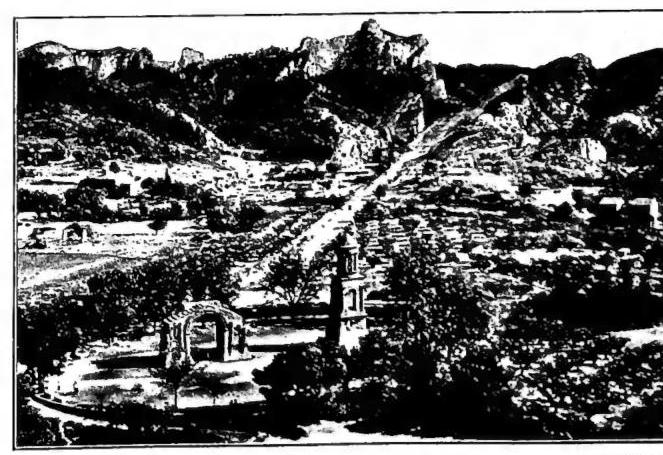
(photo La Cippopre) SAINT-REMY-DE-PROVENCE — Cloister of the former monastery of St-Paul-de-Mausole (late 12th–early 13th century).was reformed by St. Gerardo de Brogne; it was placed in commendam in 1538, and then passed to the Maurist Congregation in 1659. The abbey was almost destroyed by lightning in 1710; today it is partly occupied by the minor Seminary of the diocese of Amiens; the abbey church of the Savior was rebuilt in the 15th–16th centuries; restored in 1827–28, it is now used as a parish church. On the façade are 12 large statues of the Apostles; the square tower rises 50 m. The interior, 104 × 25 m and 25 m high, is in the form of a Latin cross, divided into three naves by columns brought from Italy. It has a single apse and transept. In the choir are 68 carved stalls and several statues from the earlier building. The Treasury contains precious reliquaries. Of the rich Library, the following have survived: the Carolingian purple Evangeliary, in 198 leaves with five initials and four full-page miniatures, preserved in the Library of Abbeville; and also ms. Latin 13359 of the National Library of Paris. The chronicle of the monk Ariulfo, written ca. 1688, was also destroyed; he had included in it the catalogue of the abbey Library (F. Lot, Hariulf, Chronique de l'abbaye de St-Riquier, Paris 1894). The Carmina Centulentia of Mico, Fredegardo and Odulfo constitute the poetic history of the abbey from 825 to 853 and from 861 to 871. The monastery’s charters were dispersed among several places: the departmental and national archives, and the Libraries of Amiens and Paris (National and Arsenal).
BIBL.: for St. Ricario, A. Poncelet, La plus ancienne vie de St R., in Anal. Boll., 22 (1903), pp. 173–94; E. Delignières, Peintures morales de la 1ère moitié du XVIe s. retrouvées à l'église de St-R. (Somme), in Rev. Renaissance, 10 (1909), pp. 88–97; G. Durand, St-R., in La Picardie histor. et monumentale, IV, Amiens 1907–11, pp. 133–359; id., Guide à St-R., there 1917; id., L'écl. de St-R., Paris 1933; Cottineau, II, cols. 2868–69.
Enrico Josi
Cite this article
“SAINT-RIQUIER.” Enciclopedia Cattolica, vol. X (1953), p. 971. Azione Romana digital edition, https://azioneromana.com/article/saint-riquier.