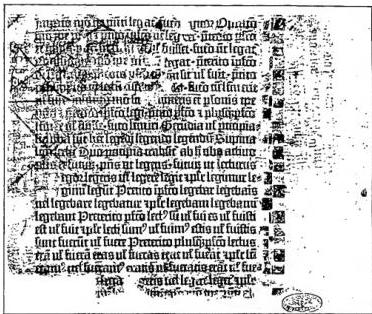
GUTENBERG, JOANNES. - Prototypographer, inventor of printing with movable type, b. at Mainz between the years 1395 and 1399; the original surname "Gensfleisch" was supplanted by "Gutenberg," derived from a paternal noble estate. Very little is known of his youth. Archival documents prove that in 1434 he was residing at Strasbourg, where it is believed he had been living in exile since 1424 for political reasons. In the period 1436-39, G. is found associated with three citizens of Strasbourg to put into operation certain industrial inventions; one of these concerned a "new art" whose secret he kept. It is traditional that the first experiments were carried out in the monastery of St. Arbogast near Strasbourg, then in the house of Andrea Dritzehn, one of the partners, who died at this time. There followed, in 1439, a lawsuit between the Dritzehn heirs and G., in which the latter obtained a favorable verdict; from the trial records it emerges that G. had set up a press and that in Dritzehn's house there were found forms, pages and tools for printing books. G.'s stay at Strasbourg is documented until 1444, the year in which he is supposed to have returned to Mainz, where the art of printing did in fact have its beginning.
According to G. Zedler, G.'s first printing would be a fragment of the Ars grammatica of Aelius Donatus, a didactic booklet very widespread in the Middle Ages, to which one would like to assign the printing date 1444. According to tradition, on the other hand, G.'s oldest printed product would be a fragment of a German poem on the Last Judgment, called Weltgericht, or also Sibyllen Buch, discovered at Mainz in 1892 and to which the printing date 1445 is assigned. Slightly later would be other fragments of the Donatus datable between the years 1446 and 1447 and a supposed Astronomical Calendar calculated for the year 1448 and therefore believed to have been printed toward the end of 1447. Recent studies, conducted on the basis of certain Mainz proof-printing fragments, tend instead to classify the supposed Calendar as a Table of the Planets and consequently to postdate it to 1458 or 1459.
Around 1450 G. entered into partnership with Johann Fust, a wealthy Mainz citizen, who contributed a notable financial contribution to the publishing ventures. To the period 1450-55 must be assigned certain small printings, among them the so-called Letters of Indulgence containing a papal bull of Nicholas V, known in eleven different editions and which represent the oldest typographic products with a date.
Between the end of 1453 and the early part of 1456 there appeared the great Bible in two volumes, called the 42-line or also the "Mazarin" Bible, traditionally regarded, and for the most part, as the work of G. During its printing there occurred the intervention of a third partner, Peter Schöffer, a skilled technician, who induced Fust to eliminate G. from the workshop and from his publishing ventures. This is proved by a lawsuit brought against G. for contractual non-fulfillment, in which he was the losing party, as is attested in a notarial document of 6 Nov. 1455, known as the "Helmaspergerische Notariatsinstrument."
According to tradition, G., with a modest supply of type, which appears connected to that of the aforementioned printings, continued on his own his typographic activity, bringing out small booklets, some calendars and another bull of Callistus III, which recent studies tend instead to attribute to unknown Mainz printers, perhaps workmen of G. and Fust, operating in competition and secretly. Controversial too is the assignment to G. of another Bible, called the 36-line, datable between the years 1457-58, in which the printer Albert Pfister of Bamberg appears to have had a notable part. A last book, the Catholicon of Giovanni Balbi, printed at Mainz in 1460, has more reliable claims to be assigned to G.
After this year there is no further news of G.'s typographic activity, who in 1465 appears as a courtier of the archbishop and prince-elector Adolph II of Nassau.
G. died at Mainz, probably on 3 Feb. 1468, according to a manuscript annotation traced in an incunabulum by F. W. Roth in 1915. His name does not appear in any of the works, booklets and fragments attributed to him, but it is undoubted that the evidence attained, even through scanty and fragmentary documentation and a unanimous and constant tradition, designates him as the sole and true prototypographer of the world.
Bibliography3 works