
CRAFTSMANSHIP. – Small-scale industry carried on by the owner with the assistance of a few employees.
I. DEFINITION
Repeated attempts have been made to define the artisan, but full agreement has never been reached. At present, a special commission established within the International Union of Handicrafts and Small and Medium-Sized Enterprises is collecting documentation on the subject with the aim of arriving at an international definition of the artisan. At the national level, the same definition is also under study; it will have to be based on the character of the enterprise, its size, the predominance of manual labor, the number of employees, and the nature of the individual operations. Taking all this into account, it may be stated, with considerable approximation, that artisan is the professional designation of one who, in the field of production, works solely with the help of family members or a few employees, imprinting upon the product the mark of his technique and his hand.II. HISTORICAL OUTLINE
The origins of craftsmanship are intertwined with mankind’s earliest achievements, when, by working stone, wood, bone, and horn, he forged the first objects suggested by need and subsequently modified by their functions. From his hands there first emerged weapons and household tools and then, gradually, rudimentary articles of clothing and furnishings. As nomadism declined, permanent habitation arose, and with the home needs increased and the sense of beauty developed: fired clay appeared in its various forms, and here and there decoration emerged to refine the products; the working of metals began. In these periods man was naturally a craftsman.There is not, nor can there be, any interruption of continuity through the centuries, and it may be asserted that craftsmanship never truly experienced periods of decline, since, when divided into two major branches (ordinary craftsmanship and artistic craftsmanship), whenever one did not make progress, the other gave us the splendor of the mosaics in the Romanesque basilicas or the chasing of sacred vessels and sixteenth-century armor. Conversely, when artistic craftsmanship seemed to decline, the energetic ingenuity and ready intuition of master craftsmen produced tools and perfect techniques that ensured woolen fabrics and damasks, or the products of the emerging art of printing, qualities never attained or surpassed by the most perfect modern industry.
The golden age of craft activities, however, unfolded during the centuries of the Middle Ages and the Renaissance. The people became conscious of their worth, seeing in productive activities the guarantee of their livelihood and the source of their strength. They opposed the arrogance and claims of the nobles, while asserting their right to political freedom and to freedom of labor and trade.
The guild was the instrument that effected this profound social revolution: communal life, gathered within the city’s strongly fortified walls, offered craftsmanship great opportunities to establish itself. There was no shortage of masters, journeymen, or apprentices. The destruction of the castles, the abolition of tolls, and the relative safety of the roads enabled relations with the most distant lands, and craftsmen and merchants joined together against their common enemy—the nobles—and gave the Commune industrious life, wealth, and power (v. CORPORAZIONE; MONASTERO; SCUOLA DI ARTI E MESTIERI).
Then the development of mechanical progress and the machine’s alarming advance undoubtedly restricted the field of work available to craftsmanship. Craftsmanship could no longer—
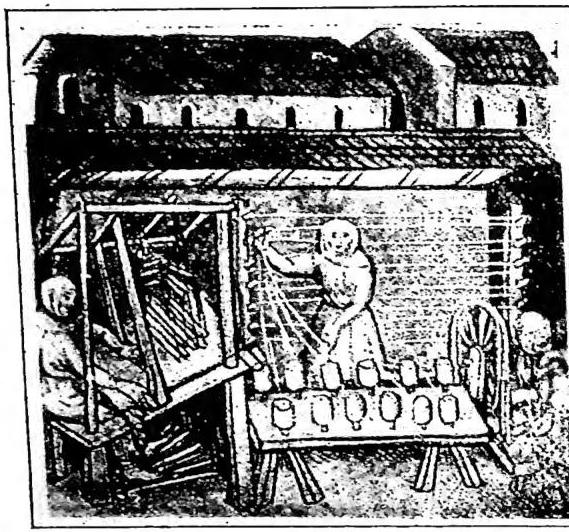
But craftsmanship, having had its field of activity reduced, has gained in quality what it has lost in breadth.
III. CRAFTSMANSHIP AND INDUSTRY
The position of the industrial product vis-à-vis the craftsman’s product may be summarized as follows: the industrial product is a mass-produced product; a standard product which, although it does not correspond to anyone’s particular taste or requirements, can meet everyone’s needs. The craftsman’s product is a quality product; not the anonymous object that comes from a machine in thousands of copies, but the object that bears the imprint of the hand that produced it and responds to the particular aesthetic or practical requirements of the person who commissioned its manufacture or purchased II.Industry accounts for the bulk of production, whereas craftsmanship has remained at its margins, margins more or less significant depending on the sector under consideration. For example, in the artistic trades, as in goldsmithing and clothing, a broad field has remained open to craft work. In certain typical trades, industry has been unable to offer any competition, while in the various activities connected with clothing, and particularly in the making of garments, craftsmanship has resisted the mass-produced product victoriously.
By contrast, wherever the product has a predominantly instrumental function and what is chiefly required is a low price for widespread consumption, together with standardized types corresponding to the practical needs of modern life, industry has reduced craft work to a minimum. This may be observed, for example, in metalworking, in the textile and printing arts, and in construction.
The achievements of science and technology have nevertheless opened up new fields and given rise to new trades: electrical engineering, mechanics, the development and diffusion of precision instruments, and the photographic art have provided craftsmen with the means of asserting their abilities in keeping with the times.
Our considerations also set aside the extensive and intensive work that craftsmanship performs in repairing industrial products and articles damaged through use. From footwear to clothing, from the most common objects of daily use to the restoration of works of art, from the repair and overhaul of engines and machines in general to the retreading and repair of tires, there is no sector in which the practical and acute intelligence of the craftsman does not double or triple the life of an object through his modest yet precious work.
A shoe today very often comes from a factory, but how many times is it necessary to turn to the work of the artisan shoemaker before declaring it unusable? The same reasoning may be applied to kitchen utensils, clothing, tires, typewriters, watches, and cigarette lighters, and one will see how great is the wealth that is not lost, perhaps thanks to a patient seamstress or to a hardworking and enterprising blacksmith.
This activity does not confer titles of nobility or glory in the world of production, but it constitutes a valuable collaboration even for industry.
It may therefore be concluded that craftsmanship is not a productive sector, but a mode of production applicable to all productive sectors.
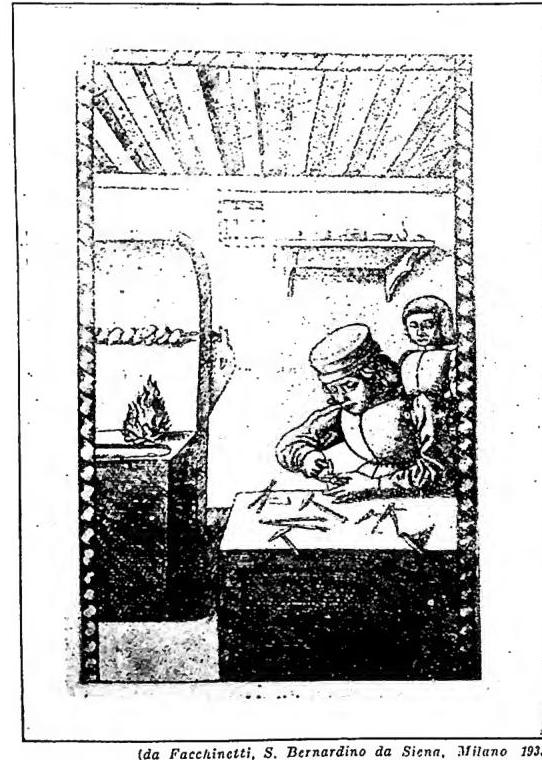
Uniform products grow tiresome, and the North American consumer too seeks for his home furniture of craft manufacture, ceramic tableware, or at least
(from Facchinetti, S. Bernardino da Siena, Milano 1933)
ARTIGIANATO – The goldsmith craftsman. Anonymous print (15th century)
Milan, Civic Print Collection.
some original decorative object by an Italian, French, or Flemish master craftsman.
IV. PERSONAL CHARACTER OF THE A
The artisan represents the highest affirmation of human personality in the world of production: whether decorator, engraver, tailor, or carpenter, he embodies within himself the fundamental elements of production: labor, technique, and capital. His intellectual faculties, his muscles, and all his financial resources are bent toward the productive effort, and he brings to his work the passion of one who feels that the success of his life and the future of his family are bound up with this labor.In the artisan’s workshop work the master craftsman, a few apprentices, and sometimes a few employees. Very often there are neither apprentices nor employees, but only the artisan’s sons and grandsons, learning the trade already transmitted for centuries from father to son. In the artisan’s workshop, the machine is a precious aid for avoiding the harsh labor involved in preparing the work, but it is never the actual instrument of the work itself. The apprentices and workers live in uninterrupted contact with one another within a few square meters of space: the master craftsman is with them, directing and teaching while he works.
V. ASPETTO SOCIALE
Social unrest brushes against, but does not overwhelm, the artisan’s workshop, which represents an oasis of peace: unemployment does not normally exist in the artisan family; women artisans can work in their own homes without neglecting domestic duties; women’s work often supplements the insufficient earnings of the head of the family and, in rural areas, is seasonal. The woman artisan works during the winter months, when all agricultural activity is silent, and from her hands emerge lace and fine needlework of distinguished workmanship, or precious handwoven fabrics. The peasant, likewise, often turns, in the “dead season,” into a reaper- and plough-repairer, a cooper, or a carpenter.Artisanal work thus represents a felicitous solution to the social problem. It is a valuable complement to work in the fields, ensuring financial stability for the rural family; in the many forms of work carried out at home, it permits the orderly life of the family without taking women into factories; the occupations of seamstress, embroiderer, mender, and knitter represent at once a source of income and a safeguard of femininity.
The occupations of tailor, furrier, tie-maker, glovemaker, and quite a few others provide us with the ideal type of the family enterprise, because they bring together the men and women, young men and girls of the same household in a productive activity.
Because of its distinctly personal and familial character, artisanal work has always been viewed favorably both in Christian social teaching and in the social movements inspired by II.
VI. POLITICAL ASPECT
The profound sense of individualism—which the very nature of the activity they practise arouses in artisans—has not prevented craftsmanship from asserting itself through the centuries in social and political life, through professional organizations whose memory still arouses admiration.We must first note that, from the earliest times, craftsmanship flourishes in a climate of freedom. In the East as in the West, in Greece as in Rome, the free class is made up of artisans and merchants. The Roman plebs, in fact, consisted for the most part of artisans. During the Middle Ages, communal liberties found their economic expression in the arts and trades. Even today, a political community is less exposed to sliding toward tyrannical regimes the more craftsmanship flourishes within II.