
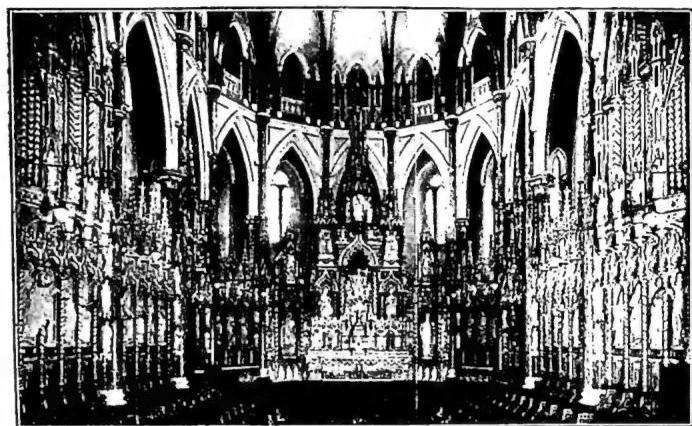
OTTAWA, Archdiocese of. - In the province of Ontario, Canada. The archdiocese has an area of 13,000 square miles with a population of 376,000 inhabitants, of whom 338,000 are Catholics, distributed among 132 parishes. The clergy is composed of 248 diocesan priests and 370 regulars, 3 seminaries, one diocesan, one university (Séminaire St-Paul de l'Université d'O.) and one minor seminary, 51 male religious communities and 111 female.
Msgr. Ignace Bourget, having taken possession of his episcopal see of Montreal (Quebec) in 1840, thought of uniting the various dioceses of Canada into ecclesiastical provinces and also insisted on the need to divide the dioceses already existing. In 1844, Rome erected the first ecclesiastical province of Canada with the dioceses of Quebec, Montreal, Kingston and Toronto. Meanwhile the bishop of Montreal sent missionaries into the west and north of the country and in 1841 obtained from Msgr. Eugène de Mazenod, bishop of Marseilles, the Oblate missionaries of Mary Immaculate for his diocese. The Oblates landed at Montreal on 2 Dec. 1841 and, in 1844, Msgr. Bourget sent some of them to Bytown. In 1846, he set before the Canadian bishops the need to erect a diocese at Bytown. All the bishops concerned signed to that end a petition to the Holy See and also asked that Fr. Eugène Bruno Guigues, O.M.I., be appointed its bishop. Pius IX granted the desired favor and erected the diocese on 25 June 1847 with the bull Ad prospiciendum facilis, entrusting it to Fr. Guigues (9 July), who immediately set to work to organize the new diocese. He founded schools, hospitals, parishes and a classical college that became the Catholic University of O. A large part of the churches were dedicated to the Madonna.
The name of the diocese was changed to that of O. on 14 June 1850 and Leo XIII raised it to an archdiocese on 8 June 1886.
When Msgr. Guigues came to Bytown he found there 6 diocesan priests and 8 Oblate missionaries; on 8 Feb. 1874, the day of his death, the diocese already counted 55 churches, 33 chapels and 80,000 faithful.
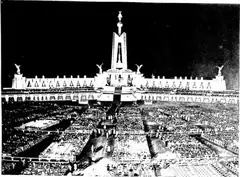
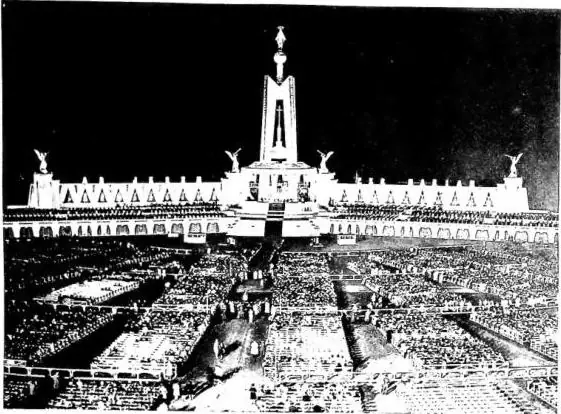
The ecclesiastical province of O. is composed today of the dioceses of Pembroke (Ontario), Mont-Laurier (Quebec), Timmins, Hearst and of the apostolic vicariate of James Bay (all in the province of Ontario). In 1947, to commemorate the centenary of the archdiocese, a great Marian congress was held at O. which was attended by more than 1,000,000 of the faithful, 9 cardinals and 104 bishops.
Bibliography7 works
UNIVERSITY OF OTTAWA
Immediately after his consecration, Msgr. Guigues began the foundation of an educational institution, which, under the name of St. Joseph's College of Bytown, was inaugurated on Sept. 26, 1848; the following year it was recognized by the government under the name of College of O. Msgr. Guigues entrusted its care, in perpetuity, to the Missionary Oblates of Mary Immaculate.
The good organization of the College and the spirit by which it was inspired, in order to secure for the two peoples, the English and the French, the right of instruction in both languages, led the government of the United Canadas to grant it (July 4, 1866) the civil status of a university. Leo XIII conferred on it (Febr. 5, 1889) the status of pontifical university, which, revised in accordance with the constitution Deus Scientiarum Dominus, was again approved by Pius XI (Nov. 15, 1934), constituting the first case of its kind in the entire American continent. The civil charter was also updated and approved by the Parliament of Ontario on Apr. 18, 1933.
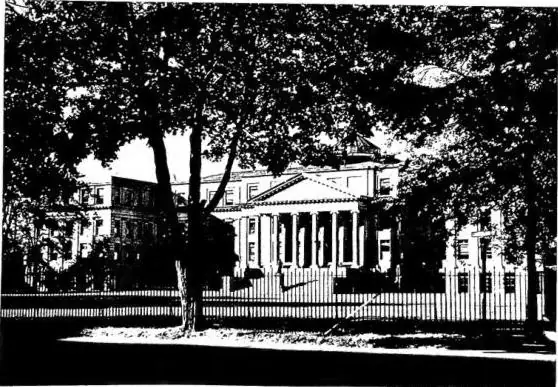
From the very beginning Thomist philosophy and the sciences were cultivated in a quite particular way; but the specifically academic development of the University in reality began in 1923. A bilingual normal school (Institute of Pedagogy) was established then, which four years later became the official School of the government of Ontario. In 1929, the already existing School for nurses at the general hospital of the Grey Nuns of O. affiliated with the University and became, in 1940, a University School. In that same year 1929 a pre-medicine course was instituted, transformed, in 1945, into a Faculty of medicine with its corresponding university hospital, generously prepared by the Grey Nuns. The School of sacred music, founded in 1932, became, three years later, the present School of music and declamation. In 1934, an Institute of philosophy welcomed young laymen desirous of a higher formation, and in the summer of 1936 the St. Paul University Seminary opened for ecclesiastical students of the Faculties of theology, canon law and philosophy. Worthy of note is the Library of this latter institution, to be counted among the richest existing in North America.
A special mention deserves the Faculty of arts, the first nucleus of the University of O., whose progressive development marks the rhythm of the evolution of the entire work. From 1935 is the foundation of the course of sciences; from 1937 that of commerce; from 1951 the institute of geography. There were also summer courses in 1935, correspondence courses in 1936, evening courses in 1937, with the institution of a school for graduates in 1949. The School for librarians, the School of political and diplomatic sciences, the Institute of experimental psychology with its education section, the School of Catholic Action, the School of applied sciences (Engineering), the East and South European Institute, the Inter-American Institute, the Institute of physical education, the Faculty of law and the Institute of missiology complete the series of existing schools and faculties. The Catholic Center and the Social Center spread Catholic and social doctrine throughout the country and the United States. The scientific activity of the University of O. is documented by the Revue de l'Université and by the Editions de l'Université d'O.
The 120 students of 1856 have today become more than 4000. - See plate XXXII.
Bibliography2 works
Gastone Carrière