
FLABELLI. — From flabellum = fan: this name today commonly refers to the two large fans of white ostrich = peacock feathers, arranged in two tiers, supported by a long staff covered with crimson velvet and adorned with a gold ribbon, carried on either side of the pontiff when he proceeds ceremonially in the sedia gestatoria, and when he carries the Eucharist in procession upon the thalamos.
But the «flabellum» or «muscarium» was already known in antiquity, used in civil life and also
in religious rites both as a sign of social distinction and for a practical purpose, namely to keep flies, mosquitoes, etc. at a distance. Babylonian, Assyrian, Egyptian, and Greek monuments offer frequent examples of them in representations of sovereigns and high-ranking persons. Latin literature frequently alludes to the practical purpose of the instrument (cf. Ovid, Ars amatoria, I, 161; Martial, Epigram., III, 72, 82; Plautus, Trinum., II, 1, V. 22; St. Jerome, Ep. 44 and Ep., 108, 27; PL 22, 480, 903). Of greater or lesser size, the fly-fan could be made of parchment, paper, = leather, like the highly worked one belonging to Theodolinda, now preserved in the Museum of Monza.
The first mention of its use in Christian worship is found in the 4th century in the Apostolic Constitutions (VIII, 12, 3; ed. F. X. Funck, Didascalia et Constitutiones Apostolorum, I, Paderborn 1905, p. 496), where deacons are instructed to use it between the Offertory and Communion. Its use became frequent in the East and is found in the liturgies of St. Basil, St. John Chrysostom, etc. Even today, although with symbolic significance, the use persists in the East of small f., generally made of metal, which are waved after the Consecration of the species.
In antiquity, however, f. for liturgical use were always made of pliable material: peacock feathers, parchment, silk. A symbolism was eventually attached to them as well, recalling the scriptural passage of Is. 6, 2, where mention is made of the six-winged seraphim who stand before the throne of God.
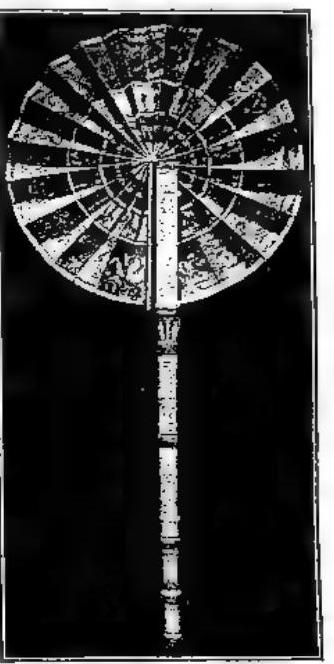
(photograph by Alineri)
FLABELLI - Liturgical fan, from the abbey of Tournus (12th century). Florence, Museo del Bargello.
metal; later they became made of feathers. Such they have remained to the present day: the task of carrying them is entrusted to two secret chamberlains, in purple dress or with a red cape.