
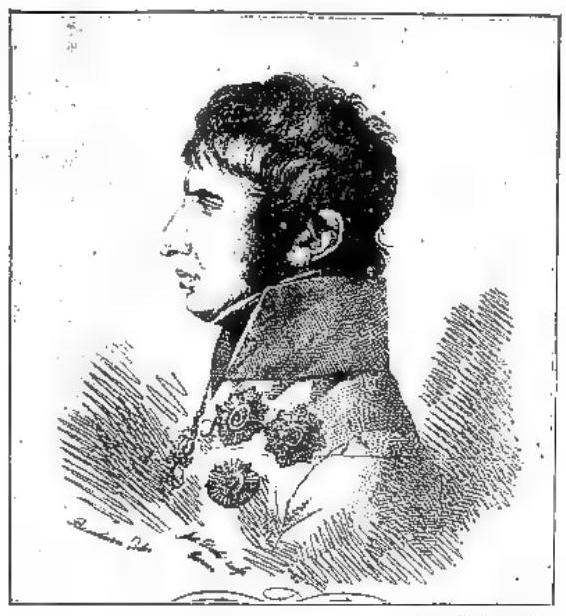
FRANCESCO IV d'Austria-Este, Duke of Modena and Reggio. — Born on 6 Oct. 1799 in Milan, died on 18 Jan. 1846 in Modena, eldest son of Ferdinand, Archduke of Austria, and of Maria Beatrice, heiress of the duchies of Modena, Reggio, Massa and Carrara. During the Revolution and the Empire he was in exile and in 1812 married, in Cagliari, Maria Beatrice of Savoy. After Napoleon’s fall, he became in 1814 Duke of Modena and Reggio. Intelligent and cultured, he governed with prudent energy, displaying remarkable administrative gifts, although from the very first years it was evident that he tended to centralise all power in his own person and to prevent in every way the spread of any innovative ideas in his State.
He made no further secret of this after the uprisings of 1820-21 in Naples and Piedmont. He adhered without hesitation to the decisions of the Congress of Laybach and regarded as the primary aim of his political activity the struggle against secret societies, establishing a summary court at Rubiera to judge the Carbonari. He conceived his political action as a mission and a crusade. He saw excessive weakness towards revolutionaries everywhere, preaching unrelenting severity to all the other Italian rulers, and whoever did not heed him was considered by him a traitor to the absolutist cause. He even doubted Cardinal Spina, the papal plenipotentiary at the Congress of Laybach, and accused him in a letter to Pius VII of having expressed liberal principles at that assembly, for not having accepted his thesis that even those merely suspected of secret society leanings were liable to condemnation, without
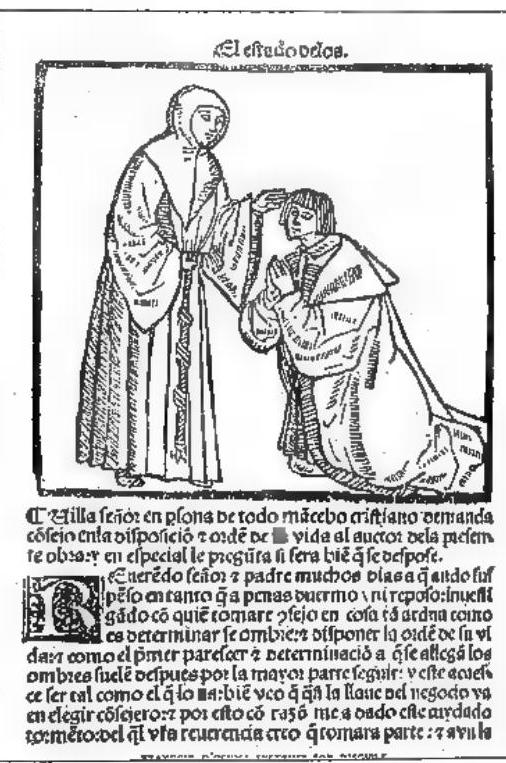
b. at Osuna (Spain) in 1497 and d. c. 1540. On account of his outstanding qualities he was entrusted with important missions. At the General Chapter of Nice in 1525 he was elected Commissary General of the Indies. He wrote several works of ascetical and mystical theology in Castilian, and others of commentary on Holy Scripture or various sermons, in Latin.
His principal works are: the *Abecedarios espirituales*, so called because each of the three books is composed of as many treatises as there are letters in the alphabet (the first published was the 3rd [Toledo 1527], of mystical content, then the 10th [ibid. 1528], which deals with the Passion and the sorrows of Jesus, and finally the 28th [ibid. 1530], which is a treatise on ascetical matters); *Grazioso conbite de las gratias del S. Sacramento del altar* (Seville 1530, Italian tr., Venice 1599); *Ley de Amor*, a synthesis of the doctrine contained in the *Abecedarios* (first issued in 1530, now at Madrid 1948), *Monte de los Estados* (Burgos 1541, 1550, 1610).