
Enciclopedia Cattolica Vol. V, 1950 Asceticism & mysticism Ascetics, mystics, writers

Francis of Osuna

FRANCESCO DA OSUNA

Italian original Cite

Also known as: Francisco de Osuna; Spanish: Francisco de Osuna

FRANCIS OF OSUNA. - Franciscan theologian and orator, nicknamed the "minorite Chrysologus."
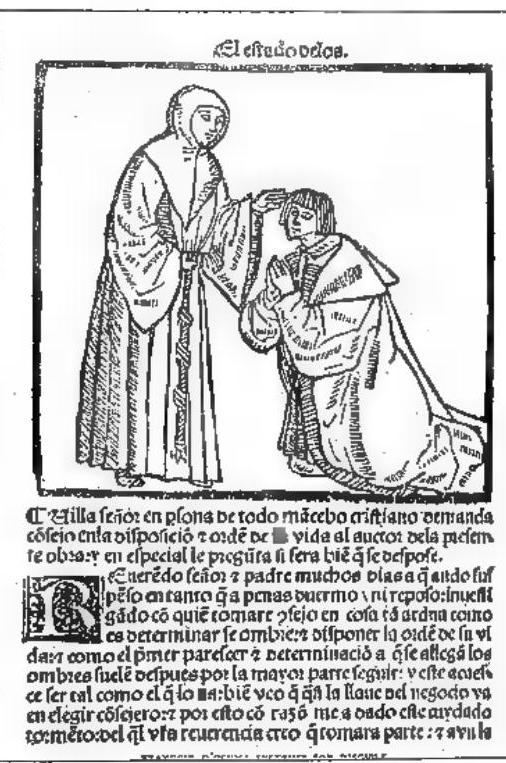
Illustration

«Alla fede en prima se todo macebo cristiano comanda
coltendo all'poolcio e onde se la vida al auctor cela preten-te obser en especial le preghita a fera bel di before.

«Cuerdo felico e padre mudros olasa q'ando fu
pello en tanto q' a penas burmo, n'repofo: inueff
gado co' qu'e tornare p'iso en cola t'a ardna como
es peterminar se ombiere ol'poner la oufe se la vi
dare como el pimer pardier e peterminacio a q'e aflegà los
ombros fude orpuos por la mayor parte fognir: v'che acudis
ce fer tal como el q' lo sabib' vco q' q' la llune ad negocio va
en elegir cloberce: por alto co' rasò me a oado che andado
tommènoel q' i vfo recuerenda creo q' romana parte: s'avi la

(from P. F. da Ros. Le pires François d'Osuna, Paris 1931)
FRANCESCO da OSUNA - F. da O. instructs his disciple.
Incipit of the Meria de los Estados, Seville 1931.

b. at Osuna (Spain) in 1497 and d. ca. 1540. Because of his singular gifts he was entrusted with important missions. At the General Chapter of Nice in 1535 he was elected commissary general of the Indies. He wrote several works of ascetical and mystical theology in Castilian, and others of commentary on Holy Scripture or various sermons, in Latin.

His principal works are: the Abecedarios espirituales, so called because each of the three books is composed of as many short treatises as there are letters of the alphabet (the first published was the 3rd [Toledo 1527], of mystical content, then the 1st [ibid. 1528], which treats of the Passion and the sorrows of Jesus, and finally the 2nd [ibid. 1530], which is a treatise of ascetics); Grazioso conbite de los gracios del S. Sacramento del altar (Seville 1530, Italian trans., Venice 1599); Ley de Amor, a synthesis of the doctrine contained in the Abecedarios (first published in 1530, and now at Madrid 1948), Morte de los Estados (Burgos 1541, 1550, 1610).

Bibliography7 works
BIBL.: Wadding, Scribitores, p. 88; Sbaralea, I, pp. 191-92; Hurter, II, col. 1318; P. Pourrat, La Spiritualité chrétienne, III, Paris 1927, pp. 133-134, 201; A. Teetgen, Osuna e Osuna (François de), III, DTHC, XI, coll. 1636-57; E. A. Peers, Stud. of the Spanish Mystics, London 1927, p. 77; Fidèle de Ros, Un maître de 1er Théorie: Le p. F. d'O. Sa vie, son oeuvre, sa doctrine spirituelle, Paris 1940. Antonio Bissucci

About this entry

By Antonio Blasucci

How we know read from the page scan

Translated from the Enciclopedia Cattolica, vol. V (1950), coll. 1596–1597.

Printed pages Open in the page viewer
Page 950
vol. 5, coll. 1595–1596
Page 951
vol. 5, coll. 1597–1598

More by Antonio Blasucci: Ferus, Giovanni (Wild) · Ferretti, Gabriele, Blessed · Bigoni, Angelo · Bartolucci, Salvatore · Lukewarmness

Cite this article

Chicago

Blasucci, Antonio. “Francesco da Osuna.” In Enciclopedia Cattolica, vol. V, coll. 1596–1597. Città del Vaticano: Ente per l’Enciclopedia Cattolica e per il Libro Cattolico, 1950. https://azioneromana.com/article/francesco-da-osuna.

MLA

Blasucci, Antonio. “Francesco da Osuna.” Enciclopedia Cattolica, vol. V, Ente per l’Enciclopedia Cattolica e per il Libro Cattolico, 1950, coll. 1596–1597. Azione Romana, https://azioneromana.com/article/francesco-da-osuna.

BibTeX

@incollection{ec5_francesco_da_osuna,
  author    = {Blasucci, Antonio},
  title     = {Francesco da Osuna},
  booktitle = {Enciclopedia Cattolica},
  volume    = {V},
  pages     = {1596--1597},
  note      = {Cited by column},
  publisher = {Ente per l’Enciclopedia Cattolica e per il Libro Cattolico},
  address   = {Città del Vaticano},
  year      = {1950},
  url       = {https://azioneromana.com/article/francesco-da-osuna}
}

One of some 20,000 entries brought back from the twelve printed volumes (1948–54). Spotted something? Help us improve it.

Save for later

Enter your email and we will send you a sign-in link. No password. What you save (articles, verses, chapters, documents) follows you to any device.