NICHOLAS OF POGGIBONSI. - Franciscan traveler of the 14th century, about whom only what he himself says in his *Libro d'oltremare* is known; this work was written in Italy based on notes taken during four years of travel in the East.
Having left Florence in March 1346, he embarked in Venice on 6 April of the same year. After various difficulties, he reached and visited the Holy Land, Syria, Chaldea, as far as Baghdad, and then went on to Egypt. In 264 chapters, he describes in Italian vernacular his journey and the monuments and places he visited. The work was published in full, after partial editions, by Alberto Bacchi, *Libro d'Oltremare di fra N. da P.* (Bologna 1881), in 2 vols.

patriarch and rebuilt the chapel of the Sancta Sanctorum. His favor toward his own people was shown in the distribution of ecclesiastical offices to them
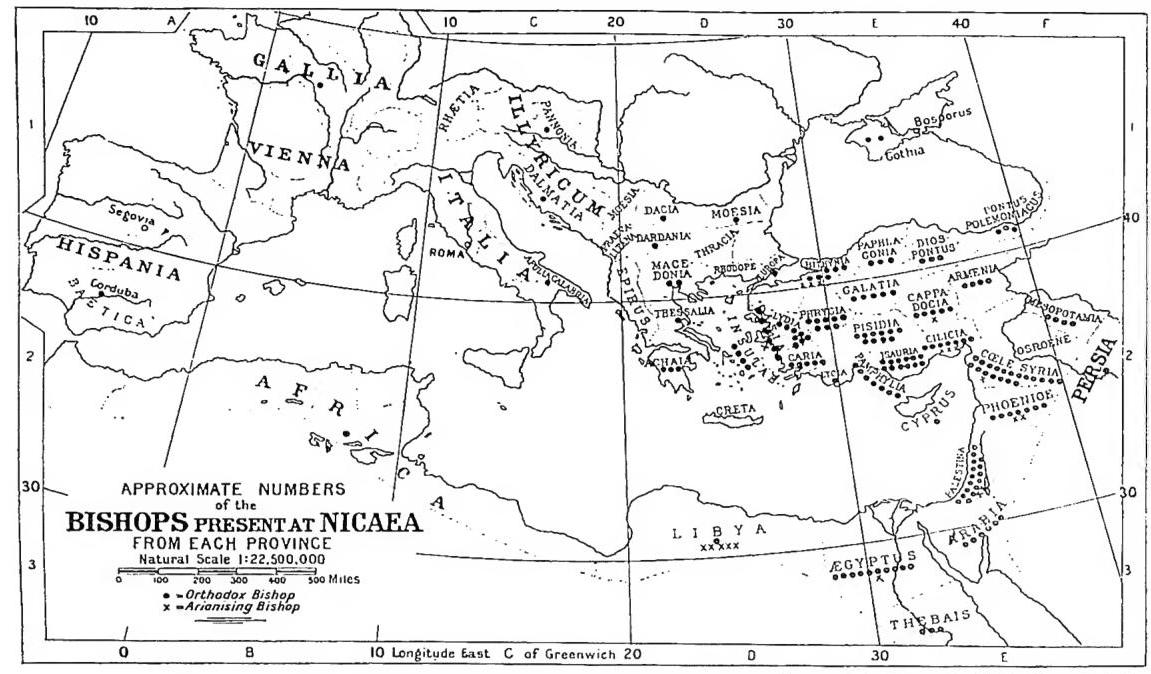
NICEA - Episcopal sees of the bishops present at the Council of N.
NICEA. - Ancient city of Bithynia, now a simple village, founded in 316 B.C. under the name of Antigoneia in Phrygia on the Hellespont, on Lake Ascania.
It was the seat of the kings of Bithynia and passed under Roman rule in 74 B.C.; in 29 B.C. a temple was erected there in honor of Rome and Augustus. Pliny the Younger resided there as governor in the year 111. Damaged by an earthquake ca. 112, it was rebuilt by Hadrian ca. 120. It was burned by the Scythians in 259 and restored by Claudius Gothicus. The group of martyrs Cosconius, Zeno, and Melanippus are commemorated at N. on 19 January in the *Epitome Syriaca* and in the *Martyrologium Hieronymianum*; Polycarp in the *Martyrologium Syriacum* is on 27 January; on 9 June the *Martyrologium Hieronymianum* places: “in Nicaea civitate Diomedis,” as in the *Synaxarium Constantinopolitanum* (p. 739); the same *Passio* of Corda places the city of N. (BHG, 2, 548-52). Also the group of the martyr Theodota and her children seems to belong to N.; the *Martyrologium Hieronymianum* on 2 August and 2 September gives “in Bithynia civitate Nicaea Theodota cum tribus filiis,” as in the *Passio* (BHG, 2, 1781). Traces of the cult of the martyr Neophytus, commemorated in the *Synaxarium* of Constantinople on 21 January, have been found at N. (O. Wulff, *Die Koimesis-Kirche in Nicaea und ihre Mosaiken*, Strasbourg 1903, pp. 20, 182). The names of its bishops prior to the Constantinian peace are unknown. The ecumenical councils of 325 and 787 were held at N. It was definitively occupied by the Turks in 1333. The ruins of the church of Hagia Sophia, with three naves, indicate at least four different construction phases; the oldest masonry dates to the original construction in which the Council of 787 was held; the second period seems to be from the 10th century; the third period dates to the 11th–12th centuries; the fourth period to the time of the Palaeologi (13th century).
The church of the Dormition of the Virgin (Κοίμησις τῆς Θεοτόκου) was built with domes, imitating the church of Hagia Sophia in Constantinople. The date of its foundation has given rise to much discussion, and while initially it was thought to have been built after the earthquake, between 1059–67, subsequent studies by Ch. Diehl, O. Wulff, H. Grégoire, Th. Schmitt, and G. de Jerphanion have pushed the date back to between the 8th and 10th centuries. The ruins, however, suffered greatly during the Greco-Turkish war. On the arch opening of the apse, within a large circle, stands the throne with a footstool; on the cushion lies a mantle and the jeweled book; above, in the center of a cross from which seven rays emanate, hovers the nimbed Holy Spirit in the form of a dove (*insignia Christi*). Guarding the throne, two on each side, are the majestic figures of four nimbed, winged angels, each holding a labarum on which is written the Trisagion (ΑΓΙΟΣ Ο ΘΕΟΣ, ΑΓΙΟΣ ΙΣΧΥΡΟΣ, ΑΓΙΟΣ ΑΘΑΝΑΤΟΣ, ΕΛΕΗΣΟΝ ΗΜΑΣ). The apse had a double mosaic decoration. At first it had a large cross in the center; later, from the top of the apse, a triple ray emanated from the hand of God, striking the veiled Madonna standing on a rich footstool, holding before her the Child with a cruciform nimbus. Behind the altar, in the pavement, an inscription from the time of Michael III (858) was reused. In seven monograms or ligatures, the inscription read: “Mother of God, remember your servant, monk, presbyter, hegumen.” Some believed the name of the monk to be Hyacinthus, others Nautricans. In the nave, the mosaic decoration dated to the 9th or 10th century. The pavement was of marble and mosaic inlays; the narthex was decorated with mosaics from the 11th century.
I. FIRST COUNCIL OF NICEA
Held in 325 to define the faith against Arianism, to settle the schism provoked by Meletius in Egypt, and to definitively establish the date of Easter.
Moreover, there are allusions to such acts in St. Jerome (Dial. c. Lucifer., 20), in Theodorus (Hist. eccl., 1, 6), and in Sozomen (Hist. eccl., 2, 21). Of the official documents that remain today are: the Creed, the canons, the list of bishops arranged by provinces (ed. H. Gelzer-H. Hilgenfeld-O. Cuntz, *Patrum nicaenorum nomina*, Leipzig 1898), and a synodal letter addressed to the Churches of Egypt, Libya, and Pentapolis preserved by Socrates and Theodorus (ed. L. Parmentier [CB, 19], p. 38). Other important sources on the Council of N. are Eusebius of Caesarea, Athanasius, Epiphanius, Rufinus, Socrates, and Sozomen.
Constantine, having become emperor of the East after his victory over Licinius (autumn of 323), found himself faced with the spread of Arianism (v.), which had arisen a few years earlier in Alexandria but was now infiltrating many eastern provinces. Ever desirous of harmony, Constantine, who was little instructed in the Christian religion, wished to settle the dispute by inviting both Arius and Bishop Alexander of Alexandria to be silent. To this end he wrote two letters (Eusebius, *In Vitam Constantini*, 2), one of which was carried to Alexandria by the bishop of Corduba, Hosius, a counselor of Constantine. When this attempt at harmony failed, the Emperor, feeling himself still the Pontifex Maximus, convened of his own initiative a synod to be held at N., to which all Christian bishops were to come, using the imperial courier (ibid., 3, 4-5; Socrates, *Hist. eccl.*, 1, 5).
That it was precisely Constantine who convened the Council without seeking the consent of the Roman See is deduced: 1) from the fact that he also convened other Synods on his own initiative, before and after N., (Rome, Arles, Tyre, Jerusalem); 2) from the positive testimonies of the Council itself (Theodore, Hist. ecd., 1, 9), of Constantine (In Vitam Constantini, 3), of Socrates (Hist. ecd., 1, 8) and of Sozomen (Hist. ecd., 1, 17). Rufinus says that Constantine made the decision «ex sacerdotum sententia» (Hist. ecd., 1, 1), probably alluding to the imperial ecclesiastical advisors. The Arian Philostorgius says that the idea came from Alexander of Alexandria to Hosius and from Hosius to Constantine (Hist. ecd., 1, 7). The first and belated document in which Pope Sylvester is said to have intervened in the convocation of the Council is the Liber Pontificalis (ed. Duchesne, I, p. 171; cf. also p. 75). The same is said of the assertion made by the Seventh Ecumenical Council (787) regarding N. Added to this is the almost material impossibility, due to the scarcity of time, of sending an imperial mission from Nicomedia to Rome to seek papal approval. In the Paris codex s.V. 62 (8th–9th cent.) there is a Syriac version of a letter attributed to Constantine, in which he indicates N. as the place for a Synod, accessible also to Westerners. This is a document of very doubtful authenticity. Moreover, no Byzantine author alludes to such a writing.