
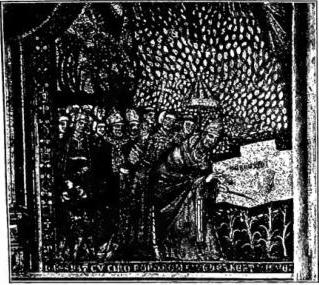
UMBRELLINO (Umbella, Umbraculum). - A small, folding umbrella of white damask silk (red in the Ambrosian rite), trimmed with gold or silk fringes, which is held in reverence over the priest who carries the Most Holy Sacrament in processions (before entering under the large baldachin and upon leaving it) and when he brings Viaticum in sol-
(phot. Enc. Catt.)
UMBRELLA (umbella, umbraculum). - A small, folding umbrella of white damask silk (red in the Ambrosian rite), trimmed with gold or silk fringes, which is held out of reverence above the priest who carries the Most Holy Sacrament in processions (before entering under the great baldachin and upon leaving it) and when he brings Viaticum in the form of a solemn procession (a use prescribed by the rubrics, already required in the instructions of St. Charles Borromeo); outside Italy it is rarely used. It is proper only to the Most Holy Sacrament, to the relics of the Holy Cross and to the instruments of the Passion; it is excluded for the relics of Saints.
The umbrella of red or crimson damask, trimmed with gold, was used for the popes (for example, in their possessions or journeys), carried by a groom to shelter them from the sun; certain dignitaries of the Papal Court enjoyed the emblem of the sky-blue silk umbrella. Sovereigns also used it; many Communes and municipal magistrates employed it as a mark of dignity and a sign of jurisdiction. The umbrella came from the East, where it was in use as an emblem of divine and human power. In processions the statues of idols were surmounted by an umbrella to indicate their majesty. In Assyrian bas-reliefs kings were represented beneath an umbrella. From the East, through Egypt and Greece, it passed to the Romans, used by distinguished personages. For the Christian use of the Middle Ages a gem is evidence, representing in all likelihood John III, bishop of Pavia, who at the request of Berengar had received the privilege from Pope Anastasius III (911). In a 13th-century fresco of the chapel of St. Sylvester at the Santi Quattro in Rome, this Pope is seen followed by a cleric with the umbrella (v. plate XL of vol. IV, col. 705).