
PAGANUZZI, GIOVANNI BATTISTA. — Lawyer at the Venice bar, Roman count, president of the Opera dei congressi, born in Venice to a noble family in 1841, died there on 23 June 1923.
From his youth he was active in the works of Catholic Action, and especially in the Italian Catholic Society for the defense of the freedom of the Church in Italy, which dates from 1865.
In 1868 he was elected president of the Circle of Catholic Youth named after s. Francesco di Sales. In agreement with other similar organizations, he was among the organizers of the first Catholic Congress, resolved upon in 1871 and convened in Venice from 12 to 16 June 1874 to commemorate the victory of Lepanto. As a lawyer he enjoyed a broad and well-deserved reputation, especially after the vigorous defense of distinguished clients, and he acquired considerable repute as a jurist through his memorandum on the Right of nomination to the Patriarchal See of Venice. From the political point of view, P. was a disciplined soldier. He accepted the principle of abstention from political and parliamentary life, and advocated with every effort participation in administrative struggles in the municipalities and provinces, succeeding in being elected as early as 1881 to the municipal council of Venice and subsequently becoming part of the Catholic-moderate list of Count Grimani. But P.’s fame is linked Opera dei congressi (v.) and Catholic committees, of which he was president from 22 September 1889 to 1902, with exemplary activity and zeal. He adopted Luigi Windthorst’s conception of general congresses: the great maneuvers of the army of Catholic Action, which serve to unite, organize, and provide direction. Impressed by the excellence of the organization entrusted to him, P., a man of iron and totalitarian character, was almost always reluctant to admit innovations, whether in form or substance; consequently, many initiatives, even appropriate ones, sometimes failed to receive a favorable welcome from him. One must also add the mistaken tactics of certain young men, eager for conquest, which increased his reluctance; among these must be numbered d. Murri (v.), who was systematically hostile to him. It was this hostility that compelled him finally to resign as president of the Opera and retire into private life, although he lent his name to the Catholic organizational forms that emerged afterward, such as the Unione popolare entrusted to Giuseppe Toniolo, and even the Italian Popular Party, subsequently founded by d. Luigi Sturzo, while in fact adhering to a right wing of the Party.
Guido Anichini
PAGGI D'ONORE DEL S.mo SACRAMENTO. — This is an association that gathers boys together, as if in a guard of honor, around the Most Holy Eucharist. Boys of either sex between five and fifteen years of age may belong to it; their distinguishing mark is a medal worn around the neck; as a complement to this (which is essential), the p. may also wear other insignia during processions or on other solemn occasions. In the spiritual sphere, the p. practice daily visits to the Most Holy Sacrament and frequent Communion.
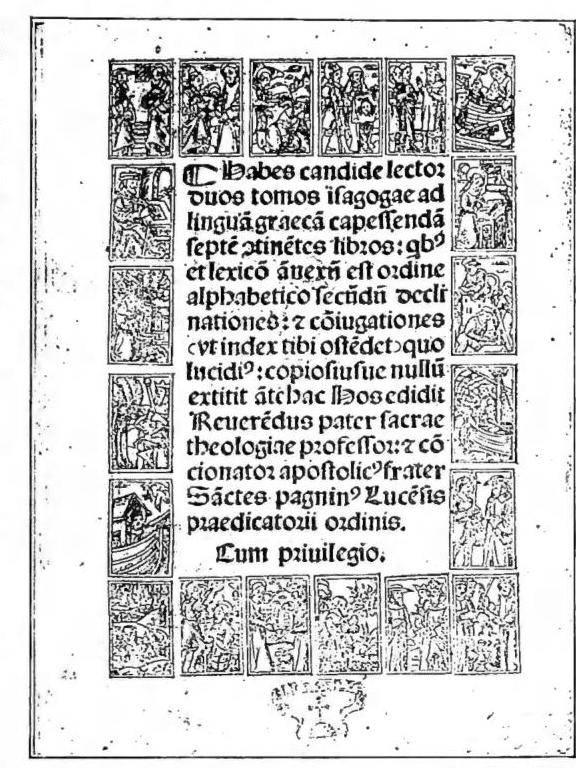
(phot. Eur. Cott.)
PAGNINI, SANTI (SANTE) - Frontispiece of the Iagogae graecae, published by Jehan de Channey, s.l. 1525. - Copy in the Vatican Library.
centres throughout the world, in accordance with the Statutes that the same cardinal vicar had approved the previous year; he enriched the Association with indulgences, extended to all those that might be aggregated to the Primaria. By this act the centre was transferred to Rome, and canon Molinari was among the first to join. From 1919 onward it found in Rome strong support in the Zelatrici del S.mo Sacramento, who, under their Statutes, undertake to promote and direct it in the individual parish centres.