
ANATOMY. — From the Greek ἀνατομή = dissection, it is the science that, through dissection, studies the intimate structure of living beings.
In our Western culture, the earliest reports of anatomical investigations carried out specifically in order to study the internal structure of the animal organism are handed down to us in connection with Alcmeone of Crotone, considered the first initiator of biological experimentation (6th century B.C.).
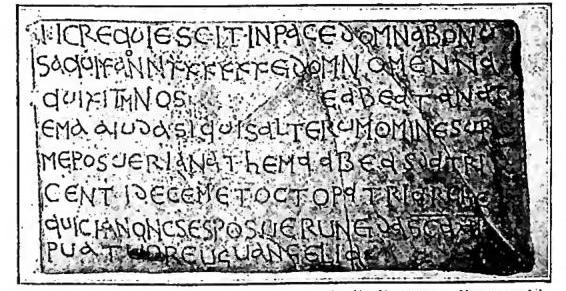
(from G. Maracch, Monumenti)
ANATEMA — Christian funerary inscription with an anathema against tomb violators — Rome, Lateran Christian Museum.
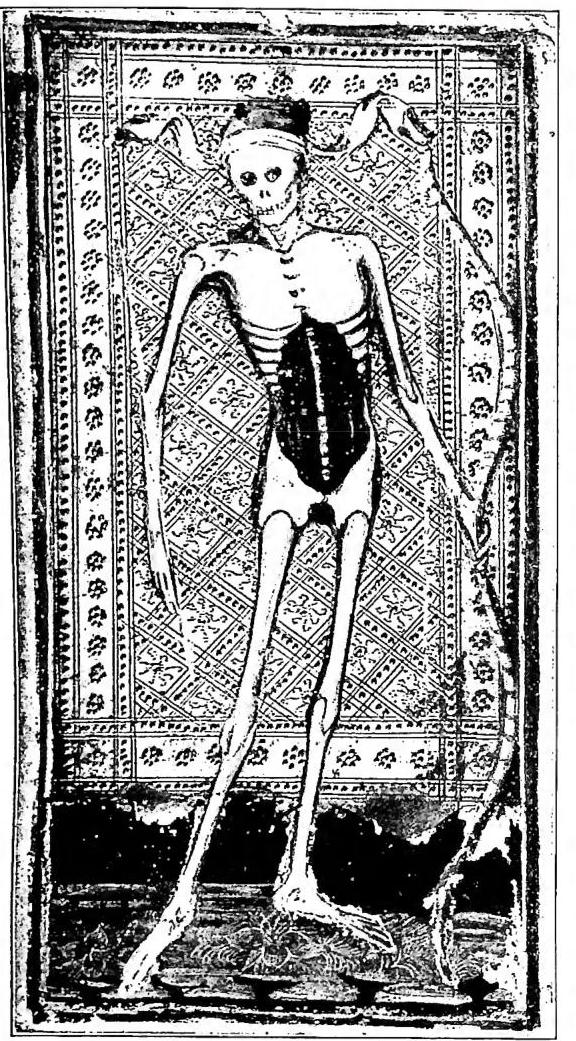
(design by B. Degenhart)
ANATOMIA - Playing card with an anatomical figure: Lombard art (10th century) - New York, Pierpont Library.
criminals condemned to death. Subsequently, the study of anatomy declined, and it experienced a later revival with Galen, an exceptionally acute, profound, and ingenious observer, but unfortunately compelled to carry out observations only on animals; consequently, the entire doctrinal system of that great scholar turned out to be largely erroneous, because the anatomy of brutes had been arbitrarily applied to man.
After Galen, this science declined once again. With all dissection practices abandoned, when the schools of Salerno, Montpellier, etc., arose again, there remained only a simple reading of the anatomical texts written by Galen and Avicenna. In Salerno, however, anatomy began to flourish again through the efforts of Federico II, who imposed its study. But it was still entirely theoretical study.
At Bologna, a university devoted to the Church, in 1315 Mondino de' Liuzzi introduced the great innovation of a lesson conducted through the autopsy of a cadaver. This marked the first beginning of the revival of anatomical studies, which reached their greatest flowering in the Renaissance, with the studies of Leonardo da Vinci and, still more, with the demolition of the ancient Galenic doctrine carried out by Andrea Vesalio, who began the construction of the new anatomy. Our anatomists Gabriele Falloppio, Realdo Colombo, Girolamo Fabrizi d'Acquapendente, Bartolomeo Eustachi, Arcangelo Piccolomini, Giulio Casserio, etc., excelled in these reconstructions.
In the 17th century, a new field of investigation opened up for study through the work of M. Malpighi: microscopic anatomy, which progressed alongside the technical development of the microscope. Illustrious names honor anatomy throughout the various centuries (G. Riva, A. Pacchioni, T. Bartholin, R. Bellini, F. Warton, F. Glisson, A. M. Valsalva, G. B. Morgagni, P. Mascagni, A. Scarpa, etc.). The beginning of the study of topographical anatomy is owed to Malacarne of Saluzzo. In the 19th century, the most widely followed approach was that of microscopic anatomy, with studies of the cell that led to knowledge of important facts directly connected with embryology, genetics, and all the experimental applications of these new sciences.
Among many historians there has arisen the accusation that the Church hindered the practice of anatomy. Indeed, there is discussion of a bull of Boniface VIII by which autopsies were supposedly prohibited; in reality, however, this bull merely forbade burial more Teutonum, in which cadavers were cut into pieces, boiled, and stripped of flesh, in order to carry the bones back to their homeland when people had died in foreign lands.
On the contrary, the Church greatly encouraged this flourishing of studies, perhaps more than many secular States, by granting the cadavers of executed persons (Sisto IV, Clemente VII, Pio V, etc.); through it, anatomical knowledge came to be regarded as knowledge of the «opificium Dei»; consequently, the writings of the Doctors likewise occasionally contain notions of anatomy, more or less extensive. In this connection, the work of s. Isidoro di Siviglia, entitled Etymologiorum libri, which contains a short treatise on anatomy, deserves mention. It is also worthy of note that the writings of Nemesio, bishop of Emesa, were even held to contain the first traces of the discovery of the circulation of the blood. - Vedi Tav. XCV.