
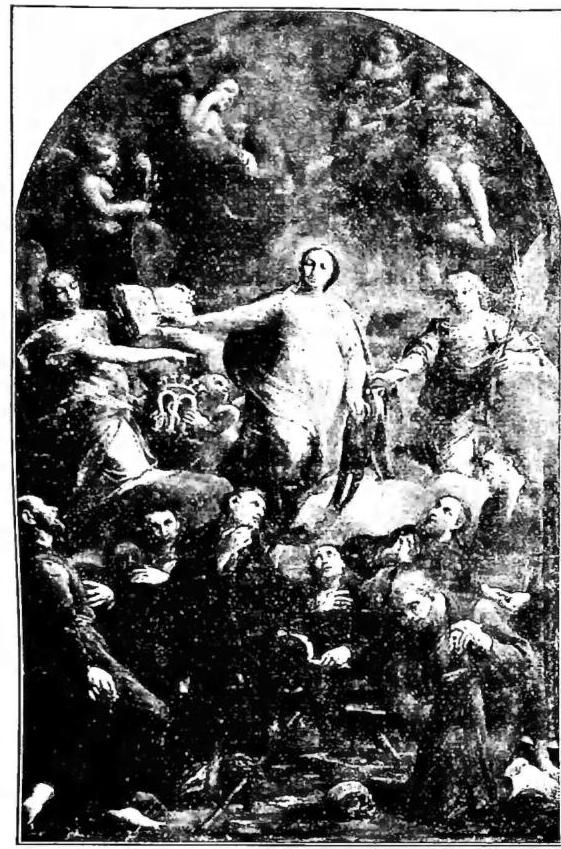
SEVEN FOUNDERS OF THE ORDER OF THE SERVANTS OF MARY, Saints. - The precise date of their birth is not known. Their names, preserved in a list by the historian of the Order Paolo Attavanti (1468), are those of Bonusfilius, Bartholomaeus, Iohannes, Benedictus, Gerardinus, Ricoverus, Alexius; later (16th-17th century) it was believed that their names could be established as follows: Buonfiglio Monaldi, Giovanni di Buonagiunta, Manetto dell'Antella, Amedeo degli Amedei, Ugo di Uguccione, Sostegno de' Sostegni, Alessio Falconieri. They were all Florentine merchants and lived religiously in the world in the state of celibacy or of marriage or of widowhood, proper to each one.
Out of the great devotion they nourished toward the Mother of God they enrolled in the Company (later called Major) of St. Mary, already at that time very flourishing in their city; in it they had the opportunity to become acquainted and to bind themselves to one another with bonds of holy friendship. The author of the Legenda de origine Ordinis Servorum Sanctae Mariae, who writes immediately after the death of St. Alexius, the last survivor of the Seven, calls them particularly devoted to the Madonna, from whom they received the vocation to abandon the world and withdraw to the eremitical life on Monte Senario, not far from Florence. In 1240 they came down to Florence, and this would have happened according to tradition following a vision of the Virgin, in order to treat with Bishop Ardingo a first rudimentary organization of the new religious family (v. SERVI DI MARIA). Having had their good spirit attested by the Dominican St. Peter Martyr, who was in Florence in 1245, the Seven and their companions, scattered here and there especially in Tuscany, until about 1250 led a predominantly eremitical life, until some of them came down to Florence, to found there a new convent dedicated to the Madonna, they began to accentuate the cenobitic and apostolic character, which then, especially under the action of St. Alexius, and of the contemporary beloved disciple St. Philip Benizi, ended by prevailing (1267-85). Since however in fact the Servants of Mary in many places lived on alms, not a few believed that the Order had remained suppressed by the Second Council of Lyon (1274), although it appeared that the institution had been equivalently approved several times by the pontiffs from as early as 1256 and 1263. St. Alexius (d. in 1310 at the age of 120) was able to see the complete triumph of the new religious family, with the definitive pontifical approval of the Order (11 Feb. 1304), which was afterward numbered among and had the privileges of the mendicant Orders.
They appear to have been venerated with collective cult from as early as the 14th century, but only the cult of St. Alexius was confirmed ab immemorabili on 1 Dec. 1717 as blessed, and that of the other six on 30 July 1725 (cf. Benedict XIV, De Servorum Dei beatificatione, lib. II, XXIV, nos. 143-45, 161-66 and lib. IV, part 2, XVIII, no. 15). Later however, following new miracles obtained through their collective invocation in the last decades of the 19th century, Pope Leo XIII canonized them on 15 Jan. 1888. Feast on 12 Feb.
Bibliography3 works
Alessio Maria Rossi