
Enciclopedia Cattolica Vol. II, 1949 Christian archaeology Various topics

Banquet, Scenes of

BANCHETTO, SCENE DI

Italian original Cite

Supper redirects here.

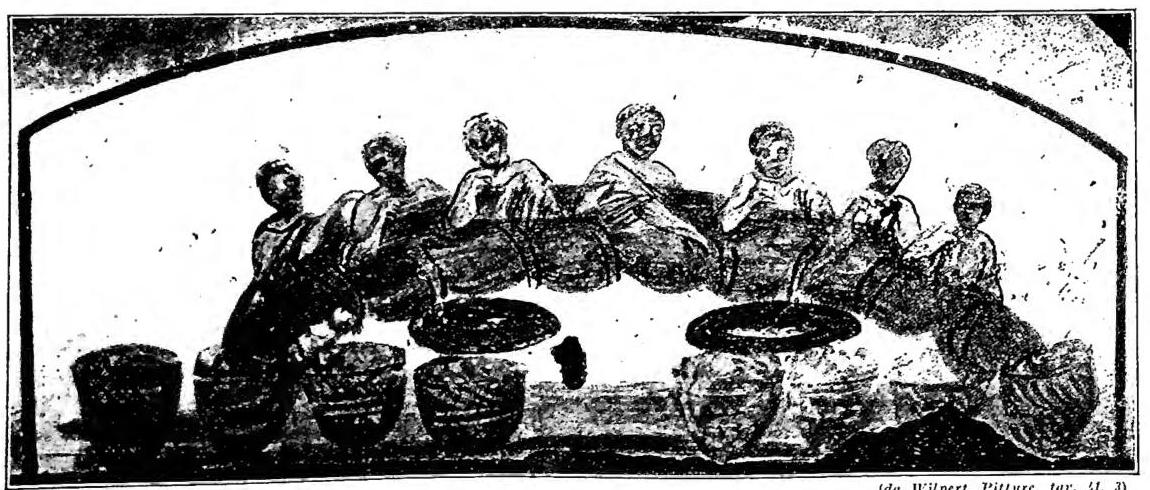
BANCHETTO - Commensali con pesci e pani. - Fresco in the cemetery of St. Callixtus (late 2nd-early 3rd century).

BANQUET, Scenes of. - It cannot yet be said that convivial scenes in Early Christian art have found a definitive interpretation. Iconographically, it is true, the individual groups already stand out with some clarity. Despite certain secondary variants and setting aside the representations of the banquet that are purely and certainly funerary, in the catacomb frescoes one can by now distinguish: a) the banquet of the seven, exceptionally twelve, almost always all men eating fish (and bread) in immediate proximity to a series of baskets filled with bread, whose number varies between 7 and 12; b) the banquet of three, exceptionally five, men, women and children, in which there appear, together with the fish on the tripod, the allegorical figures of Agape and Irene and some cup-bearer; then in sculpture: c) the banquet of bread and wine served mostly to five men, among whom the central group of three stands out; d) the banquet with fish among loaves served generally to four men and often completed by six, eight or ten baskets. A special position is occupied by the so-called Fractio panis in the Greek Chapel at Priscilla and the miracle-banquet of Cana in the cemetery "ad duas lauros" (v), despite their septenary number of guests which links them with group a. Such varieties of figurations gave rise to a great number of conflicting interpretations which in turn sought to find in them the reproduction of real scenes of earthly life, of funerary banquets, of the celestial banquet (refrigerium), of the Agape (v.), or of the eucharistic celebration. It seems by now to be ruled out that these are realistic representations of the Agape or of the Eucharist (here as elsewhere Christian art proceeds by evocative allusions), and the necessity arises of distinguishing between periods and figurative contexts. As a solution more consonant with the spirit of this art, one may hold that these are generally the refreshment of souls in the blessed life with particular references, more or less explicit, to the food of immortality, also prefigured in the miraculous repast of the crowds in the desert.

Bibliography5 works
BIBL.: L. Lefort, Etudes sur les monuments primitifs de la peinture chrétienne en Italie, Paris 1885, pp. 143-58; J. Wilpert, Fractio panis. La plus ancienne représentation du sacrifice eucharistique à la «Cappella greca», ibid. 1896; H. F. J. Liell, «Fractio panis oder «coena coelestis», Trier 1903; F. J. Dölger, IX/9/VC, V. Münster in Westf. 1940, pp. 485-540; F. Gerke, Die christlichen Sarkophage der vorkonstantinischen Zeit, Berlin 1940, p. 110 ff.

Luciano De Bruyne

About this entry

By Luciano De Bruyne

How we know signed in print

Translated from the Enciclopedia Cattolica, vol. II (1949), col. 777.

Printed pages Open in the page viewer
Page 463
vol. 2, coll. 777–778

More by Luciano De Bruyne: Baptism · Aureli, Hypogeum of the · Benediction · Ass · Ancient Christian Art

Cite this article

Chicago

De, Bruyne Luciano. “Banchetto, scene di.” In Enciclopedia Cattolica, vol. II, col. 777. Città del Vaticano: Ente per l’Enciclopedia Cattolica e per il Libro Cattolico, 1949. https://azioneromana.com/article/banchetto-scene-di.

MLA

De, Bruyne Luciano. “Banchetto, scene di.” Enciclopedia Cattolica, vol. II, Ente per l’Enciclopedia Cattolica e per il Libro Cattolico, 1949, col. 777. Azione Romana, https://azioneromana.com/article/banchetto-scene-di.

BibTeX

@incollection{ec2_banchetto_scene_di,
  author    = {De, Bruyne Luciano},
  title     = {Banchetto, scene di},
  booktitle = {Enciclopedia Cattolica},
  volume    = {II},
  pages     = {777},
  note      = {Cited by column},
  publisher = {Ente per l’Enciclopedia Cattolica e per il Libro Cattolico},
  address   = {Città del Vaticano},
  year      = {1949},
  url       = {https://azioneromana.com/article/banchetto-scene-di}
}

One of some 20,000 entries brought back from the twelve printed volumes (1948–54). Spotted something? Help us improve it.

Save for later

Enter your email and we will send you a sign-in link. No password. What you save (articles, verses, chapters, documents) follows you to any device.