Machine translation of the 1948–1954 Italian original. The original text is authoritative.
PINDEMONTE, IPPOLITO. — Poet, b. in Verona on 13 November 1753, d. there on 18 November 1828. He studied in Modena. Little more than twenty years old, partly for reasons of health, he undertook journeys to Florence, Rome, where he was appointed an Arcadian academician, Naples, Sicily, and Malta, where he was made a knight of the Order. Upon returning to his homeland, during his leisure at his villa in Avesa, he wrote (besides the utterly forgotten tragedy Arminio) the two small volumes Poesie and Prose campestri (1785). He then resumed his travels through Savoy, Switzerland, and France. From Paris he went on to London, Berlin, Vienna, and Marseille: the journeys that Foscolo would recall with affection (Sepolcri, vv. 213–14). Returning to Verona, he alternated works of sincere piety with literary works: Epistole, Sermoni, Viaggi (in verse), the Elogi dei letterati, and his translation of the Odissea, a task that lasted until his death.
Foscolo had the Poesie campestri in mind when he spoke of the “melancholy harmony” that governs P.’s song (Sepolcri, vv. 8–9). A definition that revives it and almost creates II. But invocations of solitude, melancholy, and the white sadness of the fields illuminated by the moon recur insistently in the Prose campestri, where it is permissible to discern a foreboding of Romanticism. Romanticism, not Arcadia; an anticipation, therefore, not a late flowering. And, if one wishes to reduce P. to a formula, one may say that he is a Romantic in the guise of a classicist. P. lives on in anthologies for a single poem: that Malinconia which is characteristic of his art and soul, with little five-syllable verses that seem to give us exactly the measure of his light and brief breath. In his own time, he was more
(photo Enc. Cath.)
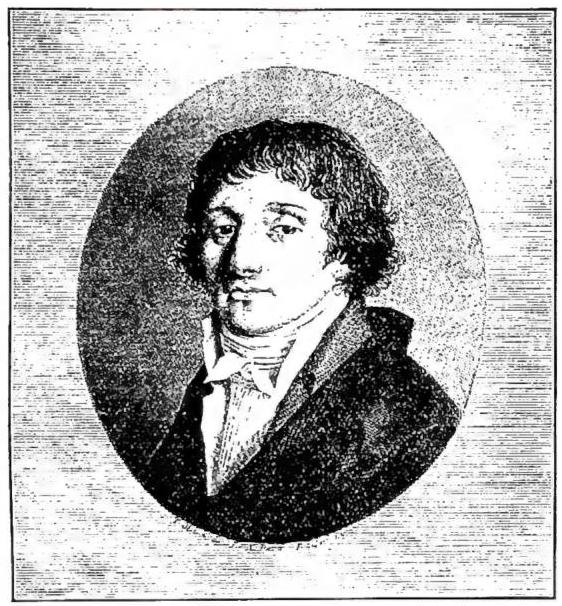
PINDEMONTE, IPPOLITO — Portrait (drawing by F. Matteini).
Print for the edition of N. Bettoni — Rome, Museo del Risorgimento.
celebrated than Foscolo and competed with Monti. But one senses how far he is from both the one and the other. He lacks the former’s imaginative power, and the latter’s lyrical intoxication. What remains is his labor as a translator; a most noble one, for, however many translations of the Odyssey may have appeared after his, his—despite an innate feebleness—is the one that still best preserves and conveys the spirituality of Homer’s poem.
BIBL.: Works: Poesie originali di I. P., edited by A. Torri, Florence 1858; Elogi di letterati it., there 1859; Le più belle pagine di I. P. selected by G. B. Angioletti, Milan–Rome 1933. Studies: G. Gini, Vita e studio critico delle op. di I. P., Como 1899; S. Peri, I. P. Studi e ricerche, Rocca S. Casciano 1905; G. Biadego, I. P. intimo, in Misc. Renier, Turin 1912, pp. 93–98; M. Scherillo, I. P. e la poesia bardita, Messina 1920; D. Claps, I. P., in Riv. d'Italia, 31 (1928), pp. 193–203; O. Bassi, Fra classicismo e romanticismo: I. P., Milan 1934. Cesare Angelini
Cite this article
“PINDEMONTE, IPPOLITO.” Enciclopedia Cattolica, vol. IX (1952), p. 897. Azione Romana digital edition, https://azioneromana.com/article/pindemonte-ippolito.