PORTLAND IN OREGON, ARCIDIOCESI DI

Image from page 1068

PORTLAND IN OREGON, ARCHDIOCESE OF. — Archdiocese and city in the State of Oregon, U.S.A. By indult of the Holy See dated 28 February 1836, the Oregon Country north of the American frontier was united to the Apostolic Vicariate of the Red River (Canada).

Today the archdiocese covers an area of 21,398 square miles with a total population (1940) of 878,693 inhabitants. Catholics number 94,786. Within the archdiocese there are:

Article illustration
(not. U.S.I.S.)

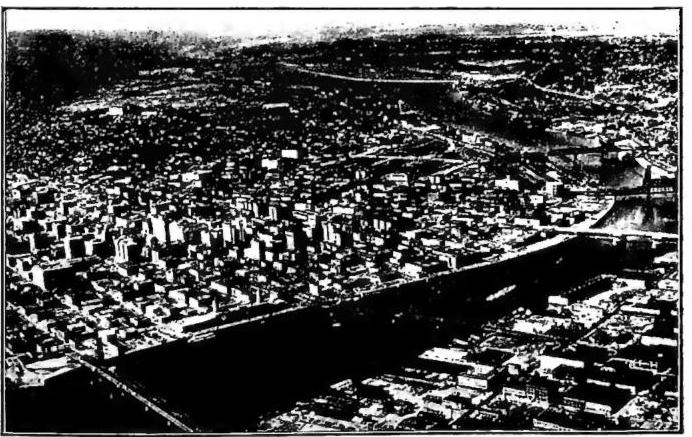
Portland in Oregon, Archdiocese of — Aerial view of the city.

PORTICO — Central part of the portico of the Cathedral. Work of Jacopo di Lorenzo and Cosma (1210) — Civita Castellana.

In the Middle Ages, during the Romanesque period, the presence of the portico, otherwise quite rare, is generally linked to classical aspirations, especially in regions bordering the Tyrrhenian Sea, such as Tuscany and Lazio (portico of the cathedral of Lucca and of the cathedral of Civita Castellana). The portico also appears in buildings such as the church of S. Angelo in Formis, which follow the harmonious and simple schemes of Paleochristian basilicas. The Abruzzese portico of S. Clemente in Casauria also recalls classical clarity. The so-called "closed porticos," which precede French Gothic churches, are divided internally by columns supporting a complex system of vaults. Cistercian architecture presents some examples of porticos, as in the abbeys of Casauria and Fossanova, where only traces remain to attest to their former presence. In municipal palaces, the portico begins to acquire a certain independence, and the first examples of architectural structures standing alone, called "loggias," appear.

During the Renaissance, the portico adapts well to new spatial concepts. Brunelleschi offers its most personal example in the Pazzi Chapel. Bramante’s porticos (canonry of S. Ambrogio and S. Maria of Abbiategrasso), with their vast central arches and pictorial contrasts of structural elements, herald the dynamic tendencies of 16th-century architecture. In the Palazzo dei Conservatori on the Capitoline Hill, Michelangelo gave the portico a new function and autonomy, the full scenographic possibilities of which Bernini would later exploit by encircling St. Peter’s Square. In S. Maria della Pace, Pietro da Cortona adapts the portico to the curvilinear layout of the entire structure. In the 17th century, the type of façade with a portico became common, both in basilicas remodeled while retaining their medieval atrium, and in entirely new constructions (S. Maria in Via Lata, S. Maria dei Miracoli).

During the Neoclassical period, the portico appears

2 abbeys, 281 priests of whom 156 are religious from 10 different congregations, 97 parishes, 15 chapels, 43 missions, 14 female congregations with 1,149 sisters, 1 diocesan seminary, 2 religious schools, 3 colleges and universities (University of Portland, under the direction of the Fathers of the Holy Cross), 2 orphanages, and 8 hospitals.

At the request of local Catholics, Msgr. Signay, Bishop of Québec, sent them the priests Norbert Blanchet and Modeste Demers, and on 17 April 1838 appointed Blanchet his vicar general. The latter left Montréal on 3 May 1838 and, after more than 4,000 miles, disembarked at Fort Vancouver on 24 November 1838, accompanied by Demers as far as the Red River. The first Mass was celebrated in the region on Sunday, 14 October. Two years later, in 1840, the Jesuit Father J. de Smet also went to Oregon. Rev. Norbert Blanchet established his first mission at St. Paul on the Willamette River and opened the first church in Oregon on 6 January 1839. The boundaries between Canada and the United States were not yet well defined, and the territory was under the jurisdiction of the Bishops of Québec (Canada) and St. Louis (United States). The two bishops requested the erection of an independent Apostolic Vicariate, which took place on 10 December 1843 with the appointment of Msgr. Norbert Blanchet.

On 24 July 1849, the Apostolic Vicariate was elevated to an archdiocese with the dioceses of Walla Walla and Vancouver as suffragans. Msgr. Magloire Blanchet, brother of the archbishop, was consecrated Bishop of Walla Walla (later suppressed on 31 March 1850 with the creation of Nesqually), and Msgr. M. Demers was created Bishop of Vancouver. The territory was divided again on 3 March 1868 to form the Apostolic Vicariate of Idaho, which became the Diocese of Boise on 25 August 1893, and again in 1903 to form that of Baker City. With the apostolic constitution *Ecclesia omnium sollicitudo* of 26 September 1928 (AAS, 21 [1929], pp. 649-51), Pius XI transferred the see from Oregon City to the industrial center of Portland, giving the diocese the title of Portland in Oregon. The ecclesiastical province of Portland comprises the dioceses of Boise and Baker City.

BIBL.: E. V. O’Hara, Oregon City, in *Cath. Enc.*, X, p. 293; J. G. Shea, *Hist. of the Cath. Church in the Unit. States*, IV, New York 1886, pp. 321-28; L. Le Jeune, Oregon, in *Dict. général du Canada...*, Ottawa 1932; *The official cath. direct.*, 1950, New York 1950, pp. 174-77.

PORTUGAL, PORTO, DIOCESE OF. — The see of Porto has been the scene of no few struggles between the bishop and the Chapter on one side and the king and the commune on the other. John I, King of Portugal, in agreement with Bishop Gil Alma, took the first steps to resolve all pending issues. In February 1405 they signed an agreement whereby the king, in exchange for dominion over the "burgo," would pay three thousand pounds annually. Innocent VII, with the bull *Solet pia Mater* (1 October 1405), commissioned the Archbishop of Lisbon to lift all excommunications if the agreement were beneficial to the Church. The final agreement was signed a year later by the King, the Queen, and the heir Duarte on behalf of civil authority, and by the bishop, dean, and Chapter on behalf of ecclesiastical authority, with the clause of the three thousand pounds payable by the King remaining in force. Under Emanuel, the sum was reduced to 120 marks of silver. From 1639 to 1671 the diocese remained vacant because the Holy See could not recognize the bishops presented by John IV. Finally, the dispute was settled after the peace with Spain through the presentation and confirmation of Don Nicola Monteiro (1671-72). Joseph I, King of Portugal, obtained from Clement XIV (10 July 1770) the division of the diocese with the creation of the new Diocese of Penafiel, which was suppressed by Pius VI in 1778.

The diocese is also one of the most celebrated in Portugal for its religious monuments, including the Romanesque cathedral of the 12th century, the 14th-century Gothic church of S. Francesco, and the 18th-century Baroque church of the Clerics.

BIBL.: F. De Almeida, *Historia da Igreja em Portugal*, I, Coimbra 1910, pp. 135 ff., 163, 189; II, 1915, pp. 11, 14, 579-582; IV, part 2, 1913, pp. 20 ff.; *Grande Enciclopedia Politica Portuguesa e Brasileira*, XXII, pp. 593-671.

PORT OF SPAIN, ARCHDIOCESE OF. — Situated in the British West Indies, its see is on the island of Trinidad and comprises the Windward Islands, the islands of Tobago, Grenada, St. Vincent, St. Lucia, the Grenadines, and other smaller islands.

In 1513, Pedro de Córdoba, Dominican provincial in Santo Domingo, sent the first Dominicans to Trinidad, but they were killed. In 1571, twelve Franciscans from Granada arrived there but fell victim to the unhealthy climate. In 1576, two Jesuits went to Trinidad and worked there for several years before moving on to Guiana. The first ecclesiastical foundation was established in 1591. In 1596, twenty-two priests from Castile and Seville arrived at Port of the Spaniards, today Port-of-Spain, accompanied by a large number of fortune-seekers. In 1622, Spain firmly established its authority over Trinidad, which was considered part of the Diocese of Puerto Rico. In 1687, the Capuchins began their apostolate there according to the system of the Paraguayan reductions and founded various missionary centers that were also centers of civil life.

On 27 March 1802 the Treaty of Amiens assigned the island of Trinidad to England, which had already occupied it in 1797. The group of American islands occupied by England were initially placed under the jurisdiction of the Apostolic Vicariate of London. By a decree of 8 April 1808, Propaganda entrusted the Antilles and the Lucayas to the Archbishop of Baltimore with the faculty to send missionaries from both the secular and regular clergy. The meagre results obtained compelled Propaganda to decree on 23 February 1818 the creation of an Apostolic Vicariate with its seat on the island of Trinidad, comprising British Guiana, the island of Trinidad with the Antilles as far as Puerto Rico (excluding French possessions), the island of Jamaica and its dependencies, the Lucayas and Bermuda.

On 8 February 1836 the division of the vicariate was decreed, partly implemented with the erection of the Apostolic Vicariate of Jamaica on 10 January 1837. The division was confirmed on 30 January 1837 and the Apostolic Vicariate was styled the Apostolic Vicariate of the Most Holy Trinity. As a result, Bermuda was ceded to the Apostolic Vicariate of Nova Scotia (now the Archdiocese of Halifax); the Apostolic Vicariate of Jamaica was created, including British Honduras (now the Apostolic Vicariate of Belize) and the Lucayas or Bahama Islands (now the Apostolic Vicariate of the Bahama Islands). On 12 April of the same year, the Apostolic Vicariate of British Guiana was also detached. On 30 April 1850 the Apostolic Vicariate was raised to the status of an archdiocese, and on the same date the Diocese of Roseau (q.v.) was detached from it, while the island of Barbados was assigned to the Apostolic Vicariate of Guiana.

The area of the islands is 6,455 sq. km., with a population of 791,946, of whom some are of African and Indian origin. There are 319,000 Catholics, 296,952 Protestants, 35,565 Muslims, 1,478,088 pagans and a few Jews. There are 146 priests, 25 brothers and 264 sisters. There is a major and minor seminary. There are 65 parishes and 118 missionary stations, 1 orphanage, 2 leper hospitals, 169 elementary schools, 12 secondary schools, 2 teacher-training colleges. Three Catholic periodicals are published.

BIBL.: GM, pp. 291-92; H. De Noussanne, La France Missionnaire aux Antilles, Paris 1936, passim; Arch. di Prop. Fide, Relatio annualis, 1950, pos. prot. n. 2866/50; S. P. Casey, Centenary of the Archdiocese of Port-of-Spain, 1950; MC, 1950, pp. 21-22.

Portugal

### I. Geography

The Portuguese territory represents the western margin of the Iberian plateau, which slopes down to the coast in plains and terraces, interspersed in the north (Minho), in the centre (Beira) and in the south (Algarve) by the last offshoots of the Spanish mountains.

The temperate-oceanic climate is much more humid than in the rest of the peninsula, except in the extreme southern regions. Of the 91.7 thousand sq. km. of the state, 3.1 belong to the Azores and Madeira, which form 4 of the 15 provinces into which the territory of Portugal is divided. The population (8.5 million inhabitants, 90 per sq. km.), of Latin origin, is very homogeneous (only 0.4% of allophones) and for the most part (94%) Catholic. Population density, as a rule, decreases from the sea towards the interior and from north to south.

Portugal is essentially an agricultural country; yet arable land covers less than one-third of the territory, compared with one-fifth of woodland and two-fifths of unproductive land. Cereals, which yield very low unit returns, are insufficient for domestic consumption. The economically most important crop is the vine, which provides a modest but high-quality product largely destined for export (to England, Brazil). Olive trees also yield a good harvest, and fruit-growing is a significant source of income. From the forests come cork (half of world production), timber and resins. Livestock farming is of minor importance (sheep and goats; cattle are numerous in the north); fishing (tuna and sardines) is much more significant. Mineral resources are varied (copper, tin, lead, silver, manganese, nickel, gold, chromite, etc.), but coal is scarce and only pyrites and tungsten are exploited to any extent. Industry, on the whole, is modest and concentrated in the main cities.

The capital of the state is Lisbon (710,000 inhabitants), with a very busy port (on the Tagus); Oporto (265,000 inhabitants) is the outlet for northern Portugal (Douro).

Portugal is a unitary republic with a corporative structure. Alongside the elective National Assembly, with limited suffrage, there operates the Corporative Chamber, composed of representatives of economic interests, which has legislative functions. The President, elected by direct suffrage, holds office for seven years.

A Portuguese colony, governed by a governor, is São Tomé and Príncipe, volcanic islands in the Gulf of Guinea, discovered by the Portuguese in 1471. The fertility of the soil and abundant rainfall favour luxuriant vegetation (tropical forests); the plantations introduced by the colonists yield exceptional production of cocoa, coffee, oil palm, peanuts, sugar cane and cotton, most of which is exported. The population (57,000 inhabitants) is made up for the most part of blacks, a few mulattos and about a thousand whites. The capital is São Tomé (8,000 inhabitants), on the island of the same name, where the governor resides.

BIBL.: R. Gallop, P., Cambridge 1936; H. Lautensach, P. auf Grund eigener Reisen und der Literatur, Gotha 1932-37; A. A. Girão, Geografia de P., Coimbra 1943; O. Ribeiro, P., ibid. 1945.

### II. Civil and Ecclesiastical History

#### 1. The Middle Ages, Civil History

The history of the western Iberian territory, up to the 11th century, does not differ from that of Spain. However, prior historical-political events and geographical and anthropological conditions form the premise for the autonomy of that strip of the peninsula. Before Fernando Magno and Alfonso VI, however, the region of present-day Portugal shared in the political vicissitudes of the entire Iberian Peninsula (q.V. SPAIN).

Among the foreign knights who came to Spain to aid the Christian kings, Raimondo, son of William Count of Burgundy, who later married Urraca, legitimate daughter of Alfonso VI of Castile, and his cousin Henry, son of the Burgundian Duke Henry, who later married Teresa, illegitimate daughter of the same Alfonso VI, distinguished themselves by their valour. Their marriages gave the former control of Galicia as far as the Tagus, and the latter the county of Portucale, under the suzerainty of his cousin. The boundaries of the County, which took its name from Portucale, the ancient Cale, situated near the mouth of the Douro, were not well defined. With the conquest of Coimbra, the county acquired a larger territory. But already in 1097 Henry secured independence from his cousin, remaining directly dependent on the King of León. When he died at Astorga (1112 or 1114), the Muslims grew stronger, recapturing Sintra, Lisbon and Santarém. The County passed to Henry’s wife Teresa, whose actions were always aimed at achieving autonomy, not neglecting to extend considerably the limits of her domain. But her son Afonso Henriques, seeing at a certain point a threat to his own power in his mother’s actions, defeated her at the battle of São Mamede (1128) and then, after defeating the Muslims at Ourique in 1139, proclaimed himself Afonso, King of the Portuguese (Afonso Portucalensium rex). By the Treaty of Zamora in 1143 this title was recognised by Alfonso VII; the legate of the Pope, Cardinal Guido of

Alfonso Henriques is therefore the creator of the independent kingdom of Portugal; and in 1147 he conquers Santarém and, with the help of northern crusaders, Lisbon. In 1158 Sintra, Aomada, and Alcácer do Sal surrender to him. Évora, lost, is reconquered in 1165. Then Beja, Serpa, Cáceres, and other cities of military and strategic importance are occupied. After his death (1185), his son Sancho continues his father’s conquests, but devotes himself especially to the internal political problems of the country. In 1211 he is succeeded by his son Afonso II, who begins an authoritarian policy and promotes the Confraternities and the Inquirições, which prove to be of great national interest. As regards the Cortes of the Kingdom, the first historically attested are those held in Coimbra in 1211, with the participation of the clergy and nobility. With the help of the bishop of Lisbon, D. Soeiro, King Afonso II takes Alcácer from the Muslims and gives valuable assistance to Alfonso VIII of Castile in the great Christian victory at Las Navas de Tolosa (1212). His successor, Sancho II, heroically devotes himself to the struggles against the Arabs. He conquers Elvas in 1226; he loses it, but reoccupies it in 1229. These wars foster internal conflicts, disorders, and revolts. The nobility and clergy accuse the King before the Pope, and Innocent IV, at the Council of Lyon (1245), absolves his subjects from obedience, and the King’s younger brother, Afonso, count of Boulogne, assumes the regency. An important date in his reign is 1254, when the Cortes meet at Leiria, to which representatives of the people participate for the first time. Afonso III completes the total conquest of the Algarve, bringing Portugal to its current borders. In 1267 the King of Castile recognizes these conquests. The Boulogne, so called because of his marriage to Matilda, countess of Boulogne, thus realizes the dream of all his predecessors and can provide for the social organization of the Kingdom, granting effective protection to the municipalities and to the third social class, the common people, who from then on are always heard in the Cortes. The new Inquirições, accompanied by other administrative and economic measures, affect many interests, causing struggles with many members of the high clergy, while the municipalities always support the King.

When the prince Denis assumed, in 1279, the government of the country, Portugal had achieved territorial unity and economic and administrative stability. He was able to found the Order of Christ, in place of the suppressed Order of the Templars, devote himself to the settlement and reclamation of the land (hence his title of Lavrador), promote trade and the navy; he summoned the Genoese admiral Manuel Pessanha for nautical and maritime training. A distinguished poet, Denis founded in 1290 the University of Lisbon, transferred in 1308 to Coimbra. His marriage to Isabella of Aragon, later proclaimed a saint by the Church, gave him immense prestige among the people, because the most virtuous woman devoted herself to works of charity and good.

But the prosperity of the Kingdom is tested by the resurgent Arab threat; in 1340, the allied forces of Alfonso XI of Castile and Afonso IV, son of Denis, win the great battle of Salado. It is in the time of Afonso IV that the sad episode of Inês de Castro occurs, immortalized by Camões in the *Lusíadas* as the great love with which the prince Peter loved her. Peter will be the King “the Just” par excellence. The brief years of his reign were marked by perfect administrative stability and great serenity for the nation. Ferdinand is the last King of this first epoch of Portuguese history. His defects, his weakness, and his inconstancy (he was called the Inconsistent) brought to Portugal invasions, wars, and struggles with the Castilians. On 16 June 1373 he signed the celebrated alliance with Edward III of England, still valid today. He nevertheless promoted agriculture with the law of the Sesmarias (1375) and developed the merchant and military navy. Dying without heirs, the threat of Castile arises and the first great crisis of national autonomy emerges.

For ecclesiastical history, from the Portuguese point of view, only Braga and Mérida are of interest, and above all the former. Already in the 3rd century the diocese of Braga was flourishing, and from this period the bishop Paternus is known. In the 4th century, at Évora, where pagan temples still existed, Christianity flourished with the bishop Quintianus, and likewise in Lisbon with Potamius. The invasion of the barbarians, between the 5th and 8th centuries, marks a dangerous crisis for Iberian Christianity, especially in the province of which Braga is the metropolitan see. The conversion of the Suebi is a notable event. Around the middle of the 6th century, St. Martin of Braga, or Bracarensis, is elevated to the episcopal dignity, and two or three years later the first Council of Braga is held, followed by a second around 572, of which St. Martin, now metropolitan, was the greatest animator. Until the conversion of the Visigoths under Reccared and then under Arab rule, the majority of Christians maintained their faith, and only some doctrinal and moral contaminations occurred, a logical consequence of contact with Jews and Muslims. The Church, however, lived bitter hours, because the problem of ecclesiastical organization under Arab rule presented daily increasing difficulties. The Christian reconquest marked a magnificent recovery in all fields, from the religious and monastic to the apostolic. It can be stated with certainty that at the beginning of the Christian reconquest a new life begins in Lusitania, in all the dioceses: Braga, Porto, Lamego, Beja, Évora, Lisbon, Coimbra, etc. The conquests of Afonso Henriques took place with the help of the Crusaders, especially the Templars; the Crusades were excellent opportunities to strike at Muslim power in its European stronghold, and Portugal benefited from them, having Silves reconquered during the Third Crusade by Sancho I, and Alcácer in 1217, during the Fifth Crusade. This means that Portugal was rebuilt, stone by stone, with the collaboration of the defenders of Christendom.

The struggles of Afonso Henriques’ successors with the clergy were merely episodes of discipline and interest rather than of a religious nature, since the Portuguese leaders have always maintained that fidelity sworn by the first king to the Church of Rome. In the time of Denis, Pope Nicholas IV with the bull *Cum olim* of 7 March 1289 gives his “placet” to the Concordat of 40 articles, by which the King’s rights are defined without prejudice to the Church and the clergy. The same royal approval, first mentioned in 1361, cannot and should not be considered prejudicial to ecclesiastical rights. The monastic orders constituted, in medieval Portugal, as many centers of civil, cultural, and political progress. The Cistercian Order, for example, and then the Franciscan and Dominican Orders, among others, act for the spread and defense of culture, promote the settlement of the territory and even administration. As regards the military orders, their contribution, as has been said, is fundamental to the conquest of the territory. The Order of Christ, founded by Denis and juridically created by Pope John XXII with the bull *Ad eo ex quibus* of 15 March 1313, in place of the suppressed Order of the Templars, was, from the Portuguese point of view, a truly providential event, because the greatest contribution to the work of the discoveries came precisely from the Order of Christ.

The celebrated Pope John XXI, Pedro Julião, author of so many fundamental works, such as the *Thesaurus Pauperum*, was born in Lisbon between 1210 and 1220.

Article illustration
Portugal – Map of the Azores.

672. Modern Age

a) Civil history. - The legitimate heir of King Fernando is Beatrice, wife of the King of Castile. The King’s widow, Leonor Teles, assumes the regency and then has Beatrice proclaimed queen.

This solution is unpopular, and a conspiracy is organized in which even the future Constable of the Kingdom, Nuno Álvares (now a blessed of the Church), takes part. The Master of the Military Order of Aviz, Giovanni (son of Pietro), father of Fernando, gains the consent and sympathy of the people and is proclaimed king by the Cortes of Coimbra in March 1385, following the dialectical defense made by João das Regras. The forces of Castile, which have invaded the Kingdom, are destroyed in the same year at Aljubarrota; other battles are won by the Portuguese, led by Bl. Nuno Álvares. The crisis is overcome. From the marriage of the King with Filippa of Lancaster was born the so-called “illustrious generation,” which played an important part in the discoveries: Duarte, learned and cultured; Pedro, humanist and traveler; Henry, known as the Navigator for the great impetus he gave to the discoveries through the founding of the nautical school at Sagres. On 25 July 1415, an expedition led by the King and the “high infants,” as Camões called them, set out for the conquest of Ceuta. It was the first great blow struck against Muslim power; in the Muslim temple of Ceuta, converted into a Christian church, the three princes Duarte, Pedro, and Henry are knighted.

The reign of Duarte sees the disaster of Tangier and the captivity of the infante Fernando, who voluntarily sacrifices himself so that Ceuta might remain Christian. From 1438, Pedro is appointed regent until Alfonso V comes of age. During Duarte’s regency, the African policy continues with the conquest of Alcácer, Seguer, Arzila, and Tangier in 1471.

Atlantic policy was a constitutional necessity for the development of the Portuguese nation, which, blocked to the east by Spain, had no outlet other than the sea. The scientific and methodical character of Portuguese discoveries is demonstrated not only by the nautical school of the Infante but also by the works of Portuguese, Jewish, and later Italian geographers, cartographers, and scientists in general. Gil Eanes, according to the testimony of the historian Gomes de Azurara, reaches the Canary Islands around 1433. The African coast as far as Cape Bon was known to the Portuguese since 1415. In 1434, the same Gil Eanes reaches Cape Bojador, according to Azurara. In the same year, this navigator, together with Afonso Gonçalves Baldaia, reaches Angra dos Ruivos; in 1435 and 1436, they reach Angra dos Cavaleiros and Porto da Gale, in the Rio de Oro. From 1440 to 1470, the year of the death of the Infante Henry, Portugal reveals to the world the entire African coast as far as 8° north latitude. In 1485, Diogo Cão reaches the Congo and arrives at Cape Negro. At this time, John II reigns in Portugal, and Bartolomeu Dias, having set out from Lisbon in 1487, the following year reaches the cape he called the Cape of Storms, a name that the King wished to change to that of Cape of Good Hope, that is, the hope of reaching India by the African route.

Article illustration

In 1487, Pero da Covilhã and Afonso de Paiva set out for the lands of the Prester John, Ethiopia, demonstrating the possibility of reaching India; while preparing a new expedition, King John dies, and his successor, Manuel I, entrusts the expedition to Vasco da Gama, who, having set out from Lisbon on 8 July 1497, arrives in Calcutta on 17 May of the following year. In 1500, Pedro Álvares Cabral discovers Brazil. In 1494, in the face of Spanish discoveries, an agreement was reached between the two powers of the Peninsula through the Treaty of Tordesillas, by which all lands discovered or to be discovered to the east of a line drawn from pole to pole, 370 leagues west of the Cape Verde Islands, were to belong to Portugal; lands to the west of this demarcation would belong to Spain. This treaty, although confirmed by Pope Julius II, did not, however, put an end to the controversies. During the reign of John III, the Portuguese push ever further eastward, as far as Japan, China, and Oceania. The consequences of their discoveries have been profound for science and geography in particular; they have been even more so for civilization and the interests of the Church. In Brazil, for example, and in India and Asia, the action of missionaries, especially the Jesuits, has been fundamental, both from the point of view of faith and from that of the organization of civil life. During this period, the Church suffers the crisis of the Lutheran schism. The tribunal of the Inquisition is established in Portugal on 23 May 1536, with the bull *Cum ad nihil magis* of Paul III. This tribunal, which, placed in the hands of civil authority, later committed abuses, at that time preserved Portugal from the terrible religious wars. After the death of John III, the young King Sebastian ascends the throne. Having obtained the consent of the Holy See, which grants the expedition the bull of Crusade, he clashes at Alcácer Quibir, in North Africa, with the Muslims. In the terrible defeat, the young King disappears in battle: thus is born the myth of “Sebastianism.”

Article illustration
This disaster created Portugal’s second great crisis

In Asia, he arrived in 1498 as a companion of Vasco de Gama, Pero da Covilha, who is thought to have been a victim of the pagans. In 1500, the first priests, Franciscans, arrived in India with Cabral’s fleet, having discovered Brazil. Until 1542, the missions were governed by Franciscans, who at that time had eleven convents, three orphanages, and eighty missionary residences stretching from East Africa to the China Sea. Francis Xavier (q.v.) arrived in India on 6 May of that year with special powers from the Pope and a mission from King John III, and thus began the magnificent series of his apostolic travels throughout the Orient. But the greatest glory of the Society of Jesus has been the formation and Christianization of Brazil.

With the advent of enlightened despotism, the Society of Jesus received in Portugal, as throughout Europe, a very hard blow. The consequences did not take long to appear, especially in the colonies. The secular and liberal spirit contaminated the structure of the purest forces of the nation (though before this, the work of a martyr of the Society of Jesus, St. John de Britto, had once again flourished). Secularism, however, soon nullified the fruits of so much secular labor. At the beginning of the new century, with the rise of liberalism, the religious orders, monasteries, convents, and ecclesiastical hospitals were extinguished in continental Portugal by the law of 30 May 1834. The goods of the Church were largely incorporated into the patrimony of the State. The liberal work was completed by the anti-religious measures of the new Republic.

673. Contemporary Portugal

The first fifteen years of the new Republic have a very sad history: revolutions at every moment, disorders, party struggles, attacks, assassinations, persecutions against representatives of the Church, ministries succeeding one another in the attempt to administer justice, maintain public order, and balance the finances. The Fatherland is sick, affirmed the same public prosecutor, General Carmona, during the trial of the revolutionaries of 18 April 1925. On 28 May 1926, the movement of General Gomes da Costa arose in Braga, and a recovery of national political life began, in order, legality, and respect for the Church and the healthy ideas of tradition. On 25 March 1928, General Oscar Carmona was elected President of the Republic. On 27 April of the same year, Professor Oliveira Salazar of the University of Coimbra became Minister of Finance and later Prime Minister. The Portuguese Constitution and Colonial Act, the new “magna carta” of the Lusitanian Empire, reflect some principles defended in the principal encyclicals of Leo XIII, Pius X, and Pius XI. While maintaining the separation between Church and State proclaimed by the Republic, a climate of great respect toward the Church was created; the Concordat and the Missionary Agreement, signed in Rome on 7 May 1940 with the Holy See, constitute a new step forward in the defense of the spiritual heritage inherited from our ancestors. One of the most interesting measures of the agreement concerns marriage, which had been considered by the Republic as merely a civil contract; now the Portuguese government once again recognizes the civil legal effects of religious marriage. From the standpoint of international politics, the government of Salazar maintained a policy of neutrality during the last war, preserved the alliance with England, and made a pact of non-aggression and friendship with Spain. In the field of culture, under the ministry of Professor Cordeiro Ramos, the last lay institutions created against the ecclesiastical organization by the Republic were abolished, and a reform of education was undertaken in which the moral and spiritual tradition of the Church was respected. Portugal thus knew how to find and reclaim, as Pius XII said in his message of 31 October 1942, “the lost path of its most beautiful traditions as a Most Faithful Nation.”
BIBL.: A. Herculano, *História de P.*, 4 vols., Lisboa 1884–94; I. Leite de Vasconcellos, *Religiosi da Lusitânia*, 2 vols., 1887–1905; F. Almeida, *História da Igreja em P.*, 4 vols., Coimbra 1910–23; id., *História de P.*, 6 vols., 1912–29; F. Rodrigues, *A Companhia de Jesus em P. e nas Missões*, Porto 1921; id., *História da Companhia de Jesus na assistência de P.*, 7 vols., 1913–56; R. A. de Azevedo, *Os Jesuítas no Grão Pará*, Coimbra 1930; C. Erdmann, *O Papado e P. no primeiro século da história portuguesa*, 1935; M. G. Cerejeira, *A Idade Média*, 1936; id., *O Renascimento em P.-Cleonardo*, 3rd ed., 1936; P. Portugaliano Numen, *Hist. e case. VIII p. Chr. usque ad XVI usus*, Acad. Scient. Olisipon., Lisboa 1936; M. Brandão-M. d’Almeida, *A Universidade de Coimbra. Esboço da sua Hist.*, Coimbra 1937; A. Baño-M. Murias-H. Cidade, *Hist. da expansão portuguesa no mundo*, Lisboa 1937–40; B. X. Coutinho, *Acção do Papado na Fundação e Independência de P.*, Porto 1939; R. Accad. d’Italia, *Relazioni storiche fra l’Italia e il P.* (on the origins of Christianity in P.; A. Ferrua, *La conquista cristiana della Lusitania*, pp. 71–86), Roma 1940; B. X. Coutinho, *L’idée de croisée au P. au XVe siècle*, Louvain 1946; M. de Oliveira, *Hist. da Igreja*, Lisboa 1942; id., *História eclesiástica de P.*, 2nd ed., 1948; *P. e Santa Sé. Concordata e Acordo Missionário de 7 de Maio de 1940*, 1943; A. R. Farinha, *A expansão da Fé no Extremo Oriente*, 1946.

Giuseppe Vittorino de Pina Martins

III. ECCLESIASTICAL ORGANIZATION

Portugal currently has one patriarchate and two metropolitan sees with fourteen suffragan sees. 1) Patriarchate: Lisbon, with suffragans: Angra, Funchal, Guarda, Leiria, Portalegre; Santiago of Cape Verde (in the Cape Verde Islands); 2) Metropolitan See: Braga, with suffragans: Aveiro, Braga, Coimbra, Lamego, Porto, Vila Real, Viseu; 3) Metropolitan See: Évora, with suffragans: Beja, Faro.

IV. LEGAL STATUS OF THE CHURCH

This is regulated by the Concordat signed on 7 May 1940. In this agreement, the legal personality of the Catholic Church is recognized (Art. 1), and its free exercise of spiritual and jurisdictional power is guaranteed, as well as full freedom of direct communication with the clergy and Portuguese Catholics (Art. 2).

Clerics are exempt from the obligation to assume offices incompatible, by canon law, with the ecclesiastical state (Art. 13).

Ecclesiastical associations and organizations (Arts. 3 and 4), which may obtain legal personality and acquire property, are free (Art. 20) to establish and maintain private, subsidized, and state-parallel schools, as well as seminaries and any other institutes of ecclesiastical formation or higher culture. In public elementary, intermediate, and secondary schools, kindergartens, orphanages, and official educational institutions, instruction in the Catholic religion shall be given, using textbooks approved by the ecclesiastical authority (Art. 21).

The Portuguese State recognizes the civil effects of marriages celebrated in accordance with canon law and transcribed in the appropriate civil registry offices, and grants exclusive competence to ecclesiastical tribunals in matters concerning the nullity and unconsummated ratification of such marriages (Arts. 22, 23, and 25); Art. 24 expressly states that “in harmony with the essential properties of Catholic marriage, it is understood that, by the very fact of the celebration of a canonical marriage, the spouses renounce the civil faculty to seek divorce, which therefore cannot be applied by civil courts to Catholic marriages.”

The Concordat, which confirms the continued validity of provisions not incompatible or modified by the agreements of 21 Feb. 1857, 23 June 1886, 15 Apr. 1928, and 11 Apr. 1929, is supplemented by a missionary agreement concluded on the same date and jointly ratified on 10 June 1940; for the Indian dioceses V. PATRONATO.

Diplomatic relations between Portugal and the Holy See are maintained through the Apostolic Nuncio and the ambassador accredited to the Vatican. Rodolfo Danieli

V. LITERATURE

The Portuguese language, which originated in the territories of the extreme northwest of the Iberian Peninsula, and precisely in those straddling the Minho River, which today marks the political border between Spain and Portugal, gradually extended southward along the western strip of the Peninsula, following the Christian reconquest that pushed the Arabs back toward Africa. From the regions where it was first used, it was called Galician-Portuguese, until, mainly due to the absorption of Galicia by the Kingdom of León and the subsequent incorporation of that region into the Spanish state (at the end of the 15th century), it split into two distinct speech forms: Galician and Portuguese proper. However, from the time of the earliest linguistic traces (9th–10th centuries) until the end of the 12th century, the Portuguese speech form is of interest to philology rather than literature. Literature begins toward the end of the 13th century, with poetry significantly preceding prose, and is traditionally divided into three periods: medieval, classical, and modern, each with distinct phases.

674. Medieval Period (1189–1502)

It begins with a love poem by the troubadour Pai Soares de Taveirós, known as the “Ribeirinha” from the diminutive of the lady addressed in it, and ends with the staging of the first play by Gil Vicente, the *Monólogo do Vaqueiro*. The two phases usually recognized within it are called the phase of Galician-Portuguese lyric poetry (12th–14th centuries) and the phase of courtly lyric poetry (15th century). The first, notable for three of the surviving songbooks out of the many—perhaps fourteen—that must have existed in its time (those of Ajuda, the Vatican, Colocci-Brancuti, and the National Library), and for the poetic compositions of King Alfonso the Wise of Castile, represents one of the most interesting and evocative manifestations of medieval Neo-Latin poetry. Without denying the influence exerted on it by Provençal lyric poetry, it must be acknowledged that, beyond their local character, the *cantigas de amigo* (songs of a friend), which, together with the *cantigas de amor* (songs of love) and the *gentilezas* (courtesies), constitute one of the two main themes treated in this poetry according to the classification given by the 16th-century humanist and poet Garcia de Resende (the other being *coisas de folgar* or *cantigas de escárnio ou de mal dizer*: “matters of amusement” or “songs of mockery or slander,” of lesser artistic importance due to their circumstantial nature).

Article illustration

While the *cantigas de amor* clearly contribute to the troubadour fashion, echoing its themes and forms, the *cantigas de amigo* reveal an unexpected poetic maturity. Their protagonist is the woman in love, a virgin or a noblewoman, who loves sincerely and expresses her anxieties by addressing herself directly to her beloved (*amigo*), more often speaking of him to her mother or a friend. The figure of the beloved, as she portrays him, enriches the many types of songs in which the woman recalls where and when she met him: dawn songs, ballads, *serranilhas*, pastorals, pilgrimage songs, and boat songs. Of the natural elements, by reason of place and time, the sea is the most frequent; the feeling of love and the emotion of the sea merge, giving rise to the state of mind that Portuguese tradition emphasizes as typical of its people and poetry—a complex of longing, expectation, hope, and many other nuances, which the Portuguese call, with a word untranslatable into other languages, *saudade*.

Of the more than two hundred authors represented in the songbooks (with about two thousand compositions), for 163 of whom some biographical information survives, only a few names can be mentioned here, especially those of composers primarily or exclusively of *cantigas de amigo*: Nuno Fernandes de Torneol (first half of the 13th century), author of delicate lyrics; João Zorro, a jester-soldier-sailor (late 13th century), author of boat songs; Martim Codax, author in the early 13th century of the most famous boat song, *Ondas do mar de Vigo*, the only lyric from the songbooks that has come down to us with its music; João Soares Coelho (c. 1210–80), a cultured poet in contact with foreigners, probably including Sordello; João Aires de Santiago, the most prolific composer after King Dinis. This great king (1261–1325) is in fact the most prolific and greatest representative of Galician-Portuguese lyric poetry: in him, the poetry of traditional, learned motifs and that of fresh popular origin converge and merge.

The rapid maturity achieved by the Galician-Portuguese language in lyric poetry, along with other factors, led to its use by poets from other regions of the Peninsula. The first among them, in terms of human and poetic importance, was the grandfather of King Dinis, Alfonso the Wise (1221–84), whose verse work, the *Livro das Cantigas de Santa Maria* (430 compositions), enriched this early poetry with a new theme, the regal (expounding and extolling the miracles of the Virgin), and also placed narrative expression beside the profuse lyric expression: this resulted in a decisive enrichment of the framework of the first Iberian poetic manifestation (musical accompaniments have also survived for some of Alfonso the Wise’s compositions). The courtly lyric poetry, transmitted through the *Cancioneiro Geral*, also called *de Resende* (1516), from the name of the aforementioned Garcia de Resende, who collected about a thousand compositions by 286 authors from the second half of the 15th century, is artistically mediocre overall and monotonous, as it draws inspiration solely from the aristocratic class from which its composers came. It reveals the subsequent reversal of the cultural situation and gives the first signs of Castilian influence on Portuguese literature (one-sixth of this songbook is written in Castilian). Here too the most frequent theme is love, but it is often treated with cerebral games; meanwhile, knowledge of the Italian Trecento poets makes itself felt, at least in the external aspects of their inspiration, and almost always through the first Spanish Italophiles (such as the Marquis of Santillana). Yet more than one poet stands out: Diogo Brandão (1550), melancholic and musical; Dom João Manuel (1460–99), who suggestively adapts several Petrarchan attitudes to the Portuguese temperament and, in the Castilian *Trovas sobre los siete pecados mortales*, draws on Dante’s motif of the journey beyond death. The influence of Dante is even clearer in the *Trovas das cousas que viu* by one of the less conventional and most interesting poets of the songbook, Duarte de Brito. Duarte de Resende, on the other hand, introduces realistic touches into love poetry unknown to the early lyric tradition, while other composers adopt markedly satirical stances.

Slow but steady was the refinement of prose. The first activity belongs to the Cistercians of the Alcobaça monastery, with their translations from Latin or their elaboration of religious works (lives of saints, rules of Orders, etc.), chronicles, and books of lineage (the latter attempts at universal history or encyclopedic treatises, such as the *Nobiliario* of Count D. Pedro). But the most significant genres pertain to chivalric life, didactic writing, and history. Above all, the atmosphere of the Round Table captivated Portuguese interest in those centuries and produced, with the *Historia dos Cavaleiros da Mesa Redonda e da Demanda do Santo Graal* (between the 13th and 14th centuries), the most notable work of literary prose preceding that of historians, while the *Amadis de Gaula* (whose oldest surviving written version, from the beginning of the 16th century, is in Spanish, but whose spirit is unmistakably Portuguese) inaugurates the series of great chivalric narratives of the Iberian Peninsula. In didactic prose, the Portuguese distinguish themselves, especially in the 16th century, with the major literary figures of the time. Meanwhile, in lyric poetry, the debate between Italianists (the most original of whom is Diogo Bernardes, 1530–1600?) and traditionalists (the most significant being António Ferreira, 1528–69, author also of the most famous 16th-century tragedy, *Castro*) intensifies, while prose matures and broadens to embrace ever wider fields and themes. It is the chivalric prose, with *Palmeirim de Inglaterra* (1567) by Francisco de Morais (1500?–1572?), the bucolic prose represented by B. Ribeiro’s *Menina e Moça*, the humanistic-popular prose exemplified in Gonçalo Fernandes Trancoso’s *Contos e Histórias de proveito e exemplo* (1575–96), inspired by Italian novellistica; the religious prose, rich and effective both literarily and as an instrument of the Portuguese people’s sense of concreteness, as they keep their gaze fixed on God while standing firmly on earth (Friar Heitor Pinto, 1528?–84, with *Imagem da Vida Christã*, 1563–1572; Friar Amador Arrais, 1530–1600, with *Diálogos*, 1589; Friar Tomé de Jesus, 1529–82, with *Trabalhos de Jesus*, 1602–1609, and others); and the scientific prose, a point of pride for its chronological precedence in Europe and its variety, reflecting a people eager for knowledge of the world (Pedro Nunes, 1492?–1576?; Garcia da Orta, 1495–1570). But most notable of all is the prose that accompanies navigation and conquest, from reports on the lands reached (from India to Brazil) to the autobiographies of the wisest navigators or governors, or the most astonishing adventurers—such as, among the latter, Fernão Mendes Pinto (1510?–83) of the famous *Peregrinação* (1614)—or the most unfortunate shipwrecked survivors, like those recorded later (1735–36) in Bernardo Gomes de Brito’s *História trágico-marítima* (1688–?). Finally, there is the prose of the historians. Indeed, in the Portuguese Renaissance, history becomes the narration and interpretation, in an exalted sense, of the nation’s overseas achievements, reaching particular pathos in João de Barros’s *Décadas* (1552–1615) (1496?–1570), more or less effectively developed by Diogo de Couto (1542–1616) and the humanist Damião de Góis (1502–74), among many others.

The ideal synthesis of the multifaceted world of the century was Luís de Camões ([v.] 1524–80), in whom the most significant elements of literary tradition and national consciousness converge, fused by the poet into a happy communion of culture and life in the epic poem *Os Lusíadas* (1572), justly elevated to the status of a symbol of his people. But Camões also speaks the highest word in lyric poetry, where, wisely and skillfully adopting the Petrarchan atmosphere according to the Renaissance aesthetic canon of perfect imitation—perfect poetry—he expresses with admirable balance the inner exuberance.

The Seicento phase, or the period of Spanish influence (1580–1700), is the most mediocre: first, the depression over foreign domination, and then the inevitable restlessness in the consolidation of regained freedom (1640), along with the well-known phenomena of Seicento culture (at least in its traditional negative sense), gravely compromised the literary achievement. In poetry, an endless series of mediocre epic poems vainly attempts to imitate *Os Lusíadas*, while an equally inexhaustible chain of lyrics delights in playing with *conceptismo* within the fashionable Spanish-influenced atmosphere, as seen in the two main anthologies, the *Fenix Renascida* (1716–28) and the *Postilhão de Apolo* (1761–62). Yet within these, there are moments of freshness and spontaneity, foremost among them the religious-mystical inspiration, especially evident in three nuns: Violante do Céu, Maria do Céu, and Maria Madalena da Glória. An exception to the mediocrity of the era is Francisco Rodrigues Lobo (1580–1622), who treats with originality not only various poetic genres—lyric, bucolic, epic—but also many forms of prose—pastoral novels, courtly themes—such as, in the latter case, in *Corte na Aldeia* and *Noites de Inverno* (1619), inspired by Castiglione’s *Il cortegiano*. But the most notable writer of the 17th century is Francisco Manuel de Melo, son of a Portuguese and a Spaniard (1608–66), a classical author in both Portuguese and Spanish, who treats the most varied themes, from marriage (*Carta de guia de casados*, 1661) to history (*História de los movimientos y separación de Cataluña*, 1645) to sententious and humorous moralism (*Apólogos Dialogais*, posthumous, 1721, among which the fourth, *Hospital das Letras*, is famous for its sharp critique of ancient and modern literary worlds), in prose; and in poetry, from theater (*Auto do Fidalgo Aprendiz*, 1665) to lyric (mostly in Castilian: *Las tres musas del Melodino*, 1644, etc.). Meanwhile, the prose of the century, wandering into *conceptismo* in the historical genre and indulging in stylistic boldness in biographical and mystical works, nevertheless manifests a compelling efficacy in sacred oratory, in which the Jesuit António Vieira (1608–1697) stands out, preaching his *Sermões* in Portugal, Italy (including in Italian), and Brazil.

The 18th-century phase, also known as the period of Franco-Italian influence (1700–1825, the year of the publication of Garrett’s poem *Camões*), is marked, in the first half of the century, by the rise or reform of academies, which seek to revive Portugal’s contacts with the outside world. Meanwhile, among the

Article illustration
(from L. van Puyvelde, *Les primitifs portugais et la peinture française*, Lisbon 1939, pl. 67)

Portugal — *Ecce Homo*. Painting by Nuno Gonçalves — Lisbon, National Museum of Ancient Art.

Personalities inclined toward spiritual and intellectual renewal included that of Fr. Luís António Verney (1713–92), who was formed in Italy under the influence of Muratori and Genovesi and who, with his Verdaguero Método de Estudiar (1746), revolutionised thought—especially pedagogical thought—in his own country. In Lisbon there arose the Arcádia Lusitana (or Ulissiponense, 1756), which, in Italianate forms, echoed chiefly French spirits, drew poetry in the footsteps of both national and foreign Renaissance models, and cleared the ground of Seicento mannerisms. In those decades, the theatre enjoyed particular prominence (with clamorous popularity on the Portuguese stage for Goldoni and Metastasio, adapted to Portuguese taste), satire flourished (notably in the heroic poem O Hissope by one of the Arcadia’s two founders, António Dinis da Cruz e Silva, 1731–99, a work that recalls Tassoni and Parini), lyric poetry distinguished itself (among many, the other founder, Pedro António Correia Garção, 1724–72), and the epic was restored to honour by José Basílio da Gama (1740–95) and José de Santa Rita Durão (1722–84), both of Brazilian origin. Yet by the century’s end many who bore the name of Arcadians were so only in part or no longer at all: poetry revived (and warmth returned even to the fashionable scientific themes of culture and versification), above all by returning to the sources of feeling, first and foremost in Manuel Barbosa Bocage (1765–1805), who restored to the sonnet the human intensity and artistic balance lost since the Cinquecento. The age of Romanticism was now imminent.

675. Modern Era (1825–1952)

Romanticism is precisely the first of three phases, extending to 1871, the year of the so-called “Democratic Conferences” at the Casino in Lisbon. National life was violently set in motion first by the French invasion and liberation, then by civil strife between absolutists and liberals. Two writers who had known exile, João Batista de Almeida Garrett (1799–1854) and Alexandre Herculano (1810–77), infused their literature with new ideas, adapting them to local and patriotic circumstances. Garrett, whose restless life was socially and politically fortunate, infused his work—lyrical (especially in the collection Fôlhas Caídas, 1853), dramatic (notably the play Fr. Luís de Sousa, 1844), and narrative (especially the novel Viagens na minha terra, 1846)—with inexhaustible feeling, refined sensitivity, and acute psychological insight. It was Garrett who also drew attention back to ancient poetic traditions through his Romance anthology. Portugal’s cultural integration with the rest of Europe, however, Herculano (v.). Besides poetry—artistically mediocre—he cultivated narrative and history, gradually shifting from historical fiction to proper historiography, guided by a scrupulous search for what he deemed the truth of events and persons. While Herculano’s narrative masterpiece is the novel Eurico ou o Presbítero (1844)—which tackles a theme dear to Iberian literatures, the conflict between sentiment and duty in the Catholic priest—his most important historical work is História do Portugal (1846–53), accompanied by the collection Portugalliae Monumenta Historica.

Far inferior to the reputation traditionally accorded him within the Romantic movement is the poet António Feliciano de Castilho (1800–75), more interesting as a translator than as an original author. Romantic literature evolved, yielding in lyric poetry two movements sliding toward sentimentalism (those of the Coimbra journals O Trovador, 1844, centred on João de Lemos, 1818–90, and O Novo Trovador, 1851, centred on António Augusto Soares de Passos, 1826–60); in narrative and history it produced works that struggled laboriously in Herculano’s wake, yet it also revealed new values increasingly visible in psychological fiction, where the transition to the next phase occurred. This transition is embodied in Júlio Dinis (1839–71), author of fine psychological studies of rural environments in his so-called country novels As pupilas do Senhor Reitor—Crónica de aldeia (1866) and A Morgadinha dos Canaviais (1868)—seen with benevolence yet without distortion, and in Camilo Castelo Branco (1826–90), whose prolific output wavered between disordered, belated Romanticism and the pitilessly acute, thoroughly modern observation of his time and customs. In Portuguese tradition Camilo is famous and widely beloved for the romantic and passionate atmosphere of Amor de perdição (1862), yet far more noteworthy are Novelas do Minho (1875) and A Brasileira de Prazins (1882), along with many lesser works of the genre, which can be considered the unmistakable introduction to Realism.

Meanwhile, between Romanticism and Realism, apart from any poetic school, the suggestive lyric work of a solitary singer of love, João da Ega (1830–96), flourished with Flos do Campo (1868) and Campo de Flores (1893).

Realist, or post-Romantic, is the name given to the second phase of the modern era (1871–1900, the death of Eça de Queiroz). It begins with the violent rebellion of a group of young students from Coimbra against the dictatorship of the old Castilho, a rebellion that started with what was called the “Coimbra Question” (1865), and took clearer shape with the subsequent “Democratic Conferences at the Casino of Lisbon” (1871), held by those same young men. Though soon suspended by the authorities, these conferences set in motion the course of new ideas. The revolution brought about by this generation is the ideal sum of three distinct movements: around Antero de Quental (v. 1842–91), who initiated the “Question” and prepared the “Conferences,” there was a ferment of social ideas that, to simplify, may be called socialism (though politically it later dissolved when Antero de Quental withdrew into his human drama and poetic world); around Teófilo Braga (1843–1924) there was the school of positivism in science and republicanism in politics; and around Eça de Queiroz (1845–1900) there was a world of writers whose ideas seemed more conciliatory and whose manners more composed, yet whose horizons were vast and whose criticism was both destructive and constructive at once. This was the group defined, by one of its members, Oliveira Martins, as the “Vanquished of Life.” Antero de Quental produced the highest poetic work of modern Portugal, especially in his *Sonetos completos*. The restless and inexhaustible cultural and literary research of Teófilo Braga, aimed at collecting the *Materials for the History of Portuguese Civilization*, prepared the documents that would make possible a calmer and more objective interpretation of literary fact for the next generation. And the combined realization of thought and art by the “Vanquished of Life” greatly narrowed the distance separating Portugal at the time from other countries. João Pedro de Oliveira Martins (1845–94) burst with decisive force into the national historical tradition, following the formula—enunciated by himself—that “history must always be a resurrection, and the artistic or synthetic process will always be the one suited to it.” Thus, from his works (fundamental among them are *História da República Romana* [1885], *História da civilização ibérica* [1879], and *História de Portugal* [1879]) there emerges a Portugal seen and felt in a way different from traditionalism, suggestively inserted into a world pathetically evoked. Eça de Queiroz brought the novel to the full maturity of realism (*O crime do Padre Amaro* [1875], *O primo Basílio* [1878], *Os Maias* [1880]), probing deeply into the Portuguese soul and, in his later works (*A ilustre Casa de Ramires* [1897], *A cidade e as serras* [1901], and the 16 letters of *Correspondência de Fradique Mendes* [1891]), covering with a veil of restrained yet moving poetry the man at the center of his literary creation. Ramalho Ortigão (1836–1915) in prose and Guerra Junqueiro (1850–1923) in poetry ideally close the group of the “Vanquished of Life”; while narrative prose spread, and even dissipated, in imitation of Eça de Queiroz, journalistic prose refined itself (and travel writing increased, including works on Italy, though its finest pages were given by Wenceslau de Morais [1854–1929] in his books on Japan), historical prose regained seriousness of study, and a growing scholarly awareness emerged (as in philology with Francisco Adolfo Coelho [1847–1919] and José Leite de Vasconcellos [1858–1941], and in criticism with Moniz Barreto [1865–94]).

Article illustration

The third and final phase, the contemporary one, seems to oscillate between two extremes: updating Portuguese culture to the rest of Europe and persistence in its own tradition. Lyric poetry has passed through nearly all the experiences known to other European countries: after the realist moment, represented among others by Gomes Leal (1849–1921; though his best collection, *Claridades do Sul* [1875], reveals a delicate spirituality) and by Cesário Verde (1855–86, who drifted toward crepuscularism), it evolved gradually, trying symbolism introduced by Eugénio de Castro (1869–1944, who in some ways recalls D’Annunzio) and brought to its happiest poetic expression, with an original adaptation to national tradition, by António Nobre (1866–1900) in *Só* (1898); the *saudosismo* (awakening of poetry and art theory in a nationalistic sense), championed especially by Teixeira de Pascoaes (b. 1878) and Afonso Lopes Vieira (1878–1946); and modernism, symbolized by the multifaceted and disconcerting personality and the still variably assessed poetic values of Fernando Pessoa (1888–1935; *Obras completas*, 1945–46). In the oscillation between the aesthetic and technical enrichment brought by Pessoa and attachment to the past, his generation and, broadly, those that followed up to the present have continued. After a brief realist phase almost exclusively limited to foreign models, the theater found an interesting artistic moment at the turn of the century in a suggestively unexpected neoromantic stance, with a preference for historical drama but enriched by psychological introspection (João da Câmara, 1852–1908; Eduardo Schwalbach, 1860–1946; Júlio Dantas, b. 1876), before evolving toward an emphasis on social problems and the expression of pathological situations (from Vitoriano Braga, 1888–1940, to Carlos Selvagem, b. 1891, to Alfredo Cortés [1880–1945]), not without a concern to reconcile traditional values with psychological depth and artistic novelty (from Vasco de Mendonça Alves, b. 1887, to Ramada Curto, b. 1887).

In prose, the novel and short story, at the opening of the twentieth century, show the influence of Eça de Queiroz, both in technique and in the choice and psychological development of themes (worthy of mention among many is Raul Brandão, 1867–1930). The multiplication of social needs and problems has affected the most recent narrative, which has also refined itself artistically thanks to ever closer contacts with foreign fiction. Among the novels and short stories, the prolific Aquilino Ribeiro (b. 1885) stands out for his unrelenting psychological analysis and disconcerting personal style (*A via Sinuosa* [1919], *S. Bento anacoreta e mártir* [1937], *Volfrâmio* [1944], etc.), as does José Maria Ferreira de Castro (b. 1898), a pathetic chronicler of emigration to Brazil (*Emigrantes* [1928], *A Selva* [1930]) and the hardships of the lower classes (*A lã e a neve* [1947], etc.), and Manuel Ribeiro (1879–1942), perhaps the most significant representative of a narrative tradition openly Catholic. But perhaps the prose that most interests contemporary Portugal is that devoted to the history of culture in the broadest sense, given the evident acceleration it has shown in this regard in recent times. The interpretation of history, in fact, has on the whole managed to balance contemporary interpretive maturity with the intention of opposing a dam to the doctrinal exaggerations of every tendency. This is documented, among other things, by the *Revista da História* (1912–28), founded and directed by Fidelino de Figueiredo (b. 1889), in whose atmosphere João Lúcio de Azevedo (1855–1933) wrote fruitfully.