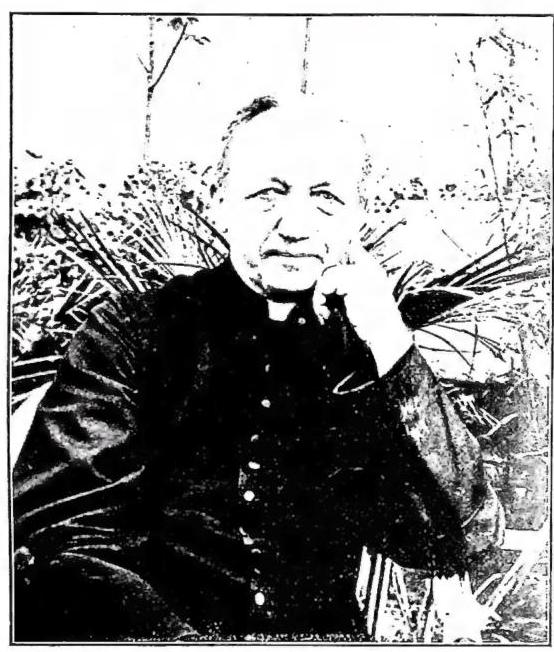
POTTER, MARY

POTTER, MARY. - Fondatrice della «Piccola Compagnia di Maria», n. a Londra il 22 nov. 1847, m. a Roma il 9 apr. 1913.

Having renounced marriage and after an attempt at cloistered life with the Religious of Mercy, responding to a clear interior voice, she founded in 1887, amid continual and serious opposition, the "Little Company," beginning her work in Nottingham in a neglected corner of the city, amid the most squalid poverty. She wished her religious to honor in a special way the maternal Heart of Mary, especially in the mystery of Calvary; and to dedicate themselves, as their field of work, to the sick, in their own nursing homes and hospitals, built next to their convents; and furthermore to pray before the Most Holy Sacrament for the dying. P., who had come to Rome in 1882 to obtain the Pope’s blessing on her work, was invited by Leo XIII to remain and found a second house in the city. Others soon opened, even outside Europe, and almost all with a hospital attached. The Institute, approved with its constitutions on May 13, 1886, received definitive approval from Leo XIII in 1893.

Besides a large number of letters, which reflect her spirituality of distinctly Montfortian stamp, P. composed various writings to urge souls to the service of Jesus through Mary: *The Path of Mary*, *The Spiritual Exercises of Mary*, *Mary Conferencas*, *Mary's Call*, *Our Lady's Retreat*, *Loves in the Heart of Mary*.

Worthy of mention is another work of P.’s: the

due to illness she had to give up teaching. Settling in Rome, she carried on a rich social apostolate as a lecturer, newspaper contributor, ecclesiastical assistant to the Catholic Labour Union (1910), founder or animator of mutual aid societies, cooperatives, and professional organizations for tramway workers, nurses, street cleaners, shop assistants, etc., and of more than ten women’s trade unions. She also held, succeeding Msgr. Radini-Tedeschi, the chair of sociology at the Leonian College (1905–15). In 1900, in Liège, she published a treatise *De iure et iustitia*, an excellent commentary on the encyclical *Rerum novarum* (1891). Head of the so-called Liège school, antithesis to the Angers school, she founded the Christian Democratic Union of Liège (1892), giving it a program of social and political demands (1893), largely realized by Belgian legislation. P. advocated family wages in 1890 and, later, profit-sharing. Around 1920, she influenced Spain through the *Grupo de la democracia cristiana*. Among her other publications are: *La coopération et les sociétés ouvrières* (Liège 1889); *L'Église et la démocratie chrétienne*, in *Les directions pontificales et la démocratie chrétienne*, by G. Goyau, G. Toniolo, A. P. (ibid. 1901); *La Questione operaia*, I (Rome 1903); *La morale catholique et les questions sociales d'aujourd'hui*, I (Charleroi 1920, II. ed. Milan 1921), II (Brussels 1921).

BIBL.: articles by C. Lolli, in *Il domani sociale* (Nov. 29, 1923); E. Vercesi, in *Il Carroccio* (Milan, Dec. 1923, pp. 749 ff.); R. E. Michetti, in *Conquista cattolica* (Dec. 2, 1923); *Homenaje a la memoria de P. por les escritores del Grupo de la Democracia cristiana*, in *Asturias Agraria* (Oviedo, Jan. 1, 1924, pp. 161–90); Studies: A. Pelzer, *Mgr. P., hommage de ses amis liégeois*, Brussels 1924 (with bibliography); G. Legrand, *Le rôle de Mgr. P. dans le mouvement social contemporain*, Paris 1934; F. Pergolesi, in *Civitas* (Milan, Feb. 1, 1925, p. 47 ff.); J. Cardolle, *Un précurseur, un pionnier social, Mgr. P.*, Brussels 1951. Augusto Pelzer