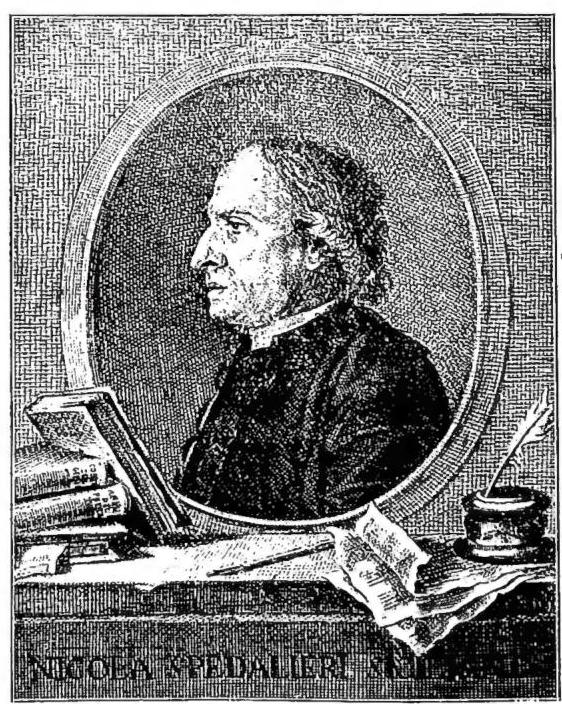
SPEDALIERI, NICOLA. — Apologist and publicist, b. at Bronte (Catania) on 6 December 1740, d. at Rome on 26 November 1795.
He completed his early studies at the Seminary of Monreale, where, after being ordained a priest, he taught philosophy, mathematics, and theology. Having moved to Rome (1773), he was admitted to the Arcadia with a free diploma and there assumed, according to the custom of that institution, the name of Melanzio Alcioneo, delivering frequent dissertations there. He also cultivated music, painting, and poetry. Pius VI made him a beneficed canon of the Vatican Basilica. He died suddenly (there was even talk of poisoning) and was buried in the demolished little church of SS. Michele e Magno, where an inscription by his friend Msgr. Nicolai commemorated him. In 1903 a large bronze statue (the work of Mario Rutelli) was erected to him in the little square of S. Andrea della Valle, at the initiative of a committee of prominent Freemasons (with his fellow countryman Cimbali as promoter), who, however, by distorting, as was later demonstrated, through ignorance, his character and thought, sought thereby to exalt an alleged revolutionary character of the «Jacobin priest», which S. never was, provoking disputes and bitter polemics that, with evident embarrassment to the unwary promoters, restored the truth. For traffic reasons, the monument was moved in 1951 to the little square of Sforza Cesarini.
S.’s fame is linked to his extensive apologetic production. In the Analisi dell'esame critico del sig. Nicola Freret sulle prove del cristianesimo (Rome 1778) he defends the truth and authenticity of the books of the New Testament; and in the Confutazione dell'esame critico del cristianesimo fatto dal sig. E. Gibbon (there 1784) he demonstrates the absurdity of rationalistic theories concerning the origin of Christianity. Some of his theses, censured at Monreale as suspected of heresy, were instead, following his appeal, approved by the Vatican Curia and published (1772) under the title Propositionum theologicarum specimen, etc. In Rome he had also begun a Historia delle Paludi Pontine, whose drainage Pius VI had initiated. The work, left unfinished by the author’s death, was subsequently printed, translated into Italian, and expanded by his friend Msgr. Nicolai.
The major work, which on its appearance provoked disagreements and polemics, especially because of the reaction of the Jansenists and the European courts, is: Dei diritti dell'uomo libri sei nei quali si dimostra che la più sicura custode dei medesimi nella società civile è la religione cristiana (Assisi 1791). The first edition, published in Rome but bearing the false date of Assisi by agreement with the Vatican itself, quickly sold out, and the fourth edition was soon reached, while almost all the European courts hastened to proscribe II. In it S., deism (v.), atheism (v.), and the so-called «natural religion», which had triumphed with the outbreak of the French Revolution, also defends Catholicism against Jansenism (v.) Freemasonry (v.), prevailing to a greater or lesser extent precisely in support of the absolutism and despotism of the reforming princes. In a clear and elegant style, the A. demonstrates that the proclamation of rights must be followed by an effective protection of them, possible only in Christian doctrine, where rights and duties are fused together in the sacred character of individual personality. The work nevertheless aroused strong opposition in many Catholic circles, which accused S., but without solid foundation, Rousseau (v.) as his model. In bk. I S. maintains that sovereignty resides in the people, who nevertheless place it in the hands of princes and rulers, who are merely its deposi-