
TAPPETO. – The fragments discovered in Turkestan (5th–6th centuries) and at al-Fusṭāt near Cairo (8th–9th centuries), with knotted construction and geometric decoration, or with confronted animals—even though their technique was already so perfected as to presuppose a long preceding tradition—have shed some light on the history of the carpet, which is poor in sources and ancient examples.
According to the prevailing view, the origin of the carpet is Eastern; in the 11th century, nomadic peoples spread its use and manufacture from Central Asia to Asia Minor, Persia, and elsewhere. The oldest centre whose production has been preserved is the Turkish one: it developed after the Selgū-
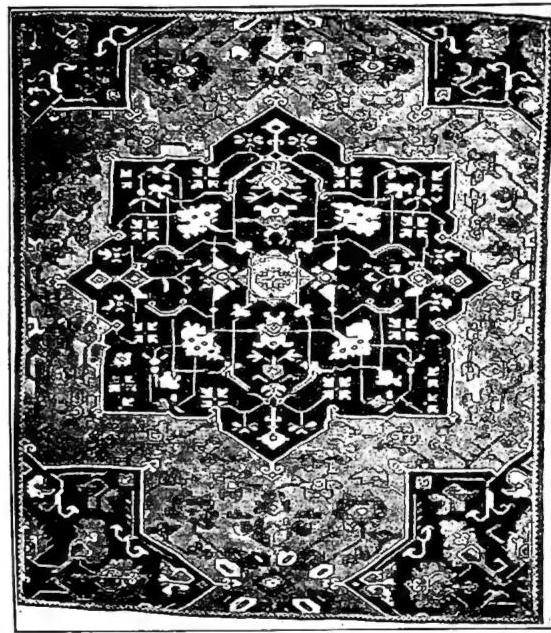
TAPPETO - Fragment of a double-medallion Ušak t., from Asia Minor (late 16th, early 17th century) - Milan, collection of Dr S. Lutomirski.
When the Selgūqid dynasty had moved from Central Asia to the Near East, a magnificent example being the t. in the Turk ve Islam Ederlei Müzesi of Constantinople, woven in the 13th century for the mosque of Conia. Another significant centre from ancient times must have been Egypt, for which, however, documentation survives only from a late period, beginning in the second half of the 15th century; a refined type of t. called “mamelucro,” also improperly called Damascene, with kaleidoscopic decoration, was widespread there (v. in Italy: Florence, Museo Bardini; Milan, Campana collection), followed later by a type with naturalistic decoration, called “Turkish court,” and another, with a checkered pattern, called “Syrian.”
Persia is undoubtedly the most notable centre; extraordinary was the flowering of the 15th century and the exquisite perfection that makes the t. a true artistic creation, closely linked to miniature painting; it acquired a courtly character under šāh 'Abbās I the Great (1587-1628), with a type of silk-and-silver t. called “Polish” (Venice, Basilica of S. Marco and Museo Correr; Florence, Museo degli Argenti). A magnificent example of a Persian t., perhaps the oldest, of the classical type with a central medallion containing hunting scenes amid interlaced stems, leaves and flowers, is in Milan at the Poldi Pezzoli, dated 1522.
The principal Persian centres are: Tabriz in northern Persia (which offers a type of t. of exceptional refinement and imagination: V. Metropolitan Museum, New York; Hatvany, Budapest; Milan, Poldi Pezzoli; Florence, Museo del Bargello), Kašān in central Persia (v. Museo of Vienna; PARADISO; Stockholm), Kismann in the southern region, and Herāt in eastern Persia. The t. of Herāt, once incorrectly called those of Ispahān, have a red ground with decoration of large palmettes and lotus flowers and sometimes animal figures, displaying particular richness and imagination (Museo of Vienna; Museo civico of Turin; Victoria and Albert Museum of London). The Persian t. exerted a strong influence on those of Anatolia, India and the Caucasus. In Asia Minor, Selgōqid production flourished first (12th-14th centuries), with geometric decoration (including the t. known as those of Holbein), followed by that with stylized animal figures, which died out in the 15th century; but the most widespread Anatolian t., the geometric one called Ušak, continued throughout the 17th century to adopt Persian elements, which it reworked with freshness and inventiveness. The prayer type, also produced at Ghiordes and Ladik, was extremely widespread; in Anatolia too, the Bergama t. flourished in the 18th century, and until the middle of the 19th century those called Smyrna. Indian models were directly inspired by Persian t. Most scholars consider the type commonly called Armenian, known as the dragon type (Museo of Berlin), long and narrow, stylized and archaic, to be of Caucasian origin.
The Chinese t. is of relatively recent origin (18th century); it influenced the Kašgar t. of eastern Turkestan at the beginning of the 19th century, while in Spain production is thought to date back to the 13th-14th centuries, the period to which the so-called synagogue t., decorated with the symbolic candelabrum, in the Museo of Berlin is assigned. The oldest types of Spanish t. (Alcaraz and Cuenca) are related to Anatolian ones, especially to those known as Holbein (Viale). Imitations of Turkish and Persian t. flourished in Paris from the 17th century onward in the Louvre and “Savonnerie” manufactories, though with ornamental motifs drawn from the West; among the most famous are the t. with the allegory of the death of Luigi XIII at the Musée des Gobelins, the magnificent series in the Louvre, and the t. for the chapel of Versailles, now in the church of S. Eustachio in Paris. - Vedi tav. CXXIII.