
ZIPS: V. SCEPUSIO.
ZIQQURATU. — Sumerian, Babylonian, and Assyrian name for the temple towers that were built in ancient Mesopotamia from the earliest, prehistoric period through the entire Babylonian period, during which they took the form of seven-stepped towers with a small temple on the uppermost platform and a staircase with several flights leading to II.
(courtesy of Prof. E. Joni)
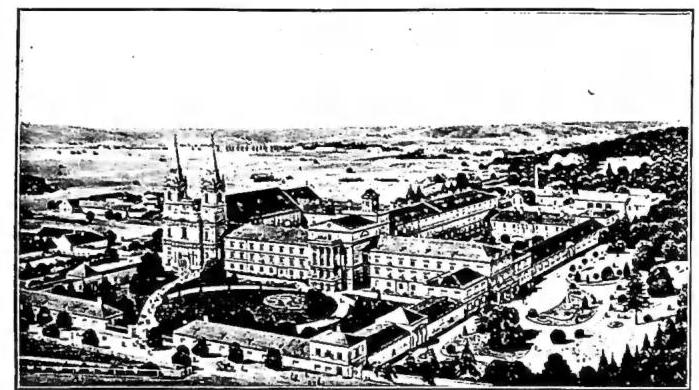
ZIRC (NOVA CLARA VALLIS) — Complex of the abbey buildings (1913).
probably that of Nebuchadnezzar at Babylon. Benjamin of Tudela and other travelers after him took the ziggurats of ‘Aqar Qûf (Dûr-Kurigalzi) or of Barsippu (Birs Nimrûd) for the Old Testament Tower of Babel.
In the ruins of the ancient Sumerian, Babylonian, and Assyrian cities, ziggurats have been discovered in great number, since there was no important temple in the land that did not have its own tower, often reconstructed and altered in its plan, height, number of steps or terraces, and in the form, direction, and length of the stairways or ramps that ascended to the summit.
Originally, in still prehistoric times, the ziggurat consisted of a high terrace or of a greater number of terraces, superimposed upon one another without a fixed number; in general, the forms of the ziggurats varied from city to city and from period to period, though not greatly, and finally the seven-stepped tower, corresponding to the number of the planets, with a small temple at the summit and an access stairway, became the typical ziggurat. Ziggurats have been discovered both in the prehistoric strata of the sub-Babylonian cities (Urû, Uruk, etc.) and in those of the Neo-Babylonian and Neo-Assyrian periods (Babylon, Barsippu, Aššûr, Kalhu, Dûr-Sarrukêni [Horsâbâd], Nineveh, etc.); the most famous was that of the temple of Marduk at Babylon, which bore the Sumerian name Etemenanki. Its dimensions are known because they were transmitted in a tablet written during the Neo-Babylonian period by a certain Anubêlsûnu.
It is not known for what purpose the ancient Mesopotamians built ziggurats, nor precisely what their religious significance was. Some scholars maintain that in the Mesopotamian plain they were imitations of the hills on whose summits the ancient Sumerians worshipped their deities in temples when they still lived on the Iranian plateau, before descending into Mesopotamia; others see in them burial places for kings, like the pyramids of Egypt; still others see them as places where the deities descended from heaven to earth, while others offer yet further interpretations of the temple towers.