Machine translation of the 1948–1954 Italian original. The original text is authoritative.
ABRAM, NICOLAS. — A humanist and Jesuit exegete from Lorraine, born at Xaronval in 1589, died at Pont-à-Mousson on 7 December 1655. He entered the Society (1606), studied in the faculties of Arts and Theology at Pont-à-Mousson, and then taught humanities there: his Epitome praeceptorum graecorum versibus latinis comprehensorum (Pont-à-Mousson 1612) went through about 50 editions up to 1645. After 8 years of active preaching (1623–30; in 1625 he collaborated with s. Pietro Fourier), he taught Sacred Scripture for 9 years at Pont-à-Mousson (after the French invasion in May 1635, expelled from Lorraine by Richelieu, he returned there only in 1643) and for 2 years at Dijon (1651–53). He left unfinished a history of the University of Pont-à-Mousson (published by Fr. Augusto Carayon, 1870).
A most learned scholar, he employed secular letters and sciences to interpret the Old Testament. In addition to commentaries on Cicero’s orations (2 vols. in folio, Paris 1631) and on Virgil (3 vols. in octavo, Pont-à-Mousson 1632–36, and many reprints), still useful today, he published: Nonni Ponopolitani paraphrasis sancti sec. Johannem Evangelii (Paris 1623), with a translation in Latin verse (therein he supplied the episode of the adulteress with its 73 Greek hexameters); in his commentary on Virgil he inserted (1636) Diatriba de quattuor fluviis et loco paradisi (which places Paradise in Palestine), as an explanation of verse 290 of Book IV of the Georgics. Ingenious is the Epitome rudimentorum linguae hebraicae (Paris 1645), in Latin verse. His principal exegetical work is the Pharus Veteris Testamenti sive sacrarum quaestionum II. XV (in folio, Paris 1648), in which, from the Hexaemeron to Daniel’s seventy weeks, he resolves in elegant dialogical form the objections raised by the natural and historical-chronological sciences. The Pharus is followed by De veritate et mendacio II. IV, likewise in dialogical form, concerning the real or apparent lies reported by the Bible. A.’s ascetical work, Axiomata vitae christianae (Pont-à-Mousson 1654), spread rapidly.
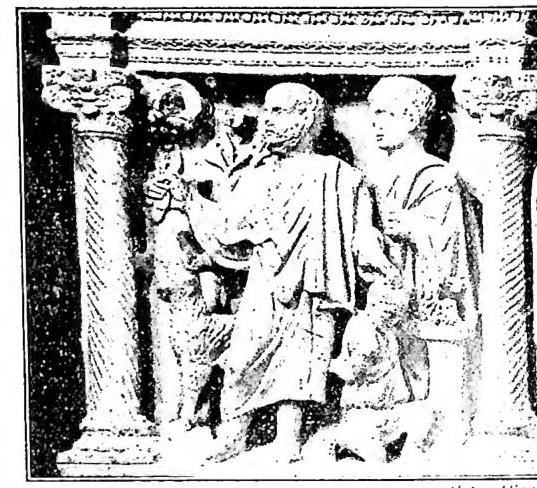
(phot. Alineri)
ABRAMO — Sacrifice of A. Detail of the sarcophagus of Giunio Basso (4th century) — Vatican Grottoes.
BIBL.: A. Carayon, L'Université de Pont-à-Mousson, Parigi 1870, Introduction, pp. XXXI-LIV; Sommervogel, I, cols. 16-21; VIII, col. 1363; Hurter, III, col. 1050 ff.; E. M. Riviere, s. V. in DHG, I, cols. 190-91. Antonino Romeo
Cite this article
“ABRAM, NICOLAS.” Enciclopedia Cattolica, vol. I (1948), p. 94. Azione Romana digital edition, https://azioneromana.com/article/abram-nicolas.