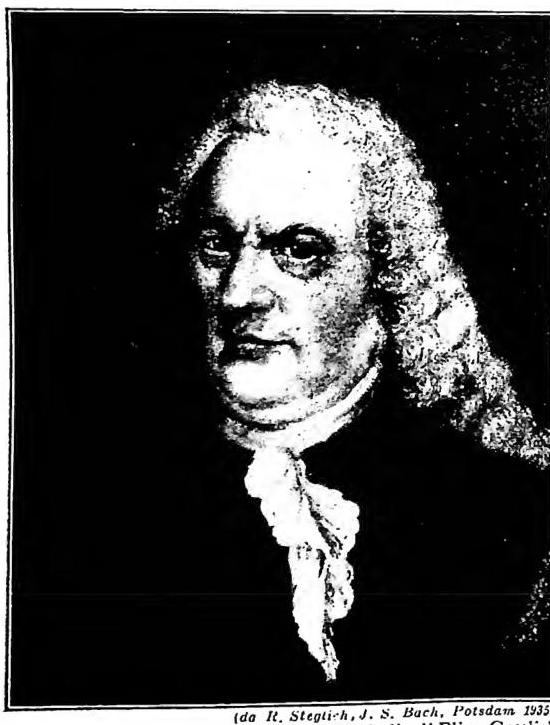
BACH. – Family of musicians, originally from Thuringia, whose progenitor was Veit (Vito), born ca. 1550 and died in 1619. The most notable among the elder members was GIOVANNI CRISTOFORO, born at Armstadt on 8 December 1642 and died on 31 March 1703, a composer of vocal music, including a Biblical History, and of organ chorales. But the most glorious member of the family was GIOVANNI SEBASTIANO, born at Eisenach on 21 March 1685 and died at Leipzig on 28 June 1750, a musician of universal renown. Having been orphaned while still a child, he was introduced to the art by his elder brother Giovanni Cristoforo, organist at Ohrdruf. In 1703 he was for a few months a court musician, as violinist, in the private chapel of Prince Giovanni Ernesto of Saxony at Weimar, and then organist in the new church at Armstadt. In 1707 he accepted the post of organist at the church of S. Biagio in Mühlhausen. Obstructed by conservative elements in his plans for the renewal of religious music, he returned the following year to Weimar as court organist and chamber musician to the duke, considerably improving his financial circumstances. In 1717 he moved to Köthen as chapel master and director of the chamber music of Prince Leopoldo of Anhalt, where, among other works, he composed the six sonatas for violin and the six concertos known as the Brandenburg Concertos, so called because they were written for Cristiano Ludovico, Margrave of Brandenburg. He left Köthen in the spring of 1723 to go to Leipzig, succeeding Kuhnau as Cantor, that is, director of the school of S. Tommaso and director of the university’s music, an office consequently inferior to the dignity of chapel master. But he was probably induced to accept this position by the need to enroll his many now-grown children at the university. His exceptional merits were not appreciated during his long, twenty-seven-year residence in this city, and his conflicts with the school rectors were at times far from insignificant. He made numerous journeys, but in general led a secluded and austere family life, devoting more time to teaching. Despite the citizens’ lack of understanding, the musician’s fame spread throughout Germany, so that he was often visited and honored by many admirers passing through Leipzig. In his final years his myopia became more severe, and after an operation performed on him in the winter of 1749–50 he lost his sight completely.
It is remarkable that a genius of such power did not achieve universal resonance among his contemporaries, who appreciated in him the performer—unparalleled as an organist and harpsichordist—rather than the composer. Having fallen into oblivion (although Mozart and Beethoven studied his works), the credit for his revival may be attributed to Mendelssohn, who in 1829 conducted the St. Matthew Passion in Berlin; from that time began the studies that culminated in the great edition of his music (1851–1900), very little of which had been published during the composer’s lifetime, and in the fundamental biography by Philipp Spitta (1873–1880).
B. is one of the artists who most profoundly expressed religious feeling, a truly fundamental element of his entire œuvre; this characteristic can also be recognized in the instrumental music, not only in the chorales, preludes, and fugues for organ, but in all those numerous compositions dominated by an austere inspiration. He is the supreme master of the fugue: from the Inventions in two and three voices through The Well-Tempered Clavier, the Musical Offering, and The Art of Fugue, his supreme mastery of contrapuntal style unfolds. The vocal compositions reveal the most varied and intense qualities of Bachian art: first to be recalled are the religious cantatas written for all the Sundays and feast days of five entire years, on texts taken from the Gospel or on sacred texts elaborated by several poets, among them Neumeister; about two hundred have come down to us, many of them masterpieces of inimitable expressive felicity. Of the five great Passions in oratorio form, only two remain, the St. John Passion (1723), predominantly mystical in character, and the St. Matthew Passion (1729), a superb dramatic conception whose extensive architecture contains grandiose tableaux and evocative episodes. Other qualities of Bachian art distinguish the Motets and the three Oratorios—of Christmas, the Ascension, and Easter. Although Protestant in confession, B. drew elements of inspiration from the Catholic rite, composing four Short Masses, the melodious Magnificat, and that great Mass in B minor (1733–34), written for the Catholic court of Dresden, which ranks among the highest religious conceptions in the art of all ages.
Several of Giovanni Sebastiano’s sons became distinguished musicians, not unworthy of their father’s name: the firstborn, GUGLIELMO FRIEDEMANN, born at Weimar on 22 November 1710 and died in Berlin on 1 July 1784, possessed a musical temperament of the first order; he was his father’s favorite, and from 1733 to 1746 was organist at the church of S. Sofia in Dresden, and until 1764 at that of S. Maria in Halle; he subsequently moved among many German cities, leading an irregular life contrary to the austere family tradition. In addition to organ and instrumental music, he composed Heilig for chorus and orchestra and a religious cantata with symphony.
The second son, CARLO FILIPPO EMANUELE, known as the Berlin or Hamburg B., was born at Weimar on 8 March 1714 and died in Hamburg on 14 December 1788. He studied at the Universities of Leipzig and Frankfurt an der Oder, where he founded a choral school; having gone to Berlin in 1738, in 1740 he became chamber harpsichordist to Frederick II; in 1767 he succeeded Telemann as director of church music in Hamburg. He was a highly prolific composer, especially skilled in improvisation and the art of thematic variation: a great deal of harpsichord, orchestral, and chamber music is preserved by him, and in the religious field no fewer than 22 Passions, two Oratorios, and numerous cantatas; as well as the celebrated theoretical work on harpsichord instruction, Versuch über die wahre Art, das Klavier zu spielen.
The fourth son, GIOVANNI CRISTOFORO FEDERICO, known as the B. of Bückeburg, was born at Leipzig on 21 June 1732 and died at Bückeburg on 26 January 1795. He first studied law, and from 1750 was a chamber musician and subsequently chapel master at Bückeburg until his death. Of the three oratorios written to texts by Herder, The Childhood of Jesus and The Resurrection of Lazarus have come down to us (both from 1773); we also have the cantata Pygmalion, motets, and instrumental music.
Finally, the youngest son, GIOVANNI CRISTOFORO,