
Enciclopedia Cattolica Vol. III, 1949 History & biography Historians, various biographies

Charles III of Bourbon, King of Spain

CARLO III DI BORBONE, RE DI SPAGNA

Italian original Cite

Charles III of Bourbon, King of the Two Sicilies and later of Spain redirects here.

Also known as: German: Karl III. von Spanien; Spanish: Carlos III de España; French: Charles III d'Espagne

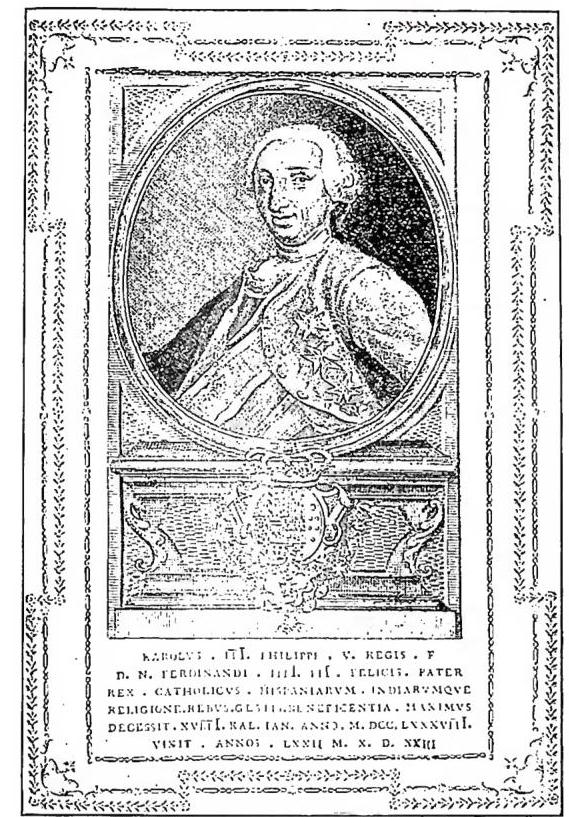
CHARLES III OF BOURBON, KING OF SPAIN. - Portrait.

CHARLES III OF BOURBON, King of Spain. - Born in Madrid on 20 January 1716, died there on 14 December 1788. Third son of Philip V of Spain and firstborn of Elizabeth Farnese, destined for a throne in Italy, he accordingly received a predominantly Italian education. According to the Treaty of The Hague (1720), the successions of Parma and Piacenza and of the grand duchy of Tuscany were to fall to him. He did in fact manage to take possession of his paternal inheritance upon the death of his uncle Antonio Farnese (1731), but before Gian Gastone de' Medici, dying in 1737, could make way for him in Tuscany, he was able to wrest from Austria by force of arms, in the name of Spain, the kingdom of the Two Sicilies (1734), which was devolved upon him by his father, and to have himself crowned in Palermo in 1735. Having renounced Parma and Piacenza (1738), he attempted to retake them in 1742, sending an army into Lombardy on behalf of his brother, as his mother Elizabeth wished; but the threat of an English bombardment of Naples (17 Aug.) forced him to recall the army. In 1744, in defiance of the neutrality of Benedict XIV, Austria sent an army against him, which was defeated by C. at Velletri; from then until 1759 C. was able to lay down his arms and devote himself to works of peace.

His government was judged variously; nevertheless, apart from his almost total subjection to Spain, at least until the death of Philip V (1746), and his partial disinterest in the cares of the State, left to ministers imbued with Enlightenment principles, not always prudent and not always Neapolitan, he was able to set the country, finally independent, on the path of reforms, toward a better order, and to link his name to works deserving of much praise, such as the great constructions (the royal palace of Caserta), the excavations of Herculaneum, the library, the National Museum, etc.

In 1759, upon the death of his brother Ferdinand, he was called to succeed him in Spain, and, having had his son Philip, born feeble-minded, declared incapable, he left on the Neapolitan throne his third son Ferdinand, practically in the hands of his friend and adviser Bernardo Tanucci. His foreign policy was anti-English and pro-Austrian. C. III saw Spanish prestige decline in the badly administered American colonies, and for a long time had Portugal as an enemy. At home, untimely reforms, foreign ministers, and financial disorder unsettled the country and stirred up dangerous riots (1766). Liberal historians are wont to praise him for his ecclesiastical policy (intervention in the affairs of the Church, suppression and expulsion of the Jesuits) and for the "family compact": in reality, however, he derived no advantages from it.

Bibliography10 works
BIBL.: A. Ferrer del Río, Historia del reinado de C. III, Madrid 1856; M. Dauvila y Collado, Documentos históricos del reinado de C. III, ivi 1903; J. Molino y Redondo de Floridablanca, Gobierno del ser. rey don C. III, ivi 1909; M. Schipa, Il regno di Napoli al tempo di C. di B., 2 voll., Napoli 1923; G. Reparaz, Reinado de C. III, Barcellona 1926; B. Sánchez Alonso, Fuentes de la Historia española e hispano-americana, I, Madrid 1927, pp. 604-16 (periodo 1759-88); G. Nuzzo, Stato e Chiesa nel tramonto del riformismo napoletano, in Arch. stor. napol., 2ª serie, 20 (1934), pp. 283-323; G. M. Monti, Per la storia dei Borboni di Napoli e dei patrioti napoletani, Trani 1939 (specie per la guerra di Velletri); T. Battaglini, L'organizzazione del regno delle due Sicilie da Carlo VII all'impresa garibaldina, Modena 1940; G. Falzone, C. III e la Sicilia, Palermo 1947.

Luigi Berra

About this entry

By Luigi Berra

How we know signed in print

Translated from the Enciclopedia Cattolica, vol. III (1949), coll. 849–850.

Printed pages Open in the page viewer
Page 505
vol. 3, coll. 849–850

More by Luigi Berra: Charles Emmanuel III of Savoy, King of Sardinia · Casati, Felice · Capilupi, Ippolito · Canossa, Ludovico di · Cavanis, Anton'Angelo and Marcantonio

Cite this article

Chicago

Berra, Luigi. “Carlo III di Borbone, re di spagna.” In Enciclopedia Cattolica, vol. III, coll. 849–850. Città del Vaticano: Ente per l’Enciclopedia Cattolica e per il Libro Cattolico, 1949. https://azioneromana.com/article/carlo-iii-di-borbone-re-di-spagna.

MLA

Berra, Luigi. “Carlo III di Borbone, re di spagna.” Enciclopedia Cattolica, vol. III, Ente per l’Enciclopedia Cattolica e per il Libro Cattolico, 1949, coll. 849–850. Azione Romana, https://azioneromana.com/article/carlo-iii-di-borbone-re-di-spagna.

BibTeX

@incollection{ec3_carlo_iii_di_borbone_re_di_spa,
  author    = {Berra, Luigi},
  title     = {Carlo III di Borbone, re di spagna},
  booktitle = {Enciclopedia Cattolica},
  volume    = {III},
  pages     = {849--850},
  note      = {Cited by column},
  publisher = {Ente per l’Enciclopedia Cattolica e per il Libro Cattolico},
  address   = {Città del Vaticano},
  year      = {1949},
  url       = {https://azioneromana.com/article/carlo-iii-di-borbone-re-di-spagna}
}

One of some 20,000 entries brought back from the twelve printed volumes (1948–54). Spotted something? Help us improve it.

Save for later

Enter your email and we will send you a sign-in link. No password. What you save (articles, verses, chapters, documents) follows you to any device.