Machine translation of the 1948–1954 Italian original. The original text is authoritative.
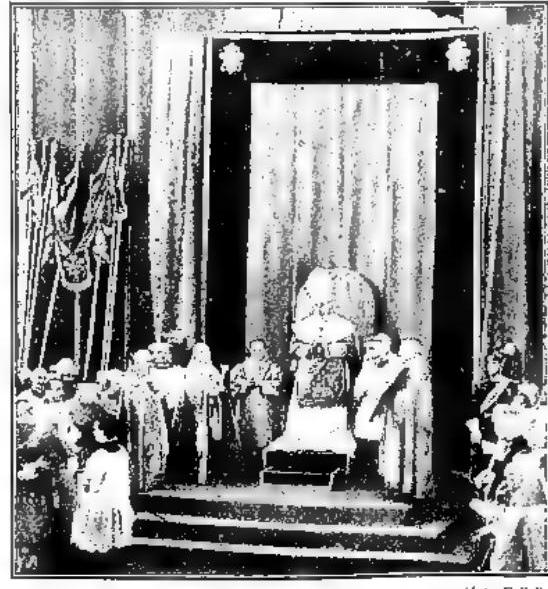
FANONE.—In its present form, it is an ornament proper only to the Supreme Pontiff, who wears it when he celebrates solemnly, after the canonical hour of terce. It consists of a double mozzetta of the finest silk and gold, woven in perpendicular stripes, one white and the other gold, joined together by a third, smaller stripe of amaranth color; a small gold braid borders its edge both above and be-
(phot. Falloi) FANONE – His Holiness Pio XII vested for the pontifical Mass. The f. is the small shoulder garment that the Pope wears over the chasuble.The outer mozzetta is also embroidered with a gold cross surrounded by rays. These two mozzettas are sewn together at the part encircling the neck, with the corresponding openings at the shoulders fastened by a button; no longer so, because Pius X had them separated for convenience. At pontifical Masses, after the Pope has taken the succinctorium and the pectoral cross, the assisting cardinal deacon places the first mozzetta of the f. on him, followed by the stole, the dalmatics, and the chasuble, and over these the second mozzetta; finally, the pallium.
It is very difficult to trace the origins of this vestment. Perhaps initially confused with the maniple, or with the amice (anabolagium), or with the oralia, a kind of handkerchiefs or napkins used to wipe the sweat from the head and therefore worn around the neck, it assumed its present form around the thirteenth century. Previously it served to cover the head like a hood, with the mitre placed over II. It was used not only in liturgical functions
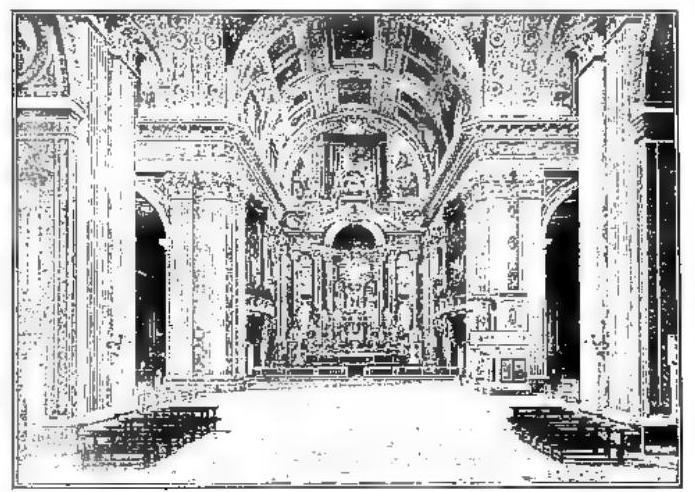
(Alinari photograph) FANSAGA, COSIMO — Interior of the church of Gesù Nuovo — Naples.liturgical functions, but also on profane occasions, such as at solemn banquets, in the distribution of the presbytery. In an old missal, whose date is unknown, from the church of S. Damiano in Assisi, it is stated that the pope places the f. on his head without the mitre for the washing of the feet on Holy Thursday; and that on Good Friday he does not use the f. Pietro Amelio, sacristan to Urban V in 1562, in his Cerinoniolo romano says that the pope ate in public with the red mantle and with the f. or orarium on his head beneath the mitre. We know that Boniface VIII wore the f. beneath the mitre and that he was buried with it; the same is said of Clement IV, who died in 1268. Innocent III (in De mysteriis Missae, i. I, chap. 13) speaks explicitly of this ornament, which he calls orarium: the practice therefore dates from the beginning of the thirteenth century. Some authors would identify the f. in the figure sculpted on the bronze door in the chapel of S. Giovanni Evangelista at the Lateran, representing Celestine III.
Various authors maintain that the practice of the Greek bishops of covering their heads with a veil, when they had donned the principal vestments, gave rise to the pope’s f.; but this is uncertain. Others, among them Innocent III himself, instead derive the f. from the ephod of the Jewish high priest, which was likewise woven with strips and gold, but was of a different form.
In ancient times this word designated a veil hanging from a staff like a flag, properly called a gonfalon, standard, or banner; or, according to ecclesiastical etymology, the veil hanging from the arm of sacred ministers, called the maniple, sudarium, or orarium.
Enrico Dante
Cite this article
“FANONE.” Enciclopedia Cattolica, vol. V (1950), p. 622. Azione Romana digital edition, https://azioneromana.com/article/fanone.