
OLINDA AND RECIFE, Archdiocese of. - In the State of Pernambuco (Brazil). It is the metropolis of the ecclesiastical province whose boundaries coincide with those of the said State and contain the suffragan dioceses of Pesqueira, Garanhuns, Nazareth and Petrolina. The archdiocese has about 14,539 sq km and a population of 990,000 inhabitants, of whom 973,842 are Catholics. It has 47 parishes with 74 diocesan priests and 142 regulars, two seminaries (at O.), 4 male religious communities and 27 female (Ann. Pont., 1951, p. 296).
At O. is the ancient Cathedral; but the archbishop and his curia reside at R.
The first explorers of the Brazilian coast did not stop at Pernambuco. In 1534, Duarte Coelho, who received the region as a hereditary fief, laid the foundation of the future city of O., which soon flourished through the talent of its owner and the fertility of the district, having in a few years become the first in the colony for the export of sugar, which is still the State's principal product. Such prosperity could not fail to attract the greed of adventurers and particularly of the Dutch, who attacked the Brazilian coast near Pernambuco, forcing the Luso-Brazilians to withdraw (1630); these, however, recovered, inflicting on the Dutch a defeat at Guararapes (1649) and finally forcing them to capitulate with the Treaty of 1661.
The ancient prelatura nullius of O., established before 1612 and then annexed to the bishopric of Bahia, was erected as a diocese suffragan of Salvador by the bull Ad sacram beati Petri of 16 Nov. 1676. In modern times, the III National Eucharistic Congress (1939) and the Catholic intellectual movement are worthy of mention.
From the territory of the ancient diocese were detached Fortaleza (1854), João Pessoa (or Paraíba, 1892) and Maceió (1900), which today head as many ecclesiastical provinces, and finally the current suffragan dioceses mentioned above, to which Carnarú must be added. By decree of the S. Congregation Consistorial, O. became a metropolitan see in 1910, obtaining its present designation with the apost. lett. Cum urbe Recife, of 26 July 1918.
Among the bishops of O. and R. are remembered Manuel Alvares da Costa (1706-15); José da Cunha de Azeredo Coutinho (1795-1802); Vital Gonçalves de Oliveira (1871-78) and the archbishop Sebastião Leme da Silva Cintra (1916-21).
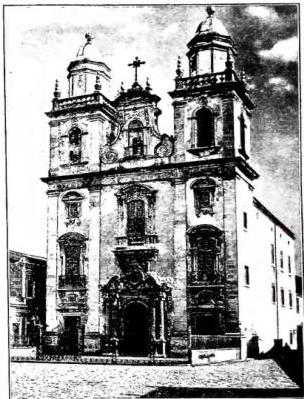
In the city of R. and its surroundings one sees not a few monuments of colonial art (v. BRASILE, III. Arte): thus the Seminary of O., the churches of S. Pedro dos Clérigos, of the Carmine, of the Third Order, etc. Also interesting are the remains of the old fortresses of the Dutch war.
Bibliography2 works
da Rocha Pombo, Historia do Brasil, Rio s. d.; AAS, 2 (1910), p. 945 and 19 (1918), p. 401; D. Leopoldo e Silva, O clero e a independencia, Rio s. d.; J. B. Lehmann, O Brasil católico, Juiz de Fora 1947, pp. 252-58.
Maurilio Cesar de Lima