
SPERANDIO di MANTOVA. - Sculptor and engraver, son of the Roman goldsmith Bartolomeo di S. Savelli, born in Mantua in 1431, died there in 1504. Having moved
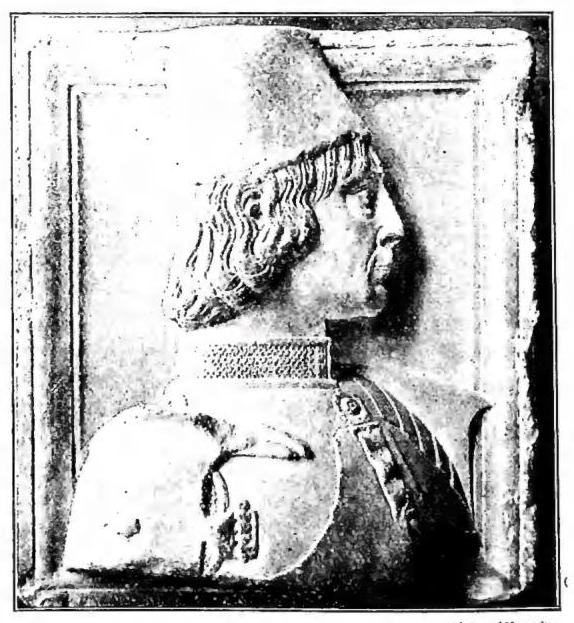
His medals are distinguished as belonging to six periods: Ferrara (1460-77), Faenza (1477-78), Bologna (1478-90), Ferrara (1490-95), Mantova (1495-96), and Venice (1496-1504). The best periods were those of Ferrara and Mantova, with the medals of the Este and Gonzaga families. As a sculptor he was particularly known for marble and terracotta bas-reliefs. Of these, one depicting Ercole d'Este is in Ferrara and two of the same subject, one in terracotta and one in marble, are in the Louvre. The beautiful terracotta-modelled tomb of Alexander V in S. Francesco in Bologna, dating from 1482, is extant. There are also painted terracottas by him in Berlin and in London, at the Victoria and Albert Museum, where there is a portrait and a bas-relief with the image of Eleonora d'Este. Typical is the plaquette with the Deposition of Christ, of which multiple examples exist in Paris, and a plaquette with the Resurrection, now in Berlin. To his activity as an architect must be assigned the model for the reconstruction of the bell tower of S. Petronio in Bologna.