
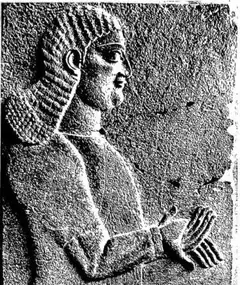
THEGLATHPHALASAR III. - King of Assyria from 745 to 727 B.C. (Assyrian Tuhulti-apil-Ešarra "My trust is the heir son of Ešarra," or the warrior god Ninurta, whose father is Enlil [v.] under the name Ešarra; Hebrew Tiglath-Pileser [2 Kings 16:7] or Tilgath-Pilneser [1 Chron. 5:6; 2 Chron. 28:20] or Tilgath-Pilneser [1 Chron. 5:26]). The true founder of the Neo-Assyrian Empire, he "might be considered the most remarkable figure in Assyrian history" (S. Smith).
Cuneiform inscriptions concerning him are relatively scarce (versions: Luckenbill, Oppenheim), so that many particulars of his ingenious work remain unknown. He ascended the throne on the 13th of 'ijār, 745 B.C., on the occasion of the revolts of Kalah. He inherited from his predecessors "a long series of disasters" and the internal weakness of Assyria. In the northeast and northwest the hegemony of Urartu had established itself; Sarduris II was recognized as "king of Syria" by the vassals; Aramean and Chaldean tribes were infiltrating the south and Babylonia. Assyria was threatened with ruin; in the cities the revolts of a population that was to a notable extent unemployed followed one another. T., a brilliant politician, administrator and also military leader, in 745 quelled the internal uprisings. He made a lightning expedition as far as the "Sea Land" (on the Persian Gulf), punishing and partly deporting the Aramean and Chaldean tribes; returning as "king of Sumer and Akkad," he secured the loyalty of Nabonassar, king of Babylon (748-734). Having thus secured the south, he tenaciously and systematically eroded the overweening power of Urartu. In 744 he made an expedition into the northeast, where he founded an Assyrian province in Media (v.); a column even reached the Caspian; he gave thought to providing himself especially with good war horses. In another expedition in the west (743-740), Mati'ilu of Agusi, who was fortified in Arpad, was surrounded (743); Sarduris hastened to his aid with a great army and many allied vassals; all were defeated by T. in the region of Kummuh (the Commagene of the classical writers), which forced the kings of Damascus, Tyre, Kummuh, Què (Cilicia), Gurgum and Carchemish to pay tribute. Arpad, besieged, fell in 740, and the city, the king, the people, and the gods were severely punished, so that later the Rabshakeh (v.) of Sennacherib (v.) used this example to inspire terror (Is. 36, 19). In 739 T. prepared the blow against Urartu; he took the regions of Ullubu and of Kirþi into direct Assyrian administration. In 738 he had to deal with Azri'āu, usurper of the kingdom of Ja'udi or Šam'al, who headed a coalition of 19 other rebellious cities in Syria and Phoenicia. It is debated whether this Azri'āu is identical with Azariah (or Uzziah [v.]) king of Judah; it is, however, more probable that they are distinct. Azri'āu was defeated and Panamu II, faithful servant of T., who "ran (close) to the wheel of his lord's chariot... among great kings" (inscription of Bar-Rekub, cf. B. Landsberger, Šam'al, Ankara 1948, pp. 68-72) re-entered possession of Šam'al. Then also Rasin (or Rezin [v.]) of Damascus and Menahem (v.) of Samaria sent tribute, as did also Zabibija, queen of Arabia. In 737 T. made another incursion into Media to procure horses, and pushed as far as the region of Teheran and to Demavend ("mountain of lapis lazuli"). There followed in 735 the march toward the capital of Urartu. Sarduris was defeated at the gates of Turušpaš (or Tušpaš), on Lake Van; but T. had no definitive success: the rocks on which the city was built were impassable for the siege engines, and the defenders were supplied with food by water.
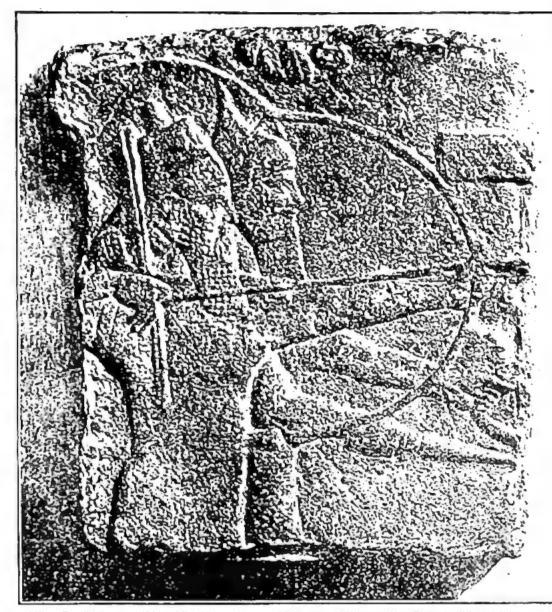 TIGLATH-PILESER III. - Fragment of a relief from Nimrud: T. grasps the bow in combat." loading="lazy" />
The hard blow dealt to Urartu allowed T. to turn his attention to the southwest: in 734 he marched on Gaza; he took Gezer (reliefs), after which Hanno of Gaza fled to Egypt. By occupying the region, he isolated the Palestinian and Syrian powers from Egyptian aid. He then took advantage of the situation reflected in Is. 7 and of the call for help from Ahaz (v.) king of Judah referred to in II Kings 16:7: Rezin of Damascus and Pekah (v.), or Pekaḥ of Israel, had pressed him hard by besieging Jerusalem, to force him to join their coalition. The Assyrian king did not delay in invading Samaria, conquering a great number of cities (II Kings 15:27-30). Then he rebelled
Hoshea (v.) rebelled against Pekah, who fled alone, but afterward returned to Samaria, where he was murdered by Hoshea. Hoshea was confirmed as king by T., but Galilee, the plain of Esdraelon, and Gilead were taken from the Kingdom of Israel, to form the Assyrian provinces of Mogidu (Megiddo) and Gal'aza (Gilead). With incredible devastation of the neighboring region, the fate of Rezin and of Damascus, taken by T., was accomplished the following year (732): it was the end of the independence of the Arameans. The impression was such that at the news Mitinti of Ashkelon went mad and his son hastened to submit as a vassal. While T. held court in conquered Damascus, the envoys of Tyre and of Samsi, queen of the Arabs, arrived, after she had suffered an incursion. Ahaz (Jauhazi) too, full of zeal for his master and lord, brought him so many tributes that he had to melt down the last metal ornaments of the furniture of the temple and of the palace; he even opened Judah to the religious influence of Assyria, as the affair of the altar shows (II Kings 16).
In Babylonia, however, a confused situation was developing after the death of Nabonassar (734). His son Nabû-nâdin-zêr was killed in 732, the 2nd year of his reign, by the rebel Nabû-šum-ukin (reigning in 731), who in turn was removed (730) by Marduk-mukin-zêr (Assyrian Ukîn-zêr) chief of the Bît-Amukkani, a Chaldean tribe. T. hastened in 729 and besieged Ukîn-zêr at Sapia, his strongly fortified capital, which it is not known whether he succeeded in taking. But before its gates he received the submission of the Bît-Dakkuri and of Merodach-Baladan (v.). At the new year in Babylon he led Bêl in procession, becoming by this rite king of that city under the name of Phul (v.).
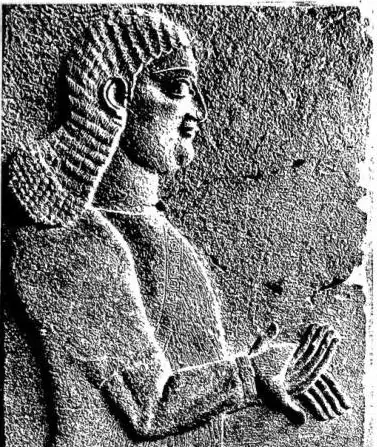
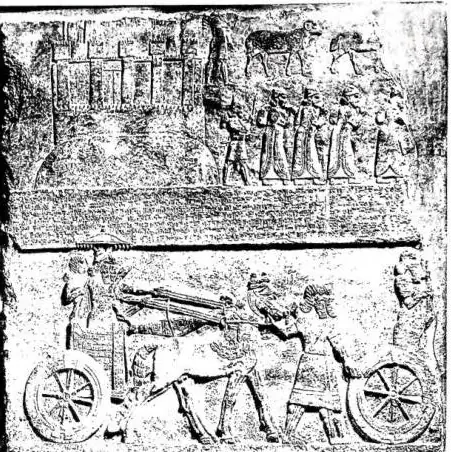
T., in many respects, was an innovator and reformer. He prepared his enterprises by systematic method. He improved the armament of his troops, making it lighter and more practical; he took special care with the technique of "chariots." The art of reliefs from his time onward shows a greater "realism" and more indications of landscape. To unify his empire, he systematically transferred a large part of the population of the subjected countries; he was not, however, the first to use such a method, which did not seem as strange in the Ancient East as it seems to us (S. Smith): it had the purpose of giving occupation to the population and of reclaiming the land, besides that of amalgamating the various peoples. T.'s administration, harsh in punishing but prudent in works of peace, brought about the revival of industry and agriculture, and cared for the fate of the transferred populations. The peoples were transferred, as far as possible, to countries of similar language, e.g., the Arameans of Damascus to the Arameans east of the Tigris. Desert regions were reclaimed by irrigation, which allowed a certain well-being for the transferred peoples. Commerce and industry also flourished in the cities of Assyria, and among the various regions with one another. It does not seem that patriotism suffered much from this: the capture of Nineveh in 612 did not come about through betrayals by that loosely organized population, which, with the exception of Babylonia which made itself independent, fought to the last man. - See pl. II.
Bibliography15 works
Pietro Nober