
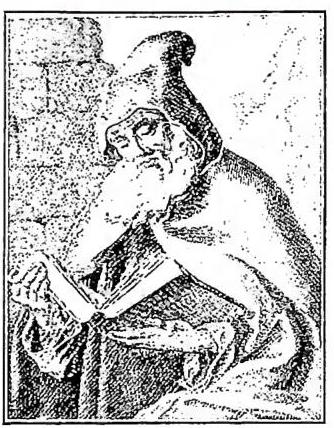
MATTHEW OF BASCIO. - B. at Bascio (Carpegna), diocese of Montefeltro, around 1495, d. at Venice on 5 Aug. 1552. He entered the Observant Friars Minor. When he was ordained a priest (1520), the longing to conform as faithfully as possible to St. Francis left him no peace. In Jan. 1525 he fled from the convent of Montefalcone Appennino in order to go to Rome and implore from Clement VII the favor of being able to imitate the Saint perfectly in his manner of dress, in the most exalted poverty and in evangelical preaching. For himself and for a companion, M. da B. obtained from Clement VII the privilege of wearing a rough and tight habit, with a pointed hood sewn to the habit, of preaching everywhere and of observing the Rule to the letter, on condition of presenting himself each year to his provincial minister. Giovanni da Fano, who was then governing the province of the Marches, availing himself of a rescript issued shortly before by the Pope against wandering friars, had him imprisoned in the convent of Forano. Freed through the energetic intervention of Caterina Cibo, duchess of Camerino, from the end of July 1525 until his death, M. da B. was able to lead undisturbed his wandering life as a penitential preacher, first in the nascent family of the Capuchins, then under the obedience of the minister general of the Observants, to whom he nominally returned around 1530.
The concession obtained by M. da B., purely personal, was the starting point of other initiatives that gave rise to the canonical institution of the new Franciscan family of the Capuchins. Worthy of note is the contribution of M. da B. to the religious renewal that began at that time in Italy, to the Catholic Reformation. He preached with great success. He several times assisted the plague-stricken, at Camerino and at Rome. In 1546 he accompanied to Germany the pontifical troops that Paul III was sending to the aid of Charles V in his struggle against the Lutheran princes of the Schmalkaldic League: at the battle of Mühlberg (1547), M. with the cross in his hand animated the Catholic soldiers until complete victory.
From the clergy and the people unanimously he received the cult of blessed until the decrees on the public cult of the servants of God issued under Urban VIII (1625-1634).
Bibliography8 works
Fredegando Callacy