
Enciclopedia Cattolica Vol. III, 1949 Art & architecture Artists

Brueghel

Italian original Cite

Brueghel redirects here.

Also known as: Brueghel family, Pieter Bruegel the Elder, Bruegel, Pieter Brueghel the Elder; Italian: Pieter Bruegel il Vecchio, Pieter Brueghel il Vecchio

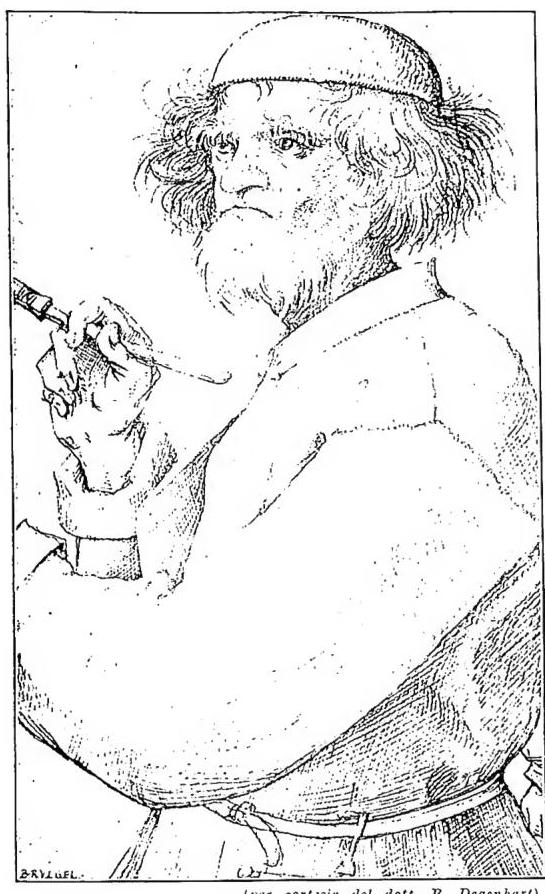
BRUSCHEL - Self-portrait of P. B. the Elder.

BRUEGHEL. - A family of Flemish painters, whose progenitor is Pieter the Elder, who had two sons, Pieter the Younger (called "of the Hells") and Jan the Elder (called "of the Velvets"); the latter was the father of Jan the Younger, from whom descended Jan Pieter, Abraham (called "the Neapolitan"), Philips, Ferdinand, and Jan Baptist.

PIETER THE ELDER, b. perhaps at Breda around 1525, d. at Brussels on 5 September 1569. A pupil of Pieter Coeck van Aelst, he absorbed the influence of the works of Hieronymus Bosch (v.); he became a master in 1551 and was active especially at Antwerp and, from 1563, at Brussels; he was in Rome in 1553.

He exercised the liveliest influence on Flemish art, whose best-known expressions, the so-called "genre" painting, depend essentially on his works, widely disseminated by the engravings that spread his fame. Among his paintings of religious subject the Adorations of the Magi in Brussels and London are especially notable; but his fame is chiefly entrusted to the series of the Months in the Vienna gallery and to the works in which his exceptional imagination manifests itself most freely, as in the landscapes (among them the Alpine ones, which document his journey to Italy) and in the popular scenes. The picture gallery of Naples preserves the allegory of the Blind, the Doria gallery in Rome the Port of Naples.

PIETER THE YOUNGER (b. at Brussels in 1564, d. at Antwerp in 1638) and JAN THE ELDER (b. at Brussels in 1568, d. at Antwerp in 1625), his sons, imitate and continue the style and compositions of their father, often preferring rather small formats both for paintings of religious subject (the "infernal" ones are very well known) and for representations of landscapes, flowers or peasant life. Pieter was a pupil of Gillis van Coninxloo. Jan, who was also a collaborator of Rubens, made a journey to Italy, staying in Rome from 1592 to 1594 and stopping in Milan in 1596.

JAN THE YOUNGER (b. in 1601, d. in 1678), son of Jan the Elder, still continues his father's manner, in ever more minute formats, and paints preferably still lifes (especially flowers), landscapes with animals, etc. The creative force of both weakens more and more, the works increasingly taking on a popularizing character and a monotonous imitation of their predecessors.

JAN PIETER (b. in 1628?), ABRAHAM (b. in 1631, d. around 1690) and JAN BAPTIST (b. in 1647, d. in 1719), working for a great part of their lives in Italy, continue to paint in the family tradition without adding new elements of importance. - See Pl. XI.
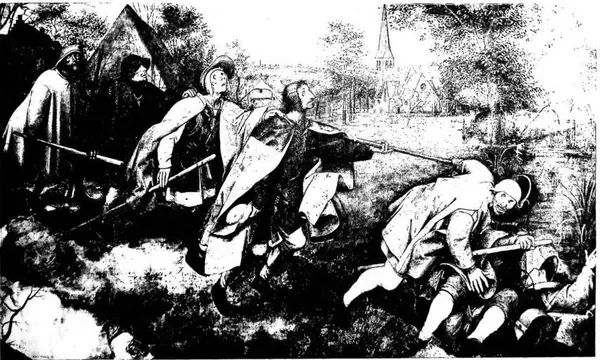
THE STORY OF THE SEVEN BLIND MEN - Naples, National Museum.
Plate XI THE STORY OF THE SEVEN BLIND MEN - Naples, National Museum.(fol. Altieri)
Bibliography15 works
BIBL.: M. Rooses, Geschichte der Malerschule Antwerpens, Munich 1889, passim; R. van Bastelaer and Hulin de Loo, P. B. l'ancien, Brussels 1905-1907; R. v. Bastelaer, Les estampes de P. B., ibid. 1908; W. Rolfs, Geschichte der Malerei Neapels, Leipzig 1910, passim; M. I. Friedländer, P. B., Berlin 1921; G. J. Hoogewerff, "Nature morte" italiane del Scicero, in Dedalo, 6 (1923-24), p. 710 ff.; K. Tolnai, Die Zeichnungen P. B., Munich 1925; M. Vaes, Le Journal de J. B., II, in Bulletin de l'Institut historique belge de Rome, 6 (1926), p. 163; F. Lugt, P. B. und Italien, in Festschrift für M. I. Friedländer, Leipzig 1927, pp. 111-20; G. Glueck, P. B., Vienna 1932; Ch. Tolnay, P. B., Brussels 1935; M. I. Friedländer, Die Altniederländische Malerei, XIV, Leiden 1937; G. Jedlicka, P. B., Zurich-Leipzig 1938; W. Hausenstein, B., Bergamo 1942; W. Cohen (and others), s. v. in Thieme-Becker, V, pp. 97-103.

Bernardo Degenhart

About this entry

By Bernardo Degenhart

How we know signed in print

Translated from the Enciclopedia Cattolica, vol. III (1949), coll. 131–132.

Printed pages Open in the page viewer
Page 100
vol. 3, coll. 131–132

More by Bernardo Degenhart: Broederlam, Melchior · Breu, Jörg, the Elder · Burgkmair, Hans · Chartres, Diocese of · Cleves

Cite this article

Chicago

Degenhart, Bernardo. “Brueghel.” In Enciclopedia Cattolica, vol. III, coll. 131–132. Città del Vaticano: Ente per l’Enciclopedia Cattolica e per il Libro Cattolico, 1949. https://azioneromana.com/article/brueghel.

MLA

Degenhart, Bernardo. “Brueghel.” Enciclopedia Cattolica, vol. III, Ente per l’Enciclopedia Cattolica e per il Libro Cattolico, 1949, coll. 131–132. Azione Romana, https://azioneromana.com/article/brueghel.

BibTeX

@incollection{ec3_brueghel,
  author    = {Degenhart, Bernardo},
  title     = {Brueghel},
  booktitle = {Enciclopedia Cattolica},
  volume    = {III},
  pages     = {131--132},
  note      = {Cited by column},
  publisher = {Ente per l’Enciclopedia Cattolica e per il Libro Cattolico},
  address   = {Città del Vaticano},
  year      = {1949},
  url       = {https://azioneromana.com/article/brueghel}
}

One of some 20,000 entries brought back from the twelve printed volumes (1948–54). Spotted something? Help us improve it.

Save for later

Enter your email and we will send you a sign-in link. No password. What you save (articles, verses, chapters, documents) follows you to any device.