
DISEGNO. — It may be defined, in brief, as the graphic necessity of an artist, manifested both on sheets of paper (that is, in the technique proper to it) and in any work of figurative art (in which it may appear as an interest or intention of the artist, more or less pronounced).
With regard to antiquity, Pliny has handed down to us a definition of the drawing line, referring to the art of Parrhasius (Nat. hist., XXXV, 67–69), in which he attributes expressive, that is, subjective, value to the concept of d., whereas in the Quattrocento it assumes the geometrical meaning of the outline or circumscription of the object (L. B. Alberti, Piero della Francesca). But there is a second interpretation of the concept of d., typically Florentine, which goes back to Cennino Cennini (late fourteenth century), in which d. is regarded as the foundation of the arts (called precisely “arts of d.”). This idea was developed during the sixteenth century (Vasari, Armenino, etc.) up to Federico Zuccari (1607), who makes a dualistic distinction between “internal d.” (the inner and conceptual image of the form) and “external d.” (the outward and perceptible image). While this distinction acknowledges the implicit foundation in drawing underlying individual works of art, it then subordinates the value of d. to the technical superiority of the finished work (painting, sculpture, building).
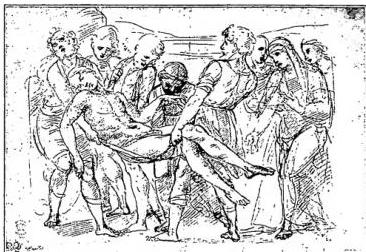
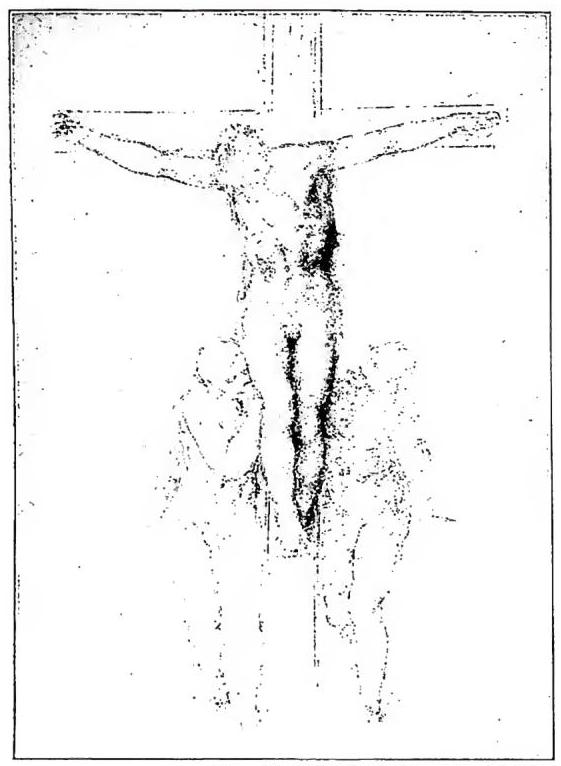
(phot. National Institute of Architecture and Art History) DISEGNO – Drawing by Michelangelo for a Crucifixion (ca. 1550) – London, British Museum, Department of Drawings.
Drawings have come down to us executed on parchment or paper, in pen, silverpoint, pencil, charcoal, or red chalk (not before the sixteenth century); with highlights in white lead, chalk, etc. Ancient medieval miniatures, on parchment and consisting only of outlines without color, could, strictly speaking, be defined as genuine drawings. In reality, the distinction between drawing and miniature becomes clear only in the fourteenth century. Among the major draftsmen from the fourteenth to the eighteenth century, the following should be remembered: Taddeo Gaddi, Lorenzo Monaco, Beato Angelico, Lorenzo di Credi, Botticelli, Filippino Lippi, Andrea Mantegna, Giovanni Bellini, Alberto Dürer, Leonardo, Raffaello, Michelangelo, Andrea del Sarto, Pontormo, Guercino, Rembrandt, G. B. Tiepolo, Francesco Guardi. – Vedi tav. C.