
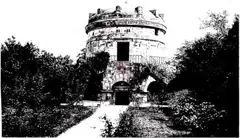
THEODORIC THE GREAT, King of the Ostrogoths. - Son of Theodemir, of the ruling Amal dynasty, b. ca. 454. His father, chief of the Ostrogoths as foederati within the borders of the Empire in Pannonia and Noricum, had to send him while still a boy as a hostage to the court of Byzantium, where he remained for ten years. At the age of twenty, on his father's death, he was designated to succeed him, and was recognized by the people as chief.
Interpreting in his own way his duties as a federate, he now helped, now blackmailed the imperial government, always managing, even when he devastated some province of it, to advance his own position. The support he gave to the emperor Zeno against the usurper Basiliscus earned him the title of patrician, the honor of the consulate (year 484) and the office of magister utriusque militiae. After this he succeeded in having the weak Zeno assign him the task of restoring Italy, occupied by Odoacer, to a more direct dependence on the Empire, while at the same time preparing new seats in better lands for his Goths. Besides, Zeno must have been pleased by the idea, if not of recovering Italy, at least of keeping the turbulent magister somewhat at a distance. The expedition did not have a merely military character, but rather that, not new, of a migration of masses, which behind the soldiers brought along throngs of non-combatants, women, old men, children. The resistance of Odoacer was not fortunate, and in two successive encounters on the Isonzo and near Verona he was defeated. Odoacer had shut himself up in Ravenna, but then fortunes seemed to change, and T. found himself in serious difficulties near Pavia, until bands of Visigoths from Gaul came to his aid. He resumed the offensive, and after winning a new victory on the Adda, he undertook the siege of Ravenna, which lasted almost three years, during which T. had the opportunity to complete the conquest of the whole peninsula. Finally, through the mediation of the bishop of Ravenna, peace was reached, by which Odoacer and T. were to divide the government of Italy, nominally reconnected to the Empire of Byzantium. But a few days later, during a banquet, Odoacer was had killed by T., and with him many of his men. It was proclaimed that Odoacer was plotting treachery, and T., confirmed as king by his Goths, acted as sovereign over the Goths and the Romans. For this reason he was for some years in conflict with the court of Byzantium, which, powerless, ended by yielding, sending back to T. those imperial insignia which the Roman Senate, acquiescing in the deposition of Romulus Augustulus, had returned to Constantinople. In some way, however, a moral supremacy of the Empire of Byzantium was still recognized.
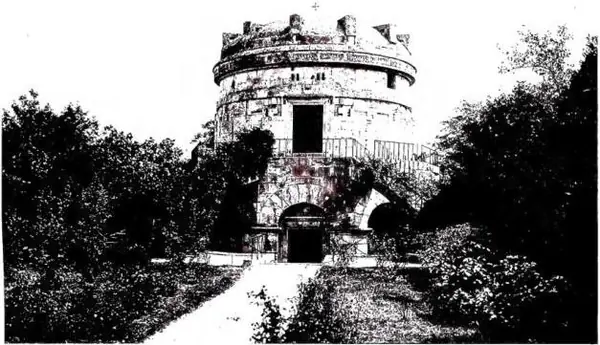
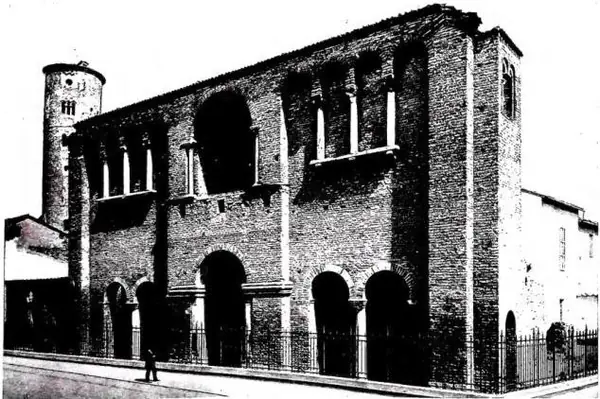
The government of T. was at first moderate and wise; the distribution to his Goths of a third of the Italian lands could perhaps be carried out without too many difficulties, given the depopulation of the peninsula and the fact that advantage could be taken of the lands that had already belonged to Odoacer and his men. For the rest, T. preserved the ancient Roman institutions, giving the Italians the civil magistracies, and entrusting to the Goths the arms and the military commands. He strove greatly so that no discords or intolerances might arise between the two peoples, he sought to favor the agricultural recovery to which the preceding events had done so much damage, he showed that he held Roman culture in high esteem, and he wished to have near him its most illustrious representatives: Cassiodorus, Boethius, the bishop of Pavia Ennodius. He devoted great care to the preservation of monumental buildings, especially in Rome and Ravenna, where he also erected new ones.
T. generally succeeded in preserving peace with the sovereigns of the barbarian states of the West, over whom he could even obtain a certain recognition of primacy, both through the prestige of Roman patrician and general of the Empire, and by concluding marriages with several of them. He secured the borders of Italy, annexing to it Istria, Raetia, and Noricum without awaiting the Emperor's approval, for which there were Byzantine reactions, taking concrete form in vain raids by imperial fleets on the Adriatic coasts of Italy. More important was T.'s intervention in the struggle between his brother-in-law Clovis, king of the Franks, and his son-in-law Alaric II, king of the Visigoths. When the latter was defeated and killed in 507, T. sent an army that defeated the Franks near Arles. The consequence of the victory was the annexation of Provence to Italy and, shortly afterward, the assumption of the government of the Visigothic part of Spain, as guardian of the son of Alaric II. The authority of T. thus came to extend from Illyricum to the Atlantic. Even in religious questions T. showed tact and equanimity. An Arian and king of an Arian people, he respected the religion of the Italians, and preserved the privileges of the Catholic Church.
But despite this it was almost impossible for a barbarian sovereign to win entirely the devotion and loyalty of the Italians, and impossible always to satisfy the greed of his Goths. These failures, as well as growing old without an heir, embittered the King. He became suspicious, irascible, unjust, while on the throne of Constantinople a harsh Macedonian soldier, Justin, succeeded weak sovereigns, and he immediately kept his nephew Justinian very close to him. A fervent orthodox, Justin exerted pressure on the heretics of his Empire and especially on the Arians. T. wished Pope John I to go to Constantinople to dissuade the Emperor from the anti-Arian persecution. The embassy naturally did not succeed and, on his return, the Pope was thrown into prison, where he died. Boethius and his father-in-law Symmachus were also victims of these troubled relations. Dying, T. recommended to his Goths that they recognize as their king the young Athalaric, son of his daughter Amalasuntha, that they observe the laws, respect the emperor, and live in good accord with the senate and the Roman people. - See plate CXXXVIII.
Bibliography7 works
Roberto Paribeni