
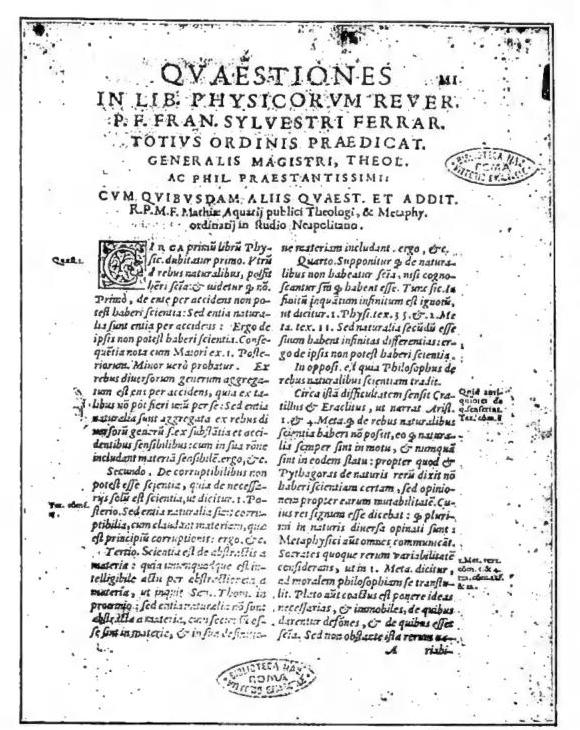
SILVESTRI, Francesco, known as Il Ferrarese (Ferrariensis). - Dominican theologian and philosopher, b. at Ferrara in 1474, d. at Rennes on 19 Sept. 1528. At the age of 14 he entered religious life in his native city. After completing his studies he taught at Mantua (where he was the spiritual director of the bl. Osanna Andreassi), at Milan and at Bologna. By 1516 he was already a master in theology, and in 1518 vicar of the Lombard congregation.
A few years later, while he was prior, regent of studies and inquisitor at Bologna, he was appointed by Clement VII vicar general of his Order (1524), and the following year he was unanimously elected master general in Rome. Having immediately devoted himself with great zeal to the government of the Order and to the visitation of the convents, he died three years later of an illness contracted in a river accident.
Principal work: In libros s. Thomae Aquinatis contra Gentes commentaria. It was already finished in 1517, but it was not printed at once. In 1518 card. Gaetano, passing through Bologna, saw the commentary, praised it most highly and earnestly urged his confreres to publish it (1st ed., Venice 1524 [not Paris 1552, as is stated in DThC, XIV, col. 2087]); among the early editions, the principal one is the Pian edition, made by order of St. Pius V (Opera omnia s. Thomae Aq., Rome 1570-71, I); among the modern ones those edited by G. Sestili (4 vols., ibid. 1897-1901; but above all the so-called Leonine edition, made by order of Leo XIII [Opera omnia s. Thomae Aq., XIII-XV, ibid. 1918-26-30]).
He wrote other works, predominantly philosophical: Annotationes in libros Posteriorum Aristotelis et s. Thomae (Venice 1535); Quaestionum libri de anima quam subtilissimae et praeclarissimae decisiones (Venice 1535); Apologia de convenientia institutorum Romanae Ecclesiae cum evangelica libertate, tractatus adversus Lutherum (Rome 1525; 2nd ed. Rome 1900, edited by G. Sestili).
Michele Piò relates that the S. had also undertaken a commentary on the Summa Theologica but desisted from it when he learned of Gaetano's. And this was a loss, because the Ferrarese, although inferior to Gaetano in speculative power, nonetheless remains an acute, intelligent Thomist, with broad views, but also an independent one, so much so that he often openly dissents from his illustrious confrere (for example, on the nature of the intellect, of analogy, of individual signation, of the possibility of several angels of the same species).
The Ferrarese also bears a note of personality on other, less important questions, as, for example, on the natural desire for beatitude, on how the relations in divinis are distinguished from the essence, and on what sense should be given to the Aquinate's statement that Relatio (in divinis) non constituit personam in quantum est relatio.
All these particulars reveal in the S. an exquisite scientific sensibility and a great love of objective truth. Posterity has assigned him the second place in the noble company of commentators on St. Thomas; a place he holds with great honor especially for his fidelity to the master, his sound understanding of the doctrines, the perspicuity of his exposition and the correct historical-critical method of his research.
Bibliography8 works
Umberto Degl'Innocenti