Machine translation of the 1948–1954 Italian original. The original text is authoritative.
FERRI, CIRO. – Painter, born in Rome in 1634, where he died on 13 September 1689. He was a pupil and collaborator of Pietro Berrettini da Cortona. Under his master’s direction, in the gallery of the Quirinal Palace during the pontificate of Alessandro VII, he executed two frescoes representing the Annunciation and a History of Cyrus.
In 1659 he was invited to complete in the Palazzo Pitti the decoration left unfinished by Cortona: there he finished
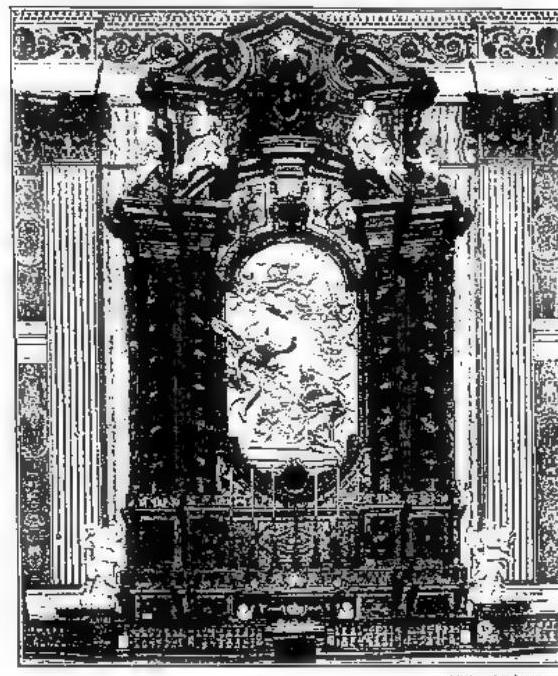
FERRI, CIRO - Altar of the Annunziata - Rome, church of S. Ignazio.he completed the Hall of Apollo (1660) and painted the Hall of Saturn (1663–64). In Florence, where he remained until 1665, his principal surviving work is the painting on the high altar of S. Maria Maddalena dei Pazzi, representing the church’s patron saint in glory with the Virgin. He then went to Bergamo, where he remained until 1667, frescoing the right nave of S. Maria Maggiore. In 1669 he returned to Rome, where he completed various works left unfinished by Cortona, including the frescoes of the dome of the Gavotti Chapel in S. Niccolò da Tolentino. His last work in Rome was the decoration of the dome of S. Agnese in Piazza Navona, which remained unfinished at his death and was completed by his pupil P. Corbellini. In Rome he executed other paintings in S. Marco, S. Andrea al Quirinale, S. Prassede, etc. For the cathedral of Monte Perzio he painted S. Antonio and the Child Jesus, and for S. Maria della Scala in Siena, S. Teresa and S. Agostino. He made the design for the ciborium of the high altar of the Chiesa Nuova, as well as that for completing the high altar of S. Giovanni de' Fiorentini, begun by Borromini.
In the field of secular painting, in addition to the works mentioned in the Palazzo Fitti, he frescoed in the Villa Falconieri at Frascati allegories of Spring, Autumn, and Winter, which are perhaps his masterpieces. He also worked on book frontispieces, coats of arms, devices, etc.
F. was also a sculptor; the guide to Rome by Titi (1763) already cited as executed from his designs two silver statues in the church of S. Lorenzo in Damaso, representing ss. Lorenzo and Damaso; some years ago four of his statues were identified in the sacristy of the Roman church of the Gesù, representing S. Francesco Saverio, S. Teresa da Lima, S. Filippo Neri, and S. Isidoro Agricola. In these sculptures the same forms as in the paintings are found, translated into plastic terms. In his major works F. was never able to free himself from Cortona’s influence; his lesser decorative works, however, are more personal.
BIBL.: L. Pascoli, Vite ecc., I, Roma 1730, pp. 171–79; G. Galassi Paluzzi, Quattro statue di C. F., in La canonizzazione dei ss. Ignazio da Lojola e Francesco Saverio, there 1922 (v. indice); H. Voss, Die Malerei des Barock in Rom, Berlino n.d., pp. 55–56; V. Galzio, Pittori e scultori nella chiesa di S. Agnese in Piazza Navona in Roma, in Archivi, 3 (1933–34), pp. 300–301. Vincenzo Galzio
Cite this article
“FERRI, CIRO.” Enciclopedia Cattolica, vol. V (1950), p. 723. Azione Romana digital edition, https://azioneromana.com/article/ferri-ciro.