
GERMANI, RELIGION of the. - On the religious beliefs of the ancient Germanic peoples prior to their contact with the Roman world—that is, until the systematic conquest by Augustus—there exists virtually no reliable information of any significance. Extremely scarce are also the firsthand accounts from the subsequent period, which extends until their conversion to Christianity, since only with this, as is well known, did the use of writing for literary purposes begin among those peoples, effectively ending their prehistory.
The fact that this conversion did not occur simultaneously among the various branches of the Germanic stock, but spanned approximately eight centuries—from the mid-4th century, when the Visigoths of Moesia converted to Arianism, until well into the 11th century, when the ecclesiastical provinces of Scandinavia were organized—as well as the circumstance that in some regions the conversion itself took place peacefully and gradually following a
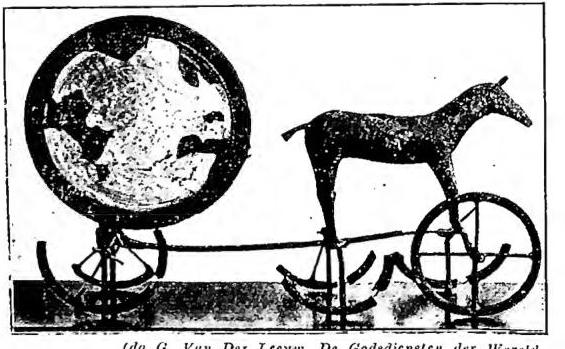
(from G. Van Der Leene, De Godsdiensten der Wereld, Amsterdam 1911, fig. 19)
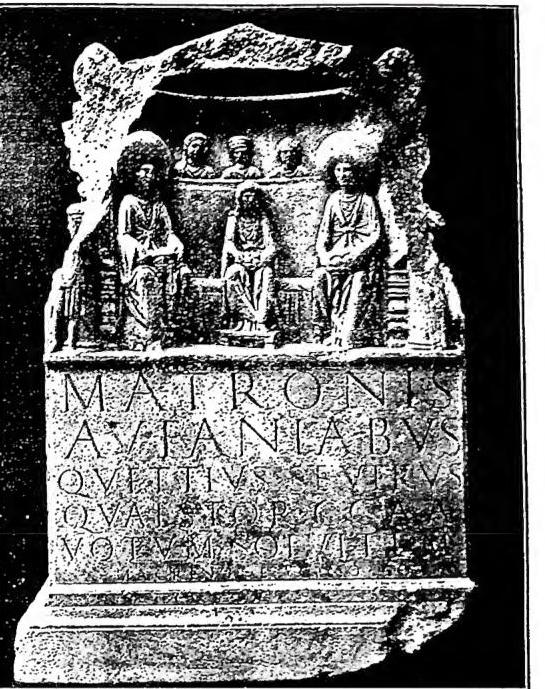
Of these three deities, the most ancient is certainly Ziu, who represents the original sky god of ancient Aryan antiquity, common, due to etymological concordance, to all the
(from Rivista di Archeologia Cristiana, 9 [1932], p. 135)
GERMANI, RELIGION OF THE - Pagan votive altar of the Matronae Anfaniae found beneath the floor of the Romanesque crypt of the collegiate church of S. Cassio - Bonn.
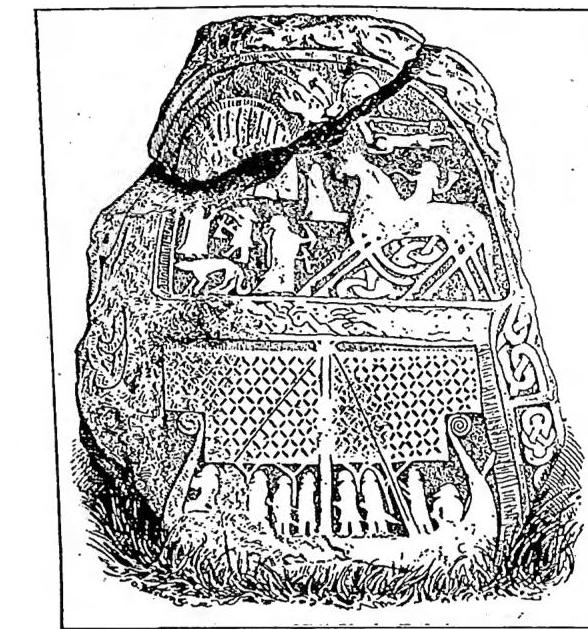
Donar, who in the North bore the name of Thor, enjoyed widespread cult. A god of thunder, as his name indicates, he was first erroneously identified by Tacitus with Hercules and later correctly with Jupiter, though only later and in Scandinavia alone did he hold the foremost place among all the gods; in other regions, he seems always to have occupied a position inferior to Ziu, and later to Wodan. He was considered the strongest and bravest of the gods and was invoked by warriors before battle. Animal sacrifices were offered to him, and trees were consecrated to him, such as the oak of Geismar, felled by St. Boniface, whose wood was used to build an oratory to St. Peter. In the North, he is the god of the common people, protector of the home, property, and nation. Personification of natural strength used in defense of the weak, he appears as the invincible vanquisher of hostile giants, the avenger and protector of the divine order. Depicted as a tall, robust, handsome man with a long red beard, armed with a formidable short-handled hammer, he may be called the most Germanic of all the gods, the one who, even in Norse literature, achieved the highest idealization without foreign elements. His name replaced that of Jupiter in the formation of the word corresponding to Thursday in all Germanic languages.
In the western and northern territories of Germania proper, the foremost place among the gods seems always to have been held by Wodan, whom the Romans identified with Mercury. Originally of a demonic nature, leader of the wild hunt during stormy nights—that is, of the host of souls he later returns to the bosom of the mountains—he later lost this character and assumed the attributes of a celestial god, lord of war and victory, but also of spiritual life and civilization. In the North, where he became the center of cult and the aristocratic god of courts and the favorite of the Skalds, a rich complex of myths developed around his figure, portraying him as the universal father and supreme orderer of the world, sovereign of magic and inventor of the runes (the first written characters derived from the Latin alphabet and used as mysterious signs for divinatory purposes). As lord of war, he reigns in the marvelous Walhall, or "hall of the slain," a kind of aristocratic paradise where those who died in battle are welcomed, continuing their favored earthly occupations in martial exercises and sumptuous feasts, entertained by the Valkyries, a kind of demigoddesses, Odin’s handmaidens, who ride in groups across the sky clad in helmets and armed with shields and armor, tasked with choosing, as the etymology of their name suggests, those destined to fall, while granting victory to others. In the Edda, creative activity is also attributed to him; together with his brothers Vili and Ve, he is said to have created the first man and woman, animating an elm and an ash tree on the shore of the sea. It is unnecessary to note that the Germanic myth knows nothing of creation in the sense of our Genesis: it presupposes the eternity of matter, and the gods do not stand at the beginning of the world but at the start of history. The name of Odin replaced that of Mercury in the denomination of Wednesday in all Germanic languages, except in the southern regions, that is, in present-day literary German. This fact may serve as proof that at the time of the introduction of Latin names, the populations of the territories that would later become High German did not practice the cult of Wodan.
Alongside Odin, from the earliest testimonies, stands a female deity, Frija; but apart from a Lombard legend handed down by Paul the Deacon, in which she appears under the name of Frea, and a few magical formulas, she is very sparsely documented outside the Scandinavian countries, where she took the name of Frigg and is the goddess of love, marital happiness, and the home: thus, as the companion of the supreme god, she corresponds more to Venus than to Juno, and indeed she replaced the former in all Germanic denominations of Friday.
BIBL.:
J. Grimm, Deutsche Mythologie, 4th ed., Berlin 1875-1878; E. Mogk, Germanische Mythologie, Leipzig 1891; J. de Vries, Altgermanische Religionsgeschichte, Berlin 1935-1937; H. Schneider, Germanische Heldensage, Berlin 1928-1934; G. Neckel, Die Überlieferungen vom Gotte Balder, Dortmund 1920; F. R. Schröder, Germanentum und Hellenismus, Heidelberg 1924; A. Heusler, Die altgermanische Dichtung, Potsdam 1941; G. Dumézil, Loki, Paris 1948; and the works cited in the article Mito e Mitologia (v. MITO E MITOLOGIA).
G. MESSINA
Little—indeed, nothing more than the Latinized name—is known of other deities, probably local, mentioned by Tacitus: of a Tanfana, worshipped by the Marsi; of a Nehalennia, depicted on some votive stones; of a Badbuenna, to whom a grove was sacred among the Frisians; of a god Requelivahano, mentioned on an 11th-century stele; and of others still. However, the goddess Nerthus deserves particular mention. Tacitus identifies her with the Earth Mother, venerated among certain populations of Jutland, whose sanctuary—the national temple of the Ingvaeones—was located in the midst of a forest on a solitary island in the Baltic. There, the chariot was kept upon which the statue of the goddess was carried in solemn procession, perhaps to celebrate the fertility of the earth and the awakening of vegetation. Her cult shows a striking concordance with that of the god Njord and his son Freyr in the Nordic sources, the latter of whom sometimes occupied a preeminent place in Sweden alongside Thor and Odin. However, they did not belong to the divine race of the Æsir but to that of the Vanir, an equally powerful though more barbaric and rougher race, who waged war against the Æsir and later reconciled with them through the pact that two of their number would be admitted into the council of the Æsir, who in turn gave two of their own. This war between two divine races certainly reflects a cultural struggle between the followers of an ancient faith and those of a foreign religion, perhaps the immigration of the cult of Odin into Sweden, where the worship of Freyr was already ancient, and the consequent fusion of the two cults. Other deities, characteristic of the North and thus later and independent creations, include Balder, god of purity and innocence and martyr of a fatal betrayal, whose death would be the grim prelude to the end of the world; Loki, originally a fire demon, genius of evil and father of a terrible progeny, among whom Hel, goddess of death, personification of the ancient Germanic concept of an underground place that receives the souls of all the dead and, later, when Nordic imagination had created Valhalla for heroes fallen in battle, only of those who died of old age or illness. Finally, the vague and rudimentary ideas of the ancient Germans regarding the origins of the gods and races underwent extraordinary development in Nordic literature, where, through the work of both the people and the poets, they were systematized into a true doctrine encompassing the entire divine saga in a grand tableau containing individual myths as single acts of a terrifying universal drama. These have been transmitted especially in the first book of the Edda, the Völuspá, which is at once the book of origins and the prophecy of the end (v. COSMOGONIA). Once the first progenitor of the Æsir, Odin, and then Vili and Ve were born, they built Asgard, or the garden of the Æsir, where they spent a long time in a life of joy during the golden age. But their fate darkens from the day Loki, through his cunning, brings about the death of the just Balder, and finally plunges toward catastrophe, toward the "twilight of the gods," in which, in a frightful battle between the Æsir and their adversaries, all perish while the world burns and all life disappears. Yet from the immense ashes, a new earth emerges, more beautiful than the old, upon which grain sprouts without the hand of man sowing the seed; a new sun shines, traveling the same path. Of the ancient gods, only Balder and a few others revive, but they have forever lost their former sovereignty, which now belongs to a new god, "the Almighty who comes from on high to the supreme judgment." In all this, it is easy to isolate what may truly be an ancient Germanic or more specifically Nordic conception from what is an element of importation, borrowed, that is, from the repertoire of classical motifs, Oriental speculations, or Judeo-Christian ideas about the end of the world, which reached the North during the Viking raids. One must only guard against thinking, on the basis of these and other vague yet genuine motifs, of unconscious presentiments, of "prophetic voices," in ancient Germanic antiquity, or of relations of affinity between two religious and moral conceptions that are as distant from one another as truth is from error.
I. GEOGRAPHY.
It is the European state which, over the last eighty years—that is, since the achievement of its political unity (1871)—has undergone the most extensive territorial variations. Reduced by 1/7 after the First World War, it resumed its expansion in 1936 (Saarland plebiscite), which, by the outbreak of the Second World War, had increased its dominion by over 1/6 compared to 1913 and had tripled it by 1942, when, with military victories, its eastern border ran from the Gulf of Finland to Crimea and its southern border extended into the Alps as far as Croatia.
| Area in km² | Population (in 1,000 inhabitants) | Density per km² | |
|---|---|---|---|
| 1913 | 540,835 | 65,000 | 74 |
| 1929 | 468,768 | 59,177 | 126 |
| 1937 | 470,300 | 69,300 | 147 |
| 1939 (1 Sept.) | 635,733 | 86,000 | 135 |
| 1942 (1 Jan.) | 1,678,200 | 160,919 | 96 |
| 1950 | 353,300 | 66,500 | 188 |
Following the final defeat, and even before a peace treaty regulated the new territorial delimitation of GERMANIA, what was presumably to be retained was divided into four occupation zones, each comprising a certain number of administrative units (Länder), as shown in the adjacent table.
| On 23 May 1949, the trizone occupied by the Western powers constituted itself as the Federal Republic of Germany (Bundesrepublik Deutschland) with a democratic constitution and an elective bicameral representation; while on 7 October of the same year, the Länder of the Soviet zone united in the German Democratic Republic (Deutsche Demokratische Republik), of Soviet type, which accentuated the ongoing separation between the two parts of GERMANIA controlled by the two antagonistic groups of occupiers. The part of GERMANIA east of the current German-Polish border (Oder-Neisse: 110,000 km² with 9.5 million inhabitants in the pre-war period, of whom less than 1 million were non-German-speaking) was annexed to the new Poland, as compensation for the territories previously lost to the Soviet Union. | Länder | Area in km² | Population (1,000 inh.) | Density per km² | Capitals (and their population in 1,000 inh.) |
|---|---|---|---|---|---|
| North Rhine and Westphalia | 34,076 | 11,797 | 346 | Düsseldorf (422) | |
| Lower Saxony | 47,218 | 6,433 | 136 | Hanover (358) | |
| Schleswig-Holstein | 15,658 | 2,651 | 169 | Kiel (214) | |
| Hamburg | 747 | 1,424 | 1,908 | Hamburg (1,406) | |
| British Zone | 97,698 | 22,305 | 228 | ||
| Bavaria | 70,238 | 9,029 | 129 | Munich (752) | |
| Württemberg and North Baden | 15,700 | 3,675 | 234 | Stuttgart (414) | |
| Hesse | 21,117 | 4,064 | 193 | Wiesbaden (188) | |
| Bremen | 404 | 487 | 1,205 | Bremen (385) | |
| U.S. Zone | 107,459 | 17,255 | 161 | ||
| South Rhine and Palatinate | 19,856 | 2,761 | 139 | Koblenz (80) | |
| Württemberg-Hohenzollern | 10,407 | 1,119 | 108 | Tübingen (30) | |
| South Baden | 9,952 | 1,198 | 120 | Freiburg im Breisgau (93) | |
| Saar Territory | 2,559 | 912 | 357 | Saarbrücken (90) | |
| French Zone | 42,775 | 5,990 | 139 | ||
| Saxony-Anhalt | 24,669 | 4,161 | 169 | Halle an der Saale (223) | |
| Brandenburg | 27,976 | 2,257 | 93 | Potsdam (114) | |
| Mecklenburg | 22,938 | 2,140 | 93 | Schwerin (65) | |
| Saxony | 16,992 | 5,559 | 329 | Dresden (468) | |
| Thuringia | 15,598 | 2,927 | 188 | Erfurt (175) | |
| Soviet Zone | 107,163 | 17,314 | 162 | ||
| Berlin (4 sectors) | 890 | 3,201 | 3,396 | ||
| G. 1946 | 355,985 | 66,065 | 186 | ||
| Federal Republic of Germany | 248,419 | 47,575 | 192 | Bonn (101) | |
| German Democratic Republic | 107,566 | 18,490 | 171 | Berlin (3,169) |
Territories claimed by the U.S.S.R., to which the northern sector of East Prussia with Königsberg (renamed Kaliningrad) was also assigned, constituted as an autonomous district of the R.S.F.S.R.
Thus, G. has moved to fifth place among European states by area, after the U.S.S.R., France, Spain, and Sweden, slightly surpassing Finland and Italy in this regard. No other European state, however, borders as many neighbors (Poland, Czechoslovakia, Austria, Switzerland, France, Luxembourg, Belgium, the Netherlands, and Denmark) and, conversely, has such largely conventional frontiers.
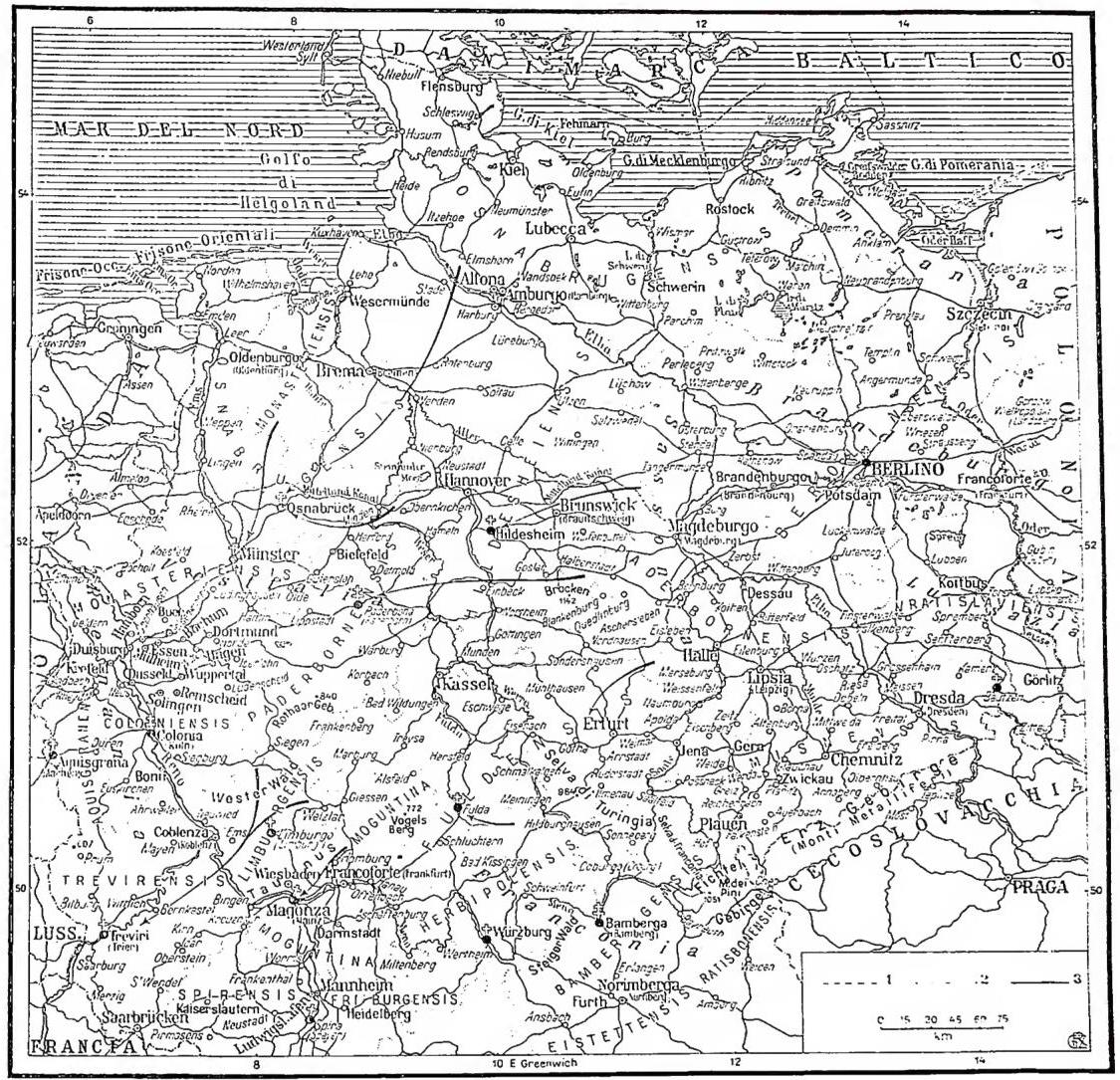
The German territory, which to the north coincides with the vast plain—often barren and marshy—that connects the French lowland to the Sarmatian, presents in the center and south a varied alternation of massifs, more or less extensive depressed zones, plateaus, and mountains. For most of its surface, the plain is poor, ill-suited to cultivation, and sparsely inhabited; only along its southern margin, at the contact with the uplands of central G., does the land become fertile and well-endowed with mineral resources (salt, potash, lignite, anthracite), while the estuaries of the great rivers (Elbe, Weser) provide easy access to the continent’s busiest sea. Central G. is a rugged and forested region, long divided into small states: its hills and mountains generally have gentle forms and modest elevations (1,603 m in the Riesengebirge, 1,493 in the Black Forest, 1,142 in the Harz), preserving their original forest cover, so much so that the same word (Wald) denotes both the relief and the forest. South of the Danube, a broad plateau, also covered
GERMANY - N.E. GERMANY - 1) State borders; 2) Ecclesiastical circumscription borders; 3) Railways. For Prussia V. relative map.
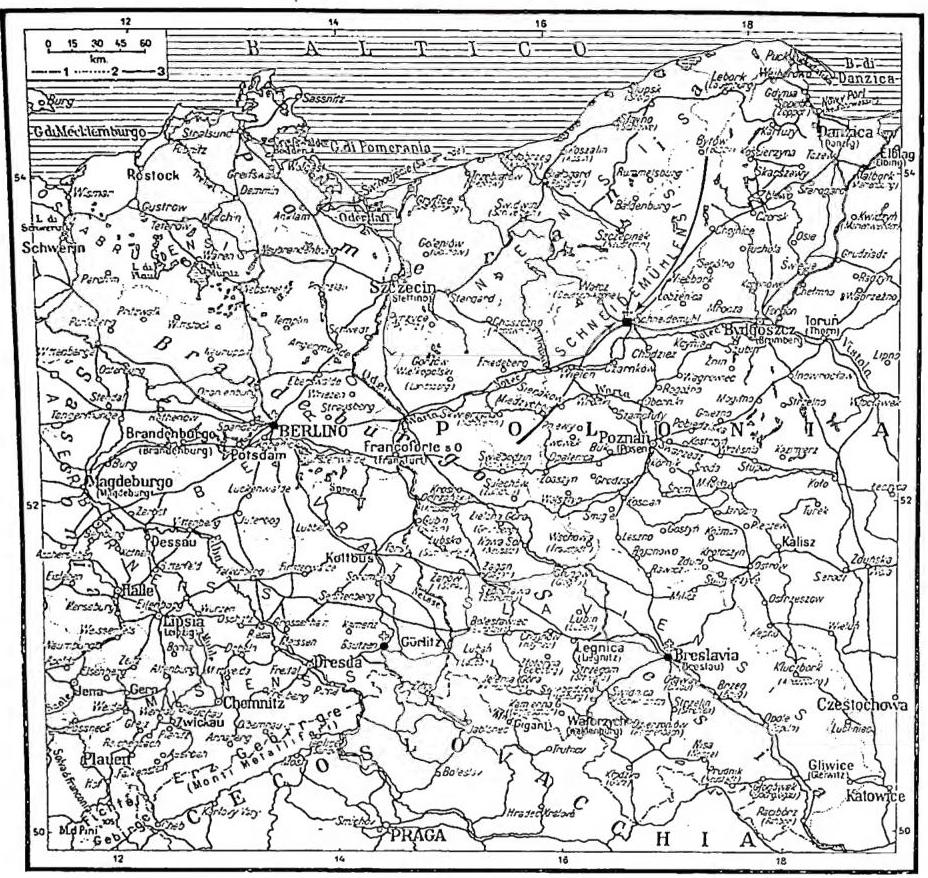
The climate, relatively mild, is less influenced by the mitigating effect of oceanic winds the closer one approaches the Sarmatian lowland; it thus becomes progressively harsher and more continental (i.e., with increasing thermal range) moving from west to east rather than from south to north. In the south, moreover, the relief becomes more rugged, with abundant winter snows in the high Alpine areas. Rainfall, generally quite abundant and well distributed throughout the year but with summer or autumn peaks (N.W. Germany), decreases in the same direction. Consequently, the rivers—eastern ones, except for the Danube, all flowing from south to north—are generally rich in water and well navigable.
The landscape of Germany has been profoundly modified by man, who has extensively reclaimed marshy and sandy soils and replaced the original forest cover with crops; nevertheless, forests still cover approximately one-quarter of German territory.
The population, ethnically highly homogeneous even before the recent territorial contraction, has grown at a steady pace, even though demographic growth had been declining before the war: the total (within the 1913 borders) was 24.8 million inhabitants at the beginning of the 19th century and, despite the two catastrophic world wars of our century (over 2 million lives lost in the First and 6 million in the Second World War), has now almost quadrupled, with approximately 95 million Germans estimated worldwide (no fewer than 10 million in the U.S.A.). Emigration, which had exceeded 220,000 annually in 1881, dropped to very modest figures (20,000) after 1930. The percentage of the urban population surpassed three-quarters of the total in 1939: the terrible destruction caused by aerial bombardments has not prevented Germany, even within its more restricted borders, from still counting two cities with over 1 million inhabitants (Berlin and Hamburg), three with over 500,000 (Munich, Leipzig, Essen; though there were 8 in 1939 within the current territory), 41 with more than 100,000 (44 in 1939), and 55 with more than 50,000 inhabitants (40 in 1939). To give an idea of the damage suffered, it suffices to recall that in Berlin 34% of buildings were destroyed and 54% more or less damaged; after the war, only 12% of the metropolis remained unscathed.
Agriculture and livestock farming employ just over one-quarter of the German population (over half at the beginning of the century). Of the territorial surface, arable land accounts for around two-thirds and is primarily used for cereal crops, which yield, in descending order of production, rye (35.2 million quintals in 1947), oats (31 million quintals), wheat (20.3 million quintals), and barley (11.3 million quintals)—insufficient, however, for domestic consumption, especially after the loss of the predominantly agricultural and sparsely populated eastern territories. Potatoes (248 million quintals, partly used for spirit distillation), sugar beet, hops (for beer), flax, and tobacco are the most widespread industrial crops. Fruit and wine (southern Germany) are also of notable importance. Livestock farming, though rationally managed and in extensive forms (14 million cattle; 8.4 million pigs; 3.5 million sheep; 2.2 million horses in 1947), does not meet the domestic demand for fats, meat, and eggs. Significant sources of income are also provided by forestry and fishing (whose pre-war quantity ranged between 600,000 and 750,000 metric tons).
Germany cannot be considered exceptionally endowed with mineral resources: but the abundance of coal and the presence of metallic and especially ferrous minerals account for the modern development of its industries, which have also thrived thanks to advanced technology and increasingly efficient organization. On the eve of the Second World War, more than two-thirds of the German population was engaged in industry, and Germany ranked, alongside the U.S.A. and England, among the best-equipped and most highly productive countries in the world in this regard. German industry was essentially based on the extraction of fossil coal, which provided motive power, fuel for metallurgy, and raw material for the chemical industry: its weaknesses lay primarily in the lack of
GERMANY - G. of N. W. - 1) State Borders; 2) Ecclesiastical Circumscription Borders; 3) Railways. For Bavaria V. relative map.
The necessity to import raw materials for processing and to find ever-new markets for the growing production gave rise to an increasingly concrete tendency toward autarky. The defeat suffered in the Second World War greatly exacerbated the difficulties of the German economy, both due to the loss of mining districts (the Silesian coal basin, the Saar, etc.) and the destruction of industrial equipment and the production limitations imposed by the Allies. Nevertheless, in the Anglo-American bizone, the production index has now almost reached pre-war levels (1936), while nothing precise is known regarding the Soviet sector.
Almost all the most efficient pre-war industries (steel, mechanical, chemical, etc.) were either destroyed or greatly limited (including textiles, footwear, paper); among the unrestricted ones, furniture-making, glass, timber, and construction industries prevail, representing a very modest share of Germany's formidable potential.
Before the war, this potential corresponded to an adequate commercial organization, which benefited from the country's privileged geographical position—intermediary between Western and Eastern Europe on one side, and between the Mediterranean and Atlantic worlds on the other—while internally disposing of excellent road networks (in 1937, there were 213,000 km of public roads in Germany) and railways (68,000 km), largely complemented by navigable rivers and canals. It placed at the service of international trade a merchant fleet that was the fourth-largest in the world (4.5 million tons in 1939) and ports among the best-equipped and busiest in Europe (Hamburg, Bremen, Emden). Currently, the available shipping has been reduced to insignificant proportions (294,000 tons).
It should be recalled that, before the First World War, Germany possessed a vast colonial empire (primarily in Africa, and partly in Asia and Oceania): nearly 3 million km² with, at the time, 13 million inhabitants (today ca. 20), later entirely lost.
II. CIVIL AND RELIGIOUS HISTORY.
SUMMARY:
I. In the Ancient World
II. The Medieval Empire
III. Germany and the Reformation
IV. Prussian Predominance
V. The German Empire
VI. The Weimar Republic and the Third Reich.I. IN THE ANCIENT WORLD
In the late Republican age, the Roman conquest of Gaul opened the way to knowledge of the lands beyond the Rhine, the river to whose banks Caesar had brought the Romans. In 38 B.C., the Ubii moved to the left bank of the Rhine, and Agrippa founded Colonia, the future metropolis of the Rhineland. However, every Roman expedition was followed by the uprising of the tribes. The Usipetes, the Tencteri, and the Sicambri crossed the river and brought war into Romanized Gaul. Augustus had to address the problem of pacifying the lands between the Rhine and the Elbe to secure the Gallic border and the Danubian limes, which could be affected by the latter's instability. The execution of this enterprise was entrusted to Drusus (13-9 B.C.) and, after his death, continued by Tiberius, who had the merit of accompanying—and indeed preceding—military action with civil penetration, achieving the best results. The failed submission of the Marcomanni, the unrest in Illyricum and Pannonia, and the revolt of 9 A.D. among the Germans, led by Arminius, chief of the Cherusci, endangered all of Rome's work from Caesar to Tiberius. Though the loss of Quintilius Varus's legions in the Teutoburg Forest could remain without graver consequences due to Tiberius's prompt return, the military operations conducted by Germanicus, and the dissensions among the insurgents, the realization of a Roman Germany from the Rhine to the Elbe was lost forever.By the end of the 1st century, western and southern Germany entered the territory of the Empire, and its fate became largely intertwined with that of Gaul. The Batavian uprising of 69-70, the subsequent attempted proclamation of a Gallic Empire, and Vespasian's victory over the vast insurrection are among the most dramatic episodes. For three centuries, Germany remained within Rome's orbit, and the peoples who came into contact with its legislative and civilizing work were drawn into civilization. From the end of the 1st century, progressively intensifying throughout the 4th, Germany was swept by the shiver of invasions: Frisians, Franks, Saxons, Lombards, Suebi, Alamanni, Bavarians, Angles and Jutes, Thuringians and Burgundians, Rugii, Sciri, Turcilingi, Heruli, Gepids, Vandals, and later Ostrogoths and Visigoths pressed in from the south, east, and sea. What profoundly influenced Germany's fate was the formation of the Frankish Kingdom: the end of the Alamanni Kingdom, marked at Tolbiacum by the founder of the Frankish dynasty, Clovis, in 496, led to Frankish intervention beyond the Rhine, favoring the formation of a state straddling the river. The Thuringian Kingdom disappeared, the Saxons occupied the Harz, and the Gothic Kingdom of Italy entered crisis due to Byzantine intervention—all of which favored the Franks' assumption of a predominant position over the Germanic peoples and made them a more effective bulwark against Slavic raids. Against the Avars and Lombards, too, the Franks would play a containing role in defense of a civilization they inherited from Rome, drawing them into the orbit of the Catholic Church and making them its observant and faithful sons.
II. THE MEDIEVAL EMPIRE
With the Frankish conquest of Gaul completed in the 6th century, and the latter—along with the annexed Germanic lands—divided into Neustria, the land of the western Franks, and Austrasia, straddling the Moselle, Main, and Rhine, the decline of the Merovingian dynasty did not, for the time being, decisively affect the loss of Frankish influence in Germany. Beginning with Pepin of Heristal and his victorious campaigns beyond the Rhine, the Carolingians resumed the expansionist policy of the early Frankish kings: Charles Martel (v.) defeated the Frisians and Saxons, driving them back from the territory between the Rhine and the Meuse to the Weser; Pepin the Short renewed the struggle against the Saxons and made the Bavarians and Alamanni tributary. With Charlemagne (v.), who subdued the indomitable Saxons in a thirty-year struggle, the work of his predecessors was completed and culminated in a general consolidation of Germany, from which it would derive the development of its own national history.When, in the name of an ideal of conquest and faith, Charlemagne had broken (with a cruelty justified only by the continual resurgence of rebellions) the resistance of the Saxons and their hero Widukind, he was able to extend to the territories beyond the Rhine the administrative-military system of counties, the religious system of bishoprics, and the judicial and civil system of Frankish laws. Contemporaneously with the fragmentation of Saxon unity, the disintegration of Bavaria also occurred in stages: the occasion was provided by the pro-Lombard orientation of the Agilolfing dukes, closely related to King Desiderius. Charles also subdued the Avars and dismantled them, freeing the middle Danube flank for the expansion and consolidation of the Germanic tribes. The Emperor’s initiative halted before the Slavs, though in his final years he still managed to secure the Jutland border against the Danes.
An empire half Roman and half Germanic, as demonstrated by the very choice of Aachen on the Rhine as its capital; profoundly religious and Catholic, as evidenced by the splendid scene of Christmas in the year 800, with Charlemagne, Germany was definitively won over to Western civilization and, thanks to St. Boniface (v.) and other missionaries of the faith, to the Catholic Church. There was, in the life of the Germanic peoples, a mitigation of customs, a progressive rapprochement with the Roman world, the joint work of the Carolingian Empire and the Church.
The death of Charlemagne in 814 marked the first crack in the unity of the two parts of the Carolingian Empire; those elements of subsequent autonomy, which had existed since the creation of Austrasia, became more pronounced under his successors and prevailed during the struggles among the sons of Louis the Pious. These disputes were also destined to favor the autonomist tendencies of the landed nobility: one of the two forces (the other, that of the great ecclesiastical holdings, would arise later, almost as a counterbalance) upon which the power of the German Empire would develop. As early as 833, Louis, king of the eastern Franks and later called the German, gathered under his scepter the majority of Germanic territories and peoples: Franconia and Thuringia, Saxony, Alamannia, and Bavaria. In 841, Louis and Charles the Bald found themselves allied against Lothair I. The Oath of Strasbourg of February 14, 842, is both the first document in the German language and the sign of the differentiation of the two nationalities. Even if Lothair I retained the supremacy of the imperial title, the Treaty of Verdun of August 843 sanctioned the respective independence of the Kingdoms of Germany and France.
Charles the Fat renewed the unity of the already divided Empire under his name in 884, during the lifetime of Louis the German, when it had been split into three autonomous entities: Bavaria, Saxony, and Alamannia; but in 887, his deposition at the Diet of Tribur marked a return to the autonomies already outlined. The situation of the Empire, shaken by internal discord and threatened externally by the incursions of the Hungarians, Normans, and Wends, was not resolved by the action of Conrad I of Franconia, elected and consecrated in 911 at Forchheim. It was restored by the sagacious, energetic, and attentive work of Henry I, founder of the Saxon house. His son Otto I, designated as successor at the assembly of Erfurt (936), was the great interpreter of the matured translatio of the Empire from France to Germany. From the outset, he inspired his actions with a grandeur unknown in the past: from his consecration at Aachen to the greater detachment from the dukes, called to the personal service of the sovereign. He established a new administrative system, creating alongside the dukes a category of officials, the palatine dukes, and fostering the creation of a broad ecclesiastical feudalism, less dangerous than the lay one for not being tied to the person, and useful above all in recalling to obedience to the crown the other ecclesiastical hierarchies, which tended to prioritize the authority and appeal of the Pontiff.
Upon the death of Otto I, his successor was little more than a child: the internal situation of Germany was so harsh that Lothair II attempted to conquer it from France. Otto II managed to halt the invader and improve the internal situation: he could have renewed, with greater success, the expansion into the eastern lands, from which his people always hoped to derive greater possibilities of life and power, and further strengthened the foundations of the monarchy. He had married (a reminder of the last, unfortunate Italian campaign of Otto I and the attempted accord, which had also been the dream of Charlemagne, with the Byzantine Empire) the Greek Theophano and, drawn by his father’s grand design, resumed, via Italy in 982, the fateful march southward against the Greeks and Saracens: defeated near Crotone in July 983, while seeking to lay the groundwork for the resumption of the struggle and news reached him from the German Kingdom of a new Slavic invasion, he died in Rome, not yet thirty years old, leaving the throne to his young son Otto, entrusted to the guardianship of his mother and grandmother. Otto III was swept up in the whirlwind of Roman factions and, at the same time, in the atmosphere pervaded by the mystical expectation of a religious reform as the millennium approached. He came to Rome, where his cousin assumed the tiara under the name Gregory V and crowned him emperor; he returned in 998 to put an end to the power of Crescentius, who was defeated and killed. Between the two expeditions, he had to confront the Slavs on the Elbe, curb the growing power of Arduin, lord of Ivrea, in the Turin march, and keep in check the Lombard princes of southern Italy, divided and rebellious: as, in the defense of the borders of the German Kingdom, the Duke of Poland aided him, so in Italy did the Margrave of Tuscany, Hugh. A pupil of the learned Bishop of Reims, Gerbert, whom he made Archbishop of Ravenna, he drew inspiration from the ancient grandeur of Rome and the traditions of classical culture. The term renovatio Imperii is frequently used: the Emperor resided on the Aventine, cloaking his mystical dream of renewal in splendid forms. In 999, he had Gerbert elected under the name Sylvester II; he found in him the other voice he needed, the spiritual one, and placed it, in the fervor of his designs, alongside the temporal voice he embodied. He had extended ecclesiastical organization in the eastern lands, in Poland and Hungary, already a friend of Adalbert of Prague and Bruno of Querfurt, martyrs of the propagation of the Faith; he had assumed a significant title such as "servus Jesu Christi" and paid homage, at Aachen, to Charlemagne, overseeing the recognition of his remains, when one of the violent and perpetual uprisings of the Romans, discontented with the failure to destroy Tivoli, sufficed for Sylvester and Otto to be expelled from the city, the earthly base of their dream. Soul
Fervent and restless in spirit, in whom Greek blood prevailed over Germanic steadiness, Otto, despite his solidarity and affection for Pope Sylvester, was inclined to deny the validity of imperial donations to the Church. Simultaneously, he considered withdrawing from the world as a hermit or launching himself as a missionary to conquer new peoples for the Faith, struck by the possibility of a conflict that his religious conscience presented to him. However, the value of the imperial function and the urgency of the tasks entrusted to him led him to overcome his inner crisis, and he turned his mind with greater confidence toward a restored ecclesiastical situation and the possibility of perpetuating the dynasty and the throne through a new Byzantine marriage. Yet, at the age of twenty, he too fell (23 January 1002), like his father, victim to one of the frequent epidemics in the peninsula.
From a collateral branch of the Saxon house, his successor, Henry II, resumed the traditional policy of Otto I, developing ecclesiastical feudalism as a counterweight to the lay nobility. He was, moreover, driven by a sincere religious zeal, which made him one of the greatest benefactors of the clergy and builders of churches and abbeys. Deeply sensitive to the atmosphere of religious renewal that Odo and Odilo had begun to radiate from Cluny, he became an enthusiastic advocate. He too was drawn to Italian politics; among his expeditions beyond the Alps, the last brought him face to face with the first violent uprising of Italian communal autonomism, with the destruction of the Royal Palace and the assault on Pavia. When he died in 1024, he left a Germany pacified and risen from the disorder into which Otto III’s reckless actions had plunged II. Agriculture, contrary to the atavistic habits of the former barbarians, had spread throughout the country: monasteries and cities cooperated in the economic revival, for which the great rivers served as instruments. The national language had now emerged, with its first surviving documents.
Royal power passed, with Conrad II, to the ducal house of Franconia, the closest in kinship to the Ottonians. Unacceptable to the reformist clergy and the great lords of Lorraine and Saxony, Conrad II became a champion of the less privileged classes, aiming to shift the foundations of central power toward the mass of minor feudal lords and knights, even granting them the heredity of fiefs. The central power would thus begin to rely, in every duchy, on its own loyalists, independent of the attitude of the great feudal lords. Agitations and conflicts at the borders—among Poles and Bohemians, Danes, Slavs, and Hungarians—allowed the resumption of Germanic expansion. Particularly notable was the acquisition of Burgundy upon the death of Rudolf III. Yet Conrad, too, did not forget, with his two descents into Italy, the orientation toward the peninsula.
Upon a pacified and united Germany, his successor, Henry III, began his reign in 1039. Yet while the power of the Empire seemed enormously increased under him, the resurgence of autonomist demands, centered on the renewed strength of the dukes, the continuous and not always successful wars at the borders, and the rise—accompanied by widespread jealousy—of confidants and officials to the highest dignities, all signaled the onset of a new crisis. Henry’s religious policy, openly favoring the Cluniac and reformist Church, and his Roman interventions would lead to an intense reaction against German and imperial power, which would center on the question of lay investitures and undermine the long reign of his son and heir.
When he personally assumed governance in 1065, IV (v.) faced a state in open and conscious anarchy, where rebellions and endemic disorders had taken on the character of feudal opposition. But as he proceeded to restore central authority, the struggle against lay investitures and for the internal renewal of the Church, which reached its VIZI (v.), abruptly halted him and confronted him with the other aspect of the Empire’s problem: the Roman and Italian one, as well as the ever-widening repercussions that the religious movement inspired by Gregory VII, opposed to German autocracy, ignited throughout Christendom. The papal excommunication deepened the latent struggle against the sovereign among Germany’s great lords, exacerbating it to the point of provoking his deposition at the Diet of Tribur and the counter-election of the Duke of Swabia, Rudolf of Rheinfelden. The dukes regained the upper hand, attempting to resolve once and for all—something they would later achieve—the problem of imperial election by changing the hereditary principle into an elective one. However, central power and the centralized monarchy represented a more modern orientation, inspired by the advantage of the collectivity over feudal power and anarchy. This was evident in what saved Henry IV and, for the moment, the hereditary principle: the uprising of cities, rural masses, the new aristocracy of ministeriales, and a large part of the bishops in favor of the excommunicated and deposed king. Some of the great lords also sided with him, including the founder of the Hohenstaufen, Frederick. At Hohenmölsen (1080), his rival Rudolf died in battle, and his successor, Hermann of Luxembourg, was appointed in vain. The divisions among his enemies, the mediation of the bishops, and the very length of the struggles, which had spread general weariness, extinguished the flames of revolt, allowing Henry IV’s long stay in Italy, where from 1081 to 1084 he curbed the rising power of the Lombard communes, kept it in check with concessions and privileges, and, having entered Rome, considered the personal struggle that had long tormented him with Gregory VII concluded with the latter’s death in exile at Salerno.
Upon his return from Italy, where he had remained from 1081 to 1084, he had to face the double rebellion of his two sons, Conrad (1093), the firstborn, and Henry, who, victorious, would assume the Empire under the name Henry V (1105–25). With him, the power of the great lords reasserted itself, nor did the act of violence and deceit with which Henry II (v.), after the renunciation of ecclesiastical goods pertaining to the Empire—for the freedom of the Church—the privilegium of reinstatement in the rights of investiture, which sounded like an insult to the centuries-long struggle for reform, help him emerge from quasi-tutelage. The opponents rallied around Lothair, Count of Supplinburg, who had become Duke of Saxony, and around the Archbishop of Mainz, Adalbert. With Henry, the Franconian house ended after concluding, with the Concordat of Worms (23 September 1122), the dispute between the Empire and the Church through a compromise that preserved the prestige of the Pope but also that of the Emperor. Lothair of Supplinburg (1125–37), belonging to the pro-Church party, was elected emperor in his place, thanks to whom he overcame the coalition between the Guelphs of Bavaria and the Ghibelline Hohenstaufen and carried out the successful expedition against the Normans in Apulia. Upon his death (1127), the throne passed, in defiance of the dynastic principle, to the former rival of the Emperor, Conrad of Hohenstaufen, under whom the struggle between the two opposing parties continued and remained a heavy legacy for his nephew Frederick Barbarossa (v.).
From the very beginning of his reign, the need to establish equal foundations for his power in Italy as well, against the now entirely autonomous and growing strength of the papacy and the flourishing development of communal autonomies, drew the Emperor to a heightened interest in the affairs of the peninsula. Not that the general peace proclaimed could ensure the stability of the internal situation in Germany: but the Emperor addressed this through the alternation between his descents into Italy, relying, especially during his absence, on the support of the dukes, who were co-interested in his governance. Henry the Lion of Bavaria, the greatest expression of this overpowering German feudalism, achieved such territorial and political advantages along this path that, even after a long defense, he was abandoned by the Emperor to the jealousy of the other great lords. His condemnation, along with the division of his lands, led to the disappearance of the largest hereditary feudal unit, and the fragmentation of lordships resumed, no longer in favor of central authority but through an inexhaustible process of anarchy, which would render the efforts of the German emperors in their homeland futile and draw them toward a consequent overvaluation of Italian politics. From the final years of Barbarossa to the reign of his son, Henry VI, and that of Frederick II, this would mark the abandonment of the German homeland and the relegation of its internal problems to a secondary role, faced with the universal issues raised by Italy and Rome.
When, in 1190, Frederick I drowned in the Saleph while en route to the Holy Land, where he intended to lead a new crusade, he had only just overcome an attempt at a vast feudal coalition raised against him by the Archbishop of Cologne. And when, due to his Italian policy, his memory was to be more associated with the defeat at Legnano, the Peace of Venice, and the Peace of Constance—which had marked the victorious affirmation of the Communes, allied with the papacy—than with the destruction of Milan and the submission of other Lombard, Tuscan, and Emilian cities. Yet, amid the difficulties of the internal German situation and that of Italy, precisely at the end of his life, the great Emperor had, with far-sighted political judgment, united his son Henry in marriage to the heir of the Norman Kingdom of Southern Italy, Constance of Hauteville.
At the outset, Henry VI found himself having to fight on two fronts: due to the reappearance of Henry the Lion in Germany, and the opposition of a national party to his assumption of the crown of Sicily. The major powers of Christendom—the Church, England, and Denmark—took part in and had an interest in both fronts. French neutrality, born of the enmity between Richard the Lionheart and Philip Augustus, and the extraordinary fortune of the capture of the former upon his return from the Crusade, saved Henry VI. Upon the death of his stubborn rival Henry the Lion, the Emperor was able to force the hand of the prince-electors at the Diet of Würzburg to obtain consent for the hereditary transmission of the crown. However, subsequent opposition led him instead to provoke the election of his son, Frederick, born to him in 1194, at the Diet of Frankfurt. Then, while turning his mind, after bloodily suppressing the Sicilian and Apulian rebellion, to vast plans of expansion in the East, Henry died in Sicily in 1197.
Once again, a regency council (for a few months, his mother; then, by maternal testament, Pope Innocent III, though in practice the turbulent court feudatories and the cunning Bishop of Troia, Walter of Palear) took control of the difficult situation. But this was in Italy. For Germany, the election of Philip of Swabia as king was sponsored by the very supporters of the Hohenstaufen, reopening the struggle with the Guelphs and their candidate, Otto of Brunswick, son of Henry the Lion, allied with England. It was the moment when, in Lorraine, the conflicting interests of France and England intertwined, both seeking to insert themselves into the internal affairs of Germany by this means. Innocent III, driven by the will to divide the Kingdom of Sicily from the Empire to maintain a balance that would not hinder the power of the Church, intervened in favor of the Guelph contender. But this led to the coalescence of the great lords of Germany, and even the episcopate, on the basis of a solidarity new to German history. Otto IV was already in a difficult position due to the severity of the defeat suffered at Wassenberg in 1206 when, shortly thereafter, the assassination of Philip of Swabia led, amid universal weariness, to the recognition of the former, who in 1209 also assumed the imperial dignity in Rome. But this caused the Pope, preferring a distant danger to an immediate one, to take up the defense of the interests of young Frederick, reviving the forces of the Hohenstaufen in Germany as well. And at the end of 1212, Frederick II was elected king of Germany. At Bouvines, two years later, having clashed with Philip Augustus, II (v.), Otto IV was defeated and disappeared from the scene. More than the absent young sovereign, soon entirely absorbed by Italian struggles, the situation that had arisen in Germany favored the uninterrupted process of disintegration of central authority, increasingly facilitating the formation of great territorial lordships.
Drawn to his beautiful Kingdom of Sicily and the Eastern mirages revived by his father and maternal ancestors, the Normans, Frederick II pursued his immense dream of a universal empire, originating from Italy and Rome, renewing legislation, culture, and the very structure of the State, which with him experienced its first hour of modernity. In Germany, after relying on the power of the lay and ecclesiastical princes, in 1229 Frederick entrusted the government to his son Henry. But in turn, the Emperor found himself faced with the rebellious attitude of his son. Seven years were necessary for Frederick to suppress the seditious movement and remedy, also through his marriage to Isabella, sister of the King of England, the situation created by the imprudent youth. The series of papal thunderbolts that struck the Emperor did not have the effects they had had in the time of Henry IV: the high clergy remained favorable, and the neighboring minor kingdoms returned under imperial authority. The Mongol threat suddenly worsened over Germany; even when it vanished due to his failure to intervene, Frederick II emerged diminished in the esteem of his subjects. The violence of the struggle with the papacy, on the other hand, received alarming fractures in the loyalty of the great feudatories.
Toward the end of his not-long life, the situation in Germany also worsened for Frederick: the ever-greater intensity of the conflict with the papacy reverberated on the loyalty of the high clergy. A spirit of revolt crept among them, soon extending to the great lay feudatories. Declared deposed at the Council of Lyon, the Landgrave of Thuringia, Henry Raspe, one of the Emperor’s favorites, was elected anti-king. Yet once again, the major cities stood firm in favor of the monarchy against the princes. The struggle thus hung in the balance when death seized the Emperor at Castelfiorentino, on the edge of his flat Apulia, on December 13, 1250.
The sudden end of the great Emperor reverberated in the long anarchy of the so-called Great Interregnum. It was then, however, that the cities directly assumed the defense of common interests. First, a league formed among the Rhenish cities, then another among the Westphalian cities: support came from the statholder of Holland, William. His death put an end, for the time being, to the federal development.
In 1273, Rudolf, Count of Habsburg, was chosen by the prince-electors as King of Germany. Energetic in domestic policy but financially weak due to the ever-increasing autonomy of the princes, he too failed to secure the hereditary succession of the throne for his son, Albert. Instead, the crown passed to Adolf, Count of Nassau, who died in battle, and after Albert was killed, he was succeeded by Henry VII, Count of Luxembourg. Having ensured stability for Germany and a certain influence over Bohemia through the marriage of his son Giovanni, Henry turned his attention to Italy. However, the Veltro whom Dante awaited concluded his descent into the peninsula fruitlessly, due to a lack of forces and adverse events, dying at Buonconvento in 1313. Louis the Bavarian, who succeeded him in conflict with Frederick of Austria, with his failed attempt to subjugate the authority of the Church—then governed by John XXII—ensured, through his descent into Italy and his Roman struggles, that the German princes ultimately took into their own hands the exclusive right to dispose of royal and imperial power (1538). Eighteen years later, in 1356, another sovereign, IV (v.), with the issuance of the Golden Bull, carried that will to its final consequence. But to reach Charles IV and his decisive act, the development of a national movement in Germany—perhaps the first—had been necessary, in which the consequences of Louis the Bavarian’s clumsy and fragile Italian attempt and its disastrous repercussions beyond the Alps, in the discontent of the princes, collided. From that discontent, and following Louis’s death, the crown was obtained by the son of Giovanni of Luxembourg and grandson of Henry IV, that is, the representative of the Bohemian branch of the family, Charles IV. The Holy Roman Empire potentially came to an end, and in its place arose an exclusively Germanic Empire.
The power of the prince-electors now knew no bounds: the king, and the designated emperor, was nothing more than an emanation, their representative. Behind the leveling of the proud imperial concept to the reality of life, the nation, the State, was born. It was, after all, a recognition, even in Germany, and an abandonment of the now meaningless allure of the imperial name, of the situation that had become common among national monarchies, established in England, France, Spain, and even in the eastern lands civilized by Germany.
Now indeed Charles IV could succeed where his predecessors had long aimed: in the transmi—
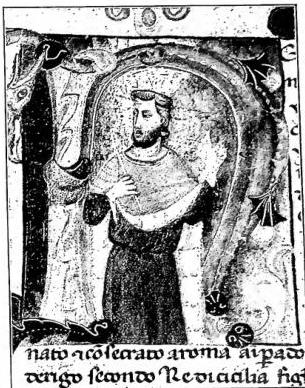
GERMANY - Frederick II, Emperor. Miniature from cod. Vat. Chig. L. VIII, 296, f. 36° (14th century) containing the Chronicles of Villani - Vatican Library.
in the transmission of the throne to his firstborn, Wenceslaus. Yet his reign was no less marked by bitter disputes among feudal lords and cities, sometimes united in leagues, with the constant intervention of the Swiss Cantons and the major princes. Imperial authority had been hollowed out, transformed.
What presses upon the entire body of the Empire is a crisis no longer merely constitutional, but general—political, religious, economic: a crisis of civilization now fully matured more through the efforts of urban centers than through any intrinsic capacity represented by the imperial institution. The antecedents and consequences of the Western Schism reverberate in Germany, in which, as in the long process of attempts at internal Church reform throughout the 15th century, one must see the greatest precursor of the Protestant Reformation. It would be the Reformation, bringing to history masses hitherto unheard and untapped, breaking the religious bond with Rome—which had been the pivot of the first diffusion of civilization in Germany and, later, the centuries-long clash between Empire and papacy—finally providing that impetus toward nation and national state, hitherto lacking, to mark the decisive turning point in German history. Political motives would prevail over the initial religious ones; it would be, as it were, a final consequence of the bitter struggle over investitures to determine, among the princes, the will to break from Rome, seizing the opportunity presented by the moral crisis of the papacy and its struggles, amid the pagan rebirth of Renaissance life, between simony and corruption, contingent problems and moral issues, principles of conciliar democracy and traditional Roman centralization.
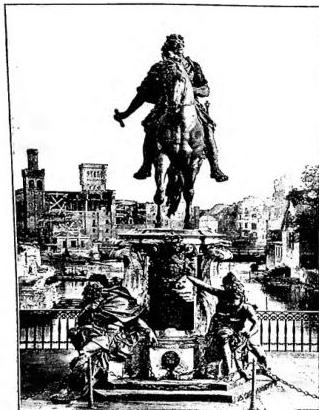
GERMANY - Monument to Frederick William (1620-88),
Elector of Brandenburg, by A. Schlüter (1608) - Berlin.
the ever-contested Rhenish frontier, danger looms between
1442 and 1445 due to the decisive French thrust; the indifference
of the Emperor and the princes, who leave the entire burden of defense
to the cities, further highlights the worsening of the unresolved
constitutional problem. In the enduring anarchy, marked by the violence
of private wars and the conflict between the Wittelsbach and Hohenzollern,
while the difficulty of reaching a concrete resolution in favor of
strengthening monarchical power becomes increasingly evident—due to the
obstacles posed by the electors' tendency to retain governance for themselves—
Hungary first, then Bohemia, withdraw from imperial authority, as did Poland,
which had formed a single kingdom with Lithuania. Maximilian I, the capable
successor (1493) to his father Frederick III, sought to reclaim the Kingdoms
of Bohemia and Hungary and to curb the growing French pressure on the Rhine.
He was driven by the anxiety to give new substance to monarchical power;
along this path, he promoted the Swabian League in 1487-88, with aims that
included policing and the high moral and economic oversight. Maximilian’s
directive undoubtedly represented an attempt to intentionally steer German
politics and to make Germany the greatest power in Europe. In domestic policy,
Maximilian was the first to have the strength to promote truly central
institutions: from the general peace to the ban on private warfare, from an
Imperial tribunal to a central treasury and well-defined taxation, with
executive powers entrusted to the Diet. However, both in the international
and domestic spheres, Maximilian’s undoubtedly perspicacious actions did not
meet with success. It was left to Germany’s now-awakened national consciousness
to align with the centralist program.
III. GERMANY AND THE REFORMATION
What shapesthe new face of Germany is, even from a constitutional
and prince-subject relations standpoint, the Reformation (v.): the movement that, precisely
as the authority of the Empire reaches its lowest ebb,
finds in a former Augustinian, Martin Luther (v.), its
foremost protagonist. Around him coalesces that league
of princes and cities which the Empire had failed to
establish on firm foundations. The right granted to the
nation as a whole to decide its political and religious
destiny fermented advantageously, binding into a single
bundle the energies of Germany hitherto represented by
the discordant rise of ever-new princely states. On the
other hand, social tendencies, due to their anarchic
impulse, found in Luther himself—ally of the princes—
the restraining element that would brutally suppress
them. The new faith lost its genuineness and efficacy,
but national consciousness and the emerging State
gained. Initially, the alignment of princes and cities
into two leagues—Protestant and Catholic—took shape.
The unity, unattained at Augsburg (1530), was consecrated
at Schmalkalden the following year by the Protestant
defensive league. And the Council that finally opened
in 1545 at Trent (v.), despite every effort by Charles V
and the papacy, was partial: the Protestants were absent.
Even earlier, Charles V had realistically acknowledged
the existence of the new order: the religious struggles,
in which figures such as Philip, Landgrave of Hesse,
Maurice of Saxony, and the other Saxon, Elector John
Frederick, emerged, ended in their first phase with the
imperial and Catholic assertion. But while the long
Council of Trent unfolded, the Protestant princes closed
ranks and ultimately prevailed over all resistance. With
the Peace of Augsburg (1555), the German Protestant
princes realized their aspirations for political and religious
autonomy. The end of the century saw their further
strengthening, even as, on the other hand, the Counter-
Reformation brought consolidation to the Catholic camp.
The Habsburgs' adherence to the Catholic side led to
an ever-greater erosion of their importance for Germany.
Amid continuous oscillations, dissensions, and shifts of
allegiance, the second decisive moment for the Reformation
arrived: the Thirty Years' War and the Peace of Westphalia
(1648), which was to represent the conclusion of both
the religious revolution and the settling of political
evolution within the very bed of the territorial states.
The impetus now came from neighboring Protestant
princes, such as Gustavus Adolphus of Sweden. The
Baltic became a Protestant sea. Preceded by a series of
separate peaces, the general peace of Münster and Osnabrück
on 24 October 1648 ended the long war, confirming the
autonomy of the states, their sovereignty—absolute within
their respective territorial spheres—marking a compromise
and, finally, the coexistence of the two faiths, based on a
principle of tolerance, though not everywhere and always
respected. Among the Protestant princes, one emerged
from the war and the peace strengthened in his already
vast domains, animated by greater aspirations and conquests:
the "Great Elector," Frederick William of Brandenburg.
From then on, Prussia would strive to assume, in opposition
to Bavaria, which remained Catholic, a role of primary
importance in German politics. The Holy Roman Empire,
by then for a long time only Germanic, would remain,
for another century and a half, an empty name without
substance: hereditary to the sovereigns of the House of
Austria, it would represent nothing more than a memory
of the past for the new princes and peoples of Germany.
IV. THE PRUSSIAN PREDOMINANCE
Already in the first decades of the eighteenth century, the path toward predominance in Germany by the Hohenzollerns, by Prussia, becomes evident. What had not succeeded for the Habsburgs, nor earlier for the House of Bavaria, instead succeeds for this other dynasty, equally eccentric with respect to the lands that had been the first cradle of the medieval Germanic Empire. What consecrates Prussia’s new role is the Seven Years’ War and, even before, its immediate precursor: the War of the Austrian Succession. With Frederick William I, through the organization of a standing army and the establishment of provincial authorities dependent on the sovereign, the foundations of Prussian power had been laid. His son, Frederick II, warrior and shrewd politician, would give prominence and momentum to the policy of the still-small Prussia, leading it, after having brought it to a parity with Austria—something that would have been unthinkable until shortly before—to a role as a European power. The War of the Polish Succession would consecrate this role.The French Revolution initially has a rather limited influence on the German states: they find themselves part of the European coalitions against France, but the role they play is certainly not vigorous. Meanwhile, due to the prevalence of the liberal-Romantic orientation, new ideas prove stronger than arms: but the revolutionary ferment operates in Germany later, primarily in a patriotic and national function, unlike in Italy, leading to the struggle against Napoleonic predominance. Faced with the tangled mass of problems that Germany must confront and resolve between the French Revolution and the Napoleonic Empire, the lack of a unified national structure is felt more acutely than ever. Even the thinkers and heralds of freedom, from Fichte to Hegel, reflect in their work the unitary aspiration: this movement of spirits would lead to the final evolution of the internal German question: from Germany as a historical and geographical expression to Germany as a national State and Empire, through the predominance of Prussia and its participation in the Germanic Confederation.
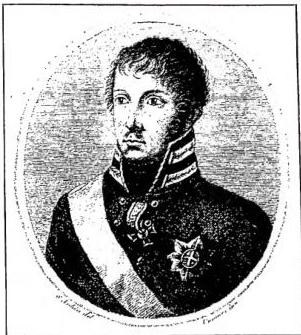
GERMANY - Portrait of Frederick William III of Prussia (1770-1840) - Rome, Museo del Risorgimento.
Roman Empire. Their example is not followed by Saxony, still feudal, or by Prussia, due to the absolutism of its king, Frederick William III. Nevertheless, the Prussian army, economic policy, and Prussian customs union constitute the most concrete foundations for the realization—non-democratic but forceful—of German unity, thanks to the Zollverein of 1834, the revolution of 1848, and the constitution of the Empire. The two tendencies—absolutist, represented by Frederick William IV, and reformist—clash, and from their conflict arises the Frankfurt Constituent Assembly, tasked with constitutionally creating German unity. Yet this does not end the disputes between Prussia and Austria, between the northern and southern principalities, between Berlin and Frankfurt, so that at a certain point Prussia opposes the German Constituent Assembly with an autonomous Prussian Constituent Assembly, cleverly conceived as a first step toward an imperial constitution, but which encounters the determined opposition of Austria.
The unitary drive of Germany still requires a negative experience; meanwhile, the conservative-reactionary stance adopted by the regent prince, William, leaves Prussia discontented and embittered. The bitterness and discontent, spread throughout Germany, determine the renewed unitary attempt of the Deutsches Nationalverein. A central government for Germany is desired: the orientation toward Prussia becomes general; the expectation that the largest state will perform the miracle of unification becomes pressing, as in Italy since 1848. Prince William reverses his policies, a liberal era seems to open, with a constitutional cabinet and a representative Chamber. Now it is the minor states that interfere between Prussia and Austria, wishing to represent a power of their own, a third force. But a sharp conflict arises between the government and Parliament over the formation of a national army. In 1861, William I finally succeeds Frederick William after his long illness, and political parties rapidly take shape. The parliamentary events and the reflection of general European politics lead to the strengthening of the progressive party and currents. The years immediately following see the attenuation of the main obstacles to further evolutionary progress: the king’s legitimism and conservatism, respectful of others’ sovereign prerogatives, is overcome—thanks to Chancellor Otto von Bismarck—by a national and unitary vision; the stubborn resistance of the other princes finds its limit in their progressive weakening; Austria’s long opposition, revealed in its true light as cold and calculated selfishness, unites German national sentiment against II. Bismarck’s policy convinces, dismantles others’ positions, is conservative, but harnesses the revolutionary forces at work for what is the purpose of his life. To this end, he bends all internal forces opposing his vast design; in foreign policy, he aims to isolate Austria; he exploits, for both internal and external ends, the opportunity presented by the reopening of the Schleswig-Holstein question (1863-64). Against the incorporation of the two duchies into Denmark upon the death of King Frederick VII, Bismarck, assuming the defense of German rights, achieves his first victory by compelling the powers to non-intervention and forcing the new Danish king, Christian IX, in a rapid campaign, to recognize the autonomy and German affiliation of the duchies; and he achieves this—no less notable a diplomatic victory—with the full support of Austria. Rivalry erupts, as expected, at the war’s end, and agitation spreads to the duchies, eager to find a place within a German framework but equally averse to outright entry into the Prussian state. It is at this moment, with a direct clash with Austria now inevitable, that Bismarck conceives and implements that alliance with Italy which allows him to bring it about in the not-too-distant future. Even if Napoleon III’s desire to turn the friction to his advantage influences Bismarck—primarily an advocate of a principle of pan-German solidarity, as his subsequent stance after Austria’s defeat would further clarify—at the Convention of Gastein (14 Aug. 1865), war is merely postponed to prepare for it better. Already at the beginning of the new year, relations become tense again: the alliance with Italy is sealed, the military machine is readied. And it is to this that credit is due for the overwhelming campaign which, after the failure of negotiations for a European congress initiated by Napoleon III, leads in the summer of 1866 to the great Battle of Sadowa, under von Moltke’s command. To renewed French interference, Bismarck hastens the conclusion, with the preliminaries of Nikolsburg, of a peace intended to secure Prussian predominance in Germany while leaving Habsburg power intact for the balance of Central-Eastern Europe. Meanwhile, French claims on southern Germany and the Rhineland become, in Bismarck’s skilled hands, the decisive card for securing the adherence of the German states to his policy of unity and for moving, in harmony with those states, toward the further decisive step of renewing a German Empire at France’s expense. For this, the dramatic shift provided by the 1867 elections—where the parliamentary majority moves from the progressives to the conservatives, advocates of a power policy—is also necessary. In the same year, the establishment of a new Zollverein finally groups all the German states together.
THE GERMAN EMPIRE
The necessity of a new war, conceived as the unifying force of national unity, against the France of Napoleon III was clear in the minds of Bismarck and his King at the very moment of the armistice, and perhaps even during the war with Austria (the coexistence of four Empires in continental Europe was impossible, even after the Austrian humiliation and amid the increasing European isolation and Asian interests of Russia). The opportunity did not delay: it was the candidacy of Prince Leopold of Hohenzollern for the Spanish throne, to which Napoleon III, hopeful of a more favorable solution, naturally objected. Conducted with extreme resolve (some have called it cynicism) by Bismarck, diplomatic solutions clashed with a determined and overt will, to which corresponded, on the opposing side, an equally overt ineptitude (Prussian renunciation, French intransigence demanding a commitment "even for the future," the Ems Telegram). The dissemination of King Wilhelm’s refusal to receive the French ambassador, Benedetti, further, arranged with bitterness by Bismarck, sounded like an offense to France and rendered any resumption of negotiations impossible. It was war. And from the outset, it proved disastrous for France (the Battle of Sedan, the captivity of Napoleon III, the surrender of Metz). After an attempt at heroic resistance beneath the walls of Paris failed, the Republic, which had succeeded the Second Empire, was forced to make peace (armistice of January 28, 1871: Peace of Frankfurt, May 10). Alsace and Lorraine passed to Germany, which, finally unified by victory and consecrated as such in the Hall of Mirrors at Versailles by Kaiser Wilhelm I’s assumption of the imperial crown, could now move from the transitional formula of annexing the southern states into the Northern Confederation to a solid imperial constitution. Yet it was even more evident than in the case of Piedmont and Italy that this was an expansion of the Prussian state: for Germany, it would leave a rich legacy of constitutional, economic, and religious problems, while the annexation of lands that were also ethnically distinct (including Polish, Bohemian, and Danish national groups) would create difficult situations for the future.
Meanwhile, from the mid-century onward, Germany had advanced considerably in economic development: industrial transformation had operated on particularly favorable terrain, as in England. The achieved unity would act as a further propulsive element, including in the colonial sphere, where, despite a significant delay compared to Western nations, Germany would eventually engage. However, Bismarck’s position became more difficult in the very consolidation of unity: even with the preexisting states reduced to a framework for Prussian predominance, political parties stirred, and the Chancellor’s iron fist, which continued to rely on conservative elements while skillfully utilizing liberal forces, clashed especially with the resistance of the clergy. Behind the clergy, the Center Party formed in 1870, rapidly gaining strength.
To render German Catholics autonomous from Rome and create a national Catholic Church, Bismarck unleashed the often violent campaign of the Kulturkampf, which ultimately failed and, in the end, benefited the Center Party. Only apparently more effective was the repressive action against the new socialist tendencies, which had manifested vividly in the homeland of Marx and Engels: in reality, Bismarck succeeded only by conceding those social defense laws that public opinion demanded and which placed Germany at the forefront in this sector. In foreign policy, to guarantee the territorial gains achieved and to ward off any renewed threat on the Rhine, the Chancellor engineered an rapprochement with Russia and a return to collaboration with the Austro-Hungarian Empire, positioning himself as the pivot amid the continual emergence of armed conflict between these two powers, motivated by Pan-Slavism in the Slavic regions of the Danubian monarchy (the question of Bosnia-Herzegovina, etc.). It was the bloc of conservative states that Bismarck strove to maintain against a West eager for change and disruption. Within this framework, and in an attempt to create a diversion from Austro-Russian frictions, one must view Bismarck’s efforts to establish the Triple Alliance with Austria and Italy. These were the foundations of three decades of international politics, useful far more for economic and technological progress than for idealistic aspirations. It was all too evident that the Triple Alliance had its limits in the growing prominence of Italian irredentist aspirations, still detached from the motherland, and in the need to end the colonial frictions between Italy and France, which Bismarck had skillfully exacerbated since the Congress of Berlin; in the consolidation of Pan-Slavism and other erosive forces within the Habsburg Empire; and in the resurgence of French nationalism, embittered by the loss of Alsace and Lorraine. Beyond this, there was another element that refused to accept exclusion from continental politics: England, with its great transmarine power. All this passed before the eyes of negotiators at every renewal of the Triple Alliance. And the failed guarantee of a bilateral Russo-German pact in 1896 sounded like a further alarm bell for the Chancellor’s policy. This occurred shortly after Wilhelm II’s ascension to the throne, as early as 1889, when Bismarck was already confronted with a general shift in political orientations. The personal clash with Wilhelm, incapable of adaptation and prudence, intolerant of control, yet inclined toward a policy of recklessness and impulsiveness, forced the old minister into retirement (1893).
Against the policy of alliances and counter-assurances, a policy of isolation now began, which would prove disastrous for the Empire. No sooner was Bismarck out of public life than Russian hostility toward Austria reflected on its ally, Germany: it found itself between two fronts, due to the increasing French enmity. The Eastern Question (the Baghdad Railway) exacerbated an already potential Anglo-German discord between two powers both aspiring to thalassocracy, but in which one, far more imbued with liberal spirits, was drawn into clearly defensive positions regarding its much older colonial and mercantile expansion. Already the final years of the century saw Germany’s arms race (von Tirpitz, large naval constructions); to Britain’s insistent warnings, Chancellor Bülow opposed a policy of blindness, which the Moroccan crisis, concluded by the Conference of Algeciras, its reopening, and the now pronounced distrust not only of France but also of Italy, clearly revealed. The Triple Entente (Russia, France, England) formed amid no small sympathies in the peninsula, assuming, despite attempts at détente by the new Chancellor Bethmann-Hollweg, a threatening stance toward the Central Powers. The majority won in the Reichstag by liberals and social democrats was not enough to halt the fatal path to war. And the final act of the drama of German isolation matured with Italy’s definitive disengagement from the Triple Alliance. Following the assassination in Sarajevo and the ultimatum to Serbia, the world conflagration rapidly ensued.
## GERMANI, RELIGIONE dei
The earliest testimonies, those of Caesar (De bello gallico, VI, 21–24) and Tacitus (Germania, 9–10), offer a synthetic and somewhat idealized image of Germanic religion. Caesar emphasizes the absence of a priestly caste and the simplicity of the cult, centered on the veneration of natural forces (sun, fire, moon) and on the figure of Mercury, whom he identifies as the principal deity. Tacitus, while confirming the importance of Mercury (Wodan/Odin), adds other gods: Mars (Tiwaz/Tyr), Hercules (Donar/Thor), and a female deity, Isis, whose identification remains uncertain. He also describes the practice of divination through the observation of the flight of birds and the neighing of horses, as well as the custom of human sacrifice, particularly in sacred groves. Both authors, however, tend to project onto the Germanic world categories proper to Roman religion, such as the triad Jupiter-Mars-Quirinus or the distinction between dii indigetes and dii novensiles.
The Scandinavian sources, particularly the Edda (13th century), though late and already influenced by Christian culture, provide a more detailed and articulated picture of Germanic mythology. Here, the pantheon is dominated by Odin, god of war, poetry, and magic, and by Thor, god of thunder and protector of men. Alongside them are figures such as Frey, god of fertility, and Loki, the trickster deity. The cosmogonic myth narrates the creation of the world from the body of the giant Ymir and the struggle between the gods (Æsir) and the giants (Jötnar), a conflict that will culminate in the apocalyptic battle of Ragnarök. The Edda also describes the cult practices, including sacrifices, banquets, and the veneration of sacred objects, such as the rings deposited in temples.
The archaeological evidence, though fragmentary, confirms and enriches the literary testimonies. The finds from bogs (Denmark, northern Germany), where weapons, jewelry, and even human bodies were deposited as offerings, attest to the importance of sacrifice in Germanic religion. The gold bracteates (5th–6th century), small medallions bearing images of deities and runic inscriptions, document the diffusion of a cult centered on figures such as Odin and Frey. The temples, though rarely preserved, are described by Adam of Bremen (11th century) in his account of the great sanctuary of Uppsala, where statues of the gods were venerated and periodic sacrifices were held.
A fundamental aspect of Germanic religion is its close connection with nature and the agricultural cycle. The gods are often associated with natural forces (thunder, fertility, war) and their cult is linked to the rhythms of the seasons. The festivals, such as Yule (winter solstice) and Midsummer (summer solstice), mark the passage of time and are accompanied by rituals of purification, divination, and propitiation. The sacred groves, mentioned by Tacitus, were places of worship where the community gathered to honor the gods and make offerings. The figure of the seeress (völva), a woman endowed with prophetic powers, also plays an important role in the religious life of the Germanic peoples.
The relationship between the individual and the divine is characterized by a sense of fatalism and the acceptance of destiny (Wyrd), which governs the life of men and gods alike. The warrior ethos, celebrated in the Edda and in the sagas, exalts courage in battle and loyalty to the chief, but also the acceptance of death as an inevitable fate. The afterlife is conceived in various ways: the fallen warriors are welcomed into Valhalla, Odin’s hall, where they feast and prepare for the final battle; others, however, are destined for Hel, the underworld ruled by the goddess of the same name. The belief in reincarnation, though not explicitly attested, seems to emerge from some passages of the Edda and from the custom of cremation, which would allow the soul to free itself from the body and return to the cycle of life.
The Christianization of the Germanic peoples, which began in the 4th century with the Goths and concluded in the 12th century with the Scandinavians, profoundly transformed their religious landscape. The process was not uniform: in some cases, it occurred through peaceful conversion (as with the Franks under Clovis), in others through violent imposition (as with the Saxons under Charlemagne). The Church often adopted a policy of syncretism, incorporating elements of the pagan cult into the Christian liturgy (e.g., the celebration of Christmas on the date of Yule) or transforming pagan deities into saints (e.g., the cult of St. Olaf in Norway). However, the persistence of pagan practices, even in Christianized areas, is attested by numerous sources, from the penitentials to the sermons of the missionaries.
The study of Germanic religion has long been influenced by romantic and nationalist interpretations, which sought in the pagan past the roots of a supposed "Germanic spirit." Modern scholarship, however, tends to approach the subject with greater critical rigor, distinguishing between the various phases of Germanic religion and avoiding generalizations. The comparison with other Indo-European religions (Celtic, Slavic, Baltic) has also allowed for the identification of common elements, such as the tripartite structure of society (priests, warriors, producers) theorized by Georges Dumézil. Nevertheless, many aspects of Germanic religion remain obscure, due to the scarcity of sources and the difficulty of interpreting them outside their cultural context.
BIBL.:
J. de Vries, Altgermanische Religionsgeschichte, 2 voll., Berlin-Leipzig 1935–37; G. Dumézil, Les dieux des Germains, Paris 1959; E. A. Philippson, Germanisches Heidentum bei den Angelsachsen, Leipzig 1929; H. Ellis Davidson, Gods and Myths of Northern Europe, London 1964; R. Simek, Lexikon der germanischen Mythologie, Stuttgart 1984; V. INDOEUROPEI, RELIGIONE; SCANDINAVIA, RELIGIONE; CELTI, RELIGIONE.
G. P.
VI. THE WEIMAR REPUBLIC AND THE THIRD REICH
Five years of war exhausted Germany’s internal resistance more than its army. The collapse of the Emperor’s personal authority, his abdication, and the assumption of power by the Social Democrat Ebert marked the final stages of defeat. A provisional government was formed to sign the armistice (11 November 1918). For the first time in German history, a democratic revolution took power while signing the Treaty of Versailles. The elections of 16 January 1919 and the Constituent Assembly in Weimar gave birth to the Republic that would bear its name. It was a weak state, burdened by the terrible legacy of defeat and threatened by revolutionary groups; yet, in its remarkable cohesion, Germany did not disintegrate, and the new regime gradually gained strength. Indeed, the harsh conditions of the peace treaty (reparations, occupation of the Ruhr, total disarmament) and the Allies’ intransigence would later fuel the dream—and then the reality—of German resurgence.For a decade, amid the severe post-war crisis, Social Democracy (led by prominent figures such as Weber) could steer the country’s fate. However, after the Treaty of Lausanne (7 July 1932) resolved the long-standing reparations issue, nationalist and right-wing currents, opposed to the policy of strict democratic adherence (though lacking in foresight) tied to the Locarno Pact and the name of Gustav Stresemann, decisively pushed for resurgence under the leadership of Hindenburg, the victor of the Masurian Lakes. Exploiting Junker sentiment, Prussian orthodoxy, and natural militarism, an Austrian who had only recently become a German citizen, Adolf Hitler, succeeded in laying the foundations—amid the collapse of the Weimar regime and the weak defense of democratic institutions by the Brüning and von Papen cabinets—of a state built upon his assumption of both the Presidency and Chancellorship (upon Hindenburg’s death), the strength of those auxiliary militias that had served as a substitute for the dissolved army, and the latent desire throughout the country for renewed military and political power. The 1932 elections (particularly the second round on 6 November) gave the majority to the party of veterans and the right-wing bourgeoisie: National Socialism. Thus began Hitler’s personal regime, with its cult of brute force, its neo-paganism, its late-Romantic and Spenglerian legacy, and, soon after, its coups against the Allies’ remaining guarantees of victory (remilitarization of the Ruhr, reannexation of the Saar), persecutions of Jews and Catholics, and the dissolution and deportation of Communists (accused of the Reichstag fire) and Social Democrats.
From then on, tendencies and ambitions within the party itself were crushed in blood (putsch of late June 1934), while the Schutz-Staffeln (SS = Protection Squads) were elevated above the SA (Sturmabteilungen), the Labour Front (Arbeitsfront) was created, the economy was unified under the control of the skilled financier H. Schacht, and the secret police was granted supreme authority. In close collaboration with his key associates (Göring, Goebbels, Himmler, etc.), Hitler pursued every stage of the most unrestrained centralization of power in history. Once consolidated internally, the National Socialist regime, banking on the weak military resolve of the democratic nations and Russia’s internal problems, began a series of international aggressions that, alongside continued military preparations, would confront Europe with faits accomplis—and with the very question of democracy’s survival. Conceived as a necessary expansion of the common fatherland, first the annexation of Austria (March 1938) and then that of Czechoslovakia (March 1939), following earlier violations of the League of Nations’ collective security system (from which Germany had withdrawn) and the sovereignty of free nations, were carried out with premeditated cynicism and bloody ferocity. All diplomatic efforts by the Western powers to avert further aggression through the Munich Agreement (29–30 September 1938), amid the Czechoslovak crisis, had already failed.
The ideological foundation was the alliance among the three right-wing totalitarian regimes: National Socialism, Fascism, and Japanese militarism. Not by chance had the path to war—opened by the very problems left by the Treaty of Versailles—begun to emerge with Germany’s denunciation of the treaty’s military clauses, the failure of the Stresa Conference (April 1935), and the close unity between Germany (ambitious for territorial revisions) and Italy (engaged in ventures in Africa and Spain). When, on 4 February 1938, Hitler centralized the high command of the German armed forces in his own hands, Germany’s internal preparations were complete, and there could no longer be any doubt that further acts of force would follow those against Austria and Czechoslovakia. Within months, the crisis over Danzig and the Polish Corridor, and the conflict that erupted on 1 September 1939, precipitated the Second World War.
Characterized initially by a period of stalemate, followed by a series of German hammer blows against the Netherlands, Belgium, France, and the Baltic states (except Sweden), and by the anxious anticipation of a landing in England, its third phase brought a reversal of the overall situation with the intervention of America and Russia and the emergence of defeats in the Mediterranean sector. As the war situation deteriorated, particularly on the Russian front, and the Anglo-American invasion of the continent unfolded, the collapse first of the Fascist regime in Italy and then the internal military putsch of July 1944 signaled the agony of Hitler’s Germany. Capitulation came shortly after the fall of Berlin and Hitler’s death, on 7 May 1945. Germany emerged from the war destroyed, impoverished, and—worse still—divided into four Allied occupation zones, as was Berlin itself, and deprived of vast industrialized regions (Silesia, Pomerania) in favor of Poland. The territorial fragmentation of the pre-unification era returned, worsened by foreign imposition and occupation. The contrasting influences of the West and Russia led to the grouping of territories into two zones, Western and Russian, corresponding to the Federal Republic of Germany and a People’s Republic.
BIBL.:
Collections of systematic bibliography: C. Dahlmann, G. Waitz, Quellenkunde d. deutschen Geschichte, 9th ed., Leipzig 1931; Jahresberichte für deutsche Geschichte, ed. by A. Brackmann and F. Hartung, ibid. 1927 ff. The largest collection of sources for German history is the Monumenta Germaniae Historica (in its various sections), Hanover 1826 ff. Smaller collections of sources (up to 1500): Ph. Jaffé, Bibliotheca verum Germanicarum, Berlin 1864-73; Acta Imperii selecta, ed. J. F. Böhmer, Innsbruck 1870; Acta Imperii inedita, ed. E. Winkelmann, ibid. 1880-1885; Die Geschichtsschreiber der deutschen Vorzeit in deutscher Bearbeitung, ed. Pertz, Grimm, Lachmann, Ranke, Ritter, and 2nd ed., ed. by W. Wattenbach, Leipzig 1890 ff.; Die Chroniken der deutschen Städte vom XIV. bis XVI. Jh., ibid. 1862 ff. Repertories for sources: A. Potthast, Bibliotheca historica M. Aevi, 2nd ed., Berlin 1896; O. Lorenz, Deutschlands Geschichtsquellen seit der Mitte d. dreizehnten Jh., 3rd ed., ibid. 1886-87; W. Wattenbach, Deutschlands Geschichtsquellen bis zur Mitte d. dreizehnten Jh., 7th ed., ibid. 1904.
General histories: K. W. Nitzsch, Geschichte d. deutschen Volkes bis z. Augsburger Religionsfrieden, 2nd ed., Leipzig 1892; K. Lamprecht, Deutsche Geschichte, 4th ed., Berlin 1902-1904; T. Lindner, Gesch. d. deutsch. Volkes, Stuttgart 1894; D. Schäfer, Deutsche Gesch., 9th ed., Jena 1922; K. Brandi, Deutsche Gesch., 3rd ed., Leipzig 1923; A. V. Hofmann, Politische Gesch. d. Deutschen, Stuttgart 1921-28; J. Haller, Die Epochen d. deutsch. Gesch., Stuttgart-Berlin 1931; H. Pinnow, Deutsche Gesch., new ed., Leipzig-Berlin 1934 (Italian trans., Milan 1935).
For the pre-Roman and Roman era: E. Wahle, Vorgeschichte d. deutschen Volkes, Leipzig 1924; F. Dahn, Urgeschichte d. german. u. roman. Völker, Berlin 1886-89; L. Schmidt, Allgemeine Geschichte d. german. Völker bis zur Mitte d. sechsten Jh., ibid. 1909; id., Gesch. d. german. Frühzeit. Der Zeitwöhrungsgang d. Nation bis zur Begründung d. fröhlichen Universalmonarchie durch Chlodowach, Bonn 1925; K. Müllenhoff, Deutsche Altertumskunde, 2nd ed., Berlin 1920; F. Kaufmann, Deutsche Altertumskunde, Munich 1931-23; T. Mommsen, Le Procène romane de Cesare a Diocleziano, trans. E. De Ruggiero, Rome 1887-90.
On the Frankish era: A. Dopsch, Wirtschaftliche u. soziale Grundlagen der europäischen Kulturentwicklung aus d. Zeit von Cäser bis Karl d. Gr., 3rd ed., Vienna 1923-24; H. V. Sybel, Entstehung d. deutschen Königstums, 2nd ed., Frankfurt 1881.
On the medieval Empire: W. V. Giesebrecht, Geschichte d. deutschen Kaiserzeit, 5th ed., Leipzig 1891-90; K. Hampe, Deutsche Kaisergesch. in der Zeit der Salier u. Staufer, 2nd ed., ibid. 1912; F. Schneider, Rom u. Romgedanke im Mittelalter, Munich 1926; G. V. Below, Die italienische Kaiserpolitik des deutschen Mittelalters, ibid. 1927; P. E. Schramm, Kaiser, Rom u. Renovatio, Leipzig 1929; R. Holtzmann, Geschichte d. sächsischen Kaiserzeit, Munich 1941; J. Jastrow-G. Winter, Deutsche Geschichte im Zeitalter der Hohenstaufen, Berlin 1897-1901; F. W. Schirrmacher, Die letzten Hohenstaufen, Göttingen 1871; P. Scheffer-Boichorst, Zur Gesch. d. 12. u. 13. Jh., Berlin 1897; G. Wendt, Die Germanisierung der Länder östlich d. Elbe, Liegnitz 1911; R. Morghen, Il tramonto della potenza sveva in Italia, Rome 1936.
On the era from the Hohenstaufen to the Reformation: O. Lorenz, Deutsche Geschichte im 13. u. 14. Jh., Vienna 1863-67; E. Michael, Geschichte d. deutschen Volkes vom 13. Jh. bis zum Ausgang d. Mittelalters, Freiburg 1897-1915; J. Kempf, Gesch. d. deutschen Reiches während des Grossen Interregnums (1235-73), Würzburg 1893; A. Leroux, Recherches critiques sur les relations politiques de la France avec l'Allemagne de 1291 à 1378, Paris 1882; C. Ullmann, Reformatoren vor der Reformation, 2nd ed., Gotha 1866; E. Gothein, Politische u. relig. Volksbewegungen vor der Reformation, Breslau 1878; G. V. Buchwald, Deutsches Geistesleben im endenden Mittelalter, Kiel 1885-87; K. Burdach, Vom Mittelalter zur Reformation, Halle 1894; J. Bühler, Das deutsche Geistesleben im Mittelalter, nach zeitgenössischen Quellen, Leipzig 1897.
On the era of the Reformation: G. Wolf, Quellenkunde der deutschen Reformationsgesch., Gotha 1915-23 and F. Schnabel, Deutschlands geschichtliche Quellen u. Darstellungen der Neuzeit, 1: 1500-1530, Leipzig 1931 (repertories); L. V. Ranke, Deutsche Gesch. im Zeitalter d. Reformation, ibid. 1867-81, critical ed., Munich 1925; id., Zur deutschen Gesch. vom Religionsfrieden bis zum 30-jähr. Krieg, in Sämtl. Werke, VII, Leipzig 1881; F. V. Bezold, Gesch. d. deutschen Reformation, Berlin 1890; id., Staat u. Gesellschaft im Reformationszeitalter, in Kultur der Gegenwart, 1. 2. Berlin-Leipzig 1908; G. Egelhaaf, Deutsche Gesch. im XVI. Jh. bis z. Augsburger Religionsfrieden, Stuttgart 1887-93; G. Mentz, Deutsche Gesch. im Zeitalter der Reformation, Gegenreformation u. des dreissigjährigen Krieges (1593-1648), Tübingen 1913; K. Brandi, Deutsche Reformation u. Gegenreformation, Leipzig 1927-30 (ed. 1941, in separate vols.); M. Ritter, Deutsche Gesch. im Zeitalter der Gegenreformation u. d. 30-jähr. Krieges, Stuttgart 1889-1908; G. Wolf, Deutsche Gesch. im Zeitalter d. Gegenreformation, Berlin 1890-1908; E. Gothein, Staat u. Gesellschaft d. Zeitalters d. Gegenreform., Italian trans., Venice 1928.
On the era of absolutism: B. E. Erdmannsdörffer, Deutsche Gesch. vom westfälisch. Frieden bis zum Regierungsantritt Friedrichs d. Grossen, Berlin 1892-93; H. V. Zwiedineck-Südenhorst, Deutsche Gesch. im Zeitalter d. Gründung d. preussischen Königstums, Stuttgart 1890-94; B. Auerbach, La France et le St Empire Romain Germanique depuis la paix de Westphalia jusqu'à la Révolution française, Paris 1912; G. Küntzel, Die drei grossen Hohenzollern u. der Aufstieg Preussens im 17. u. 18. Jh., Stuttgart 1922; W. Oncken, Das Zeitalter Friedrichs d. Gr., Berlin 1880; A. Dove, Das Zeitalter Friedrichs d. Gr. u. Josephs II., Gotha 1883; K. Th. V. Heigel, D. Gesch. vom Tode Friedrichs d. Gr. bis z. Auflösung d. alten Reichs, Stuttgart 1811-12; H. V. Sybel, Gesch. d. Revolutionszeit, 2nd ed., Frankfurt 1882; H. Hüffer, Diplomatische Verhandlungen aus d. Zeit d. franzöi. Rev., Bonn 1868-79; H. V. SERBIA, Das österr. Kaisertum u. das Ende d. heil. röm. Reiches, 1804-1806, Berlin 1927; A. Rapp, Der deutsche Gedanke, seine Entwickel. im polit. u. geistigen Leben seit dem 18. Jh., Bonn 1920; H. Schmidt, Gesch. der kathol. Kirche Deutschlands von der Mitte des 18. Jh., Münster 1920.
On Prussian predominance: G. G. Gervinus, Gesch. d. XIX. Jh. seit d. Wiener Verträge, Leipzig 1855-69; C. Bulle, Gesch. d. neusten Zeit 1815-85, 2nd ed., ibid. 1886-87; A. Stern, Gesch. Europas seit den Verträgen V. 1815 bis zum Frankfurter Frieden von 1871, Stuttgart 1890-1934; F. Schnabel, Deutsche Gesch. im XIX. Jh., vol. I: Die Grundlagen, Freiburg 1920; H. V. Zwiedineck-Südenhorst, Deutsche Gesch. u. der Auflösung des alten bis zur Gründung d. neuen Reichs, Stuttgart 1897-1905; H. V. Treitschke, Deutsche Gesch. im XIX. Jh., Leipzig 1897-94; G. Egelhaaf, Gesch. d. XIX. Jh. vom Wiener Kongress bis z. Frankf. Frieden, Stuttgart 1925; H. V. Sybel, Die Begründung des deutschen Reiches durch Wilhelm I., Munich-Leipzig 1879-94; E. Brandenburg, Die Reichsgründung, 2nd ed., Berlin 1922; G. Cavaignac, La formation de la Prusse contemporaine (1866-73), Paris 1891-98; G. S. Ford, Stein and the era of reform in Prussia, Princeton 1922; F. Meinecke, Das Zeitalter d. deutschen Erhebung, Bielefeld 1924; id., Preussen u. Deutschland im XIX. u. XX. Jh., Munich 1914 (Italian trans., Perugia 1929); O. Lorenz, Kaiser Wilhelm u. die Begründung d. Reiches 1866-73, Jena 1902.
### III. LEGAL STATUS OF THE CHURCH.
On the German Empire 1871-1918: L. Bergsträsser, Gesch. d. politischen Parteien in Deutschland, 5th ed., Mannheim 1928; E. Zechlin, Bismarck u. d. Grundlegung d. deutschen Grossmacht, Stuttgart 1930; H. W. Dawson, The German Empire 1867-1914, London 1919; G. Gorgon, L'Allemagne religieuse, 5th ed., Paris 1905-1908; H. Brisch, Gesch. d. kath. Kirche in Deutschland im XIX. Jh., 5th ed., Mainz 1902-1908; H. Fredjung, D. Zeitalter d. Imperialismus, 1881-1914, Berlin 1919-22; K. Lamprecht, Deutsche Gesch. d. jüngsten Vergangenheit u. Gegenwart, 1912-13; J. Hohlfeld, Gesch. d. deutschen Reiches 1871-1914, Leipzig 1926; A. Wahl, Deutsche Gesch. von der Reichsgründung bis z. Anbruch d. Weltkrieges, 1871-1914, Stuttgart 1926; A. Rosenberg, Die Entstehung d. deutschen Republik, Berlin 1928; E. Hartung, Die grosse Politik der europ. Kabinette 1871-1914; ed., Deutsche Gesch. vom Frankfurter Frieden bis zum Vertrag vom Versailles 1871-1919, Bonn 1929; F. Stieve, Deutschland u. Europa, Berlin 1925.
On the most recent events: M. Baumont, La faillite de la paix (1918-39), 2nd ed., Paris 1945; L. Fraser, Germany between two Wars, Oxford 1945; L. Salvatorelli, Vent'anni fra de e guerre, 2nd ed., Rome 1946; F. Friedensburg, Die Weimarer Republik, Berlin 1946; S. W. Halperin, Germany tried democracy: A pol. hist. of the Reich from 1918 to 1933, New York 1946; F. Meinecke, Die deutsche Katastrophe, Zurich 1946. Pier Fausto Palumbo
I. CONCORDATS
1. Premises
The legal condition of the Church in Germany is currently determined by the four existing Concordats: with Bavaria, of 24 January 1925; with Prussia, of 13 August 1929; with Baden, of 11 March 1933; with the German Reich, of 10 September 1933. The latter, according to the provisions of Art. 2, is valid for the entire territory of the Republic, with the exception of that of the three aforementioned regions. For these provinces, the provisions of the Concordat with the Reich are valid "insofar as they concern matters not regulated (in the respective particular Concordats) or complete the already established system."2. Concordat with Bavaria
The first Concordat that the Holy See stipulated with one of the German states after the First World War is that with Bavaria.The Concordat stipulated between Pius VII and Maximilian Joseph on 5 July 1817 no longer corresponded to the situation determined by the Weimar Constitution of 9 August 1919 and by the particular Constitution of the State of Bavaria of the same year (14 August 1919). In the first months of 1920, negotiations began to establish new norms for relations between Church and State in Bavaria. Due to various difficulties, these negotiations dragged on until 1924. On 20 March of that year, the solemn pacts could be signed. The plenipotentiary for the Holy See was the Apostolic Nuncio in Bavaria, at the time Monsignor Eugenio Pacelli. After the approval of the Bavarian Parliament, the Concordat was notified on 24 January 1925 and entered into force on the same day.
The Bavarian Concordat is a remarkable example of wise regulation of matters concerning religious instruction, benefices, and religious institutes.
3. Concordat with Prussia
In this country, some ecclesiastical questions, such as the delimitation of diocesan boundaries, the provision of ecclesiastical offices and benefices, and their endowment, had been the subject of particular agreements between Pius VII and Frederick William III of Prussia, between the latter and the princes of the Upper Rhine, and between Leo XII and George IV, King of Hanover: the conclusions of these agreements were contained in the bulls De salute animarum (1821), Provida solensque (1821), and Impenna Romanorum Pontificum (1824). The new conditions following the war of 1914-18 made new conventions necessary here as well, as in Bavaria, with the difference that here the Protestant percentage was stronger, encompassing two-thirds of the population. Thus, the negotiations, initiated immediately, encountered greater difficulties, and only after a decade (14 June 1920) was the signing achieved: the signatory on behalf of the Holy See was the Apostolic Nuncio, at the time Monsignor Eugenio Pacelli. This was followed on 9 July by the approval of the Landtag and on 13 August by ratification, after which two letters were exchanged between the high contracting parties on the school question, which was not addressed in the Concordat. These two letters were added to the acts.4. Concordat with Baden
In Baden, where religious matters were previously regulated by two bulls, Provida solensque and Ad Dominici gregis custodium (1827), the first concorded between Pius VII and some German princes, the second between Leo XII and the princes of the Upper Rhine (the bull of Pius IX Aeterni Pastoris of 1859 had remained a dead letter due to the lack of approval by the Diet of Baden), negotiations for a new concordat began in 1920. After many difficulties, the Concordat proper, along with an additional protocol, was signed by the plenipotentiaries on 12 October 1932, and an additional protocol on 7 November 1932: signatories for the Holy See were the Apostolic Nuncio, who was still Monsignor Eugenio Pacelli, and for the Supreme Council of the Republic of Baden, the ministers Joseph Schmitt, Eugen Baumgartner, and Wilhelm Mattes.These three acts, approved by a narrow margin by the Diet of Baden, came into force upon the exchange of ratifications on 11 March 1933.
5. Concordat with Germany
The need to address the gaps remaining in the three Concordats already concluded with Bavaria, Prussia, and Baden, and even more to regulate relations between the Catholic Church and the State in the other countries of the German Confederation, which did not have their own concordat, led the Holy See and the German government to enter into a general concordat for all of Germany. Indeed, attempts of this kind or at least discussions had taken place since 1919, and a draft had been prepared, but the conclusive phase occurred from 9-10 April 1933 onward, that is, after the Nazi party's rise to power, which saw in these negotiations a means to consolidate itself and to undermine the Center Party, while increasingly tying it to the government's chariot.The negotiations proceeded so rapidly that the Concordat could already be signed on 20 July 1933, ratified on 10 September: among the plenipotentiaries were Cardinal Eugenio Pacelli, then Secretary of State, on one side, and Franz von Papen, Vice-Chancellor of the German Reich, on the other. The main points of this Concordat, which, as mentioned, supplements the first three and serves as a single concordat for the other territories, can be summarized as follows: a) freedom of religion and legal protection for the free exercise of the Catholic religion throughout the territory of the Reich (Art. 1); b) full freedom for the Church in its internal governance (ibid.); c) particularly favorable to the school question is the Concordat with Germany, recognizing Catholic religion as a teaching subject in elementary, middle, and higher schools (Art. 21), with guarantees in the selection of teachers, especially in elementary schools (Art. 22, 24), while the Bavarian Concordat goes even further and places this teaching under the full supervision and direction of the Church (Art. 8, cf. also Arts. 3 ff., 9); d) more strained is the regulation of marriage matters, maintaining civil marriage, which in general should precede the religious one (Concordat with Germany, Art. 26). Likewise, Art. 31 reveals the State's concern not to leave Catholic organizations too free in their activities, especially of a social nature; e) advantageous conditions are made for the clergy regarding state subsidies in Bavaria (Art. 10 ff.), less favorable in Baden (Art. 6) and in Prussia (Art. 4).
However, from the outset, the Nazi government (of which the Church had always been suspicious but to which it could not refuse its hand when it feigned a desire for peaceful agreement) lacked the will to seriously execute the concluded Concordat, and the day after the signing, attempts were already being made to violate one by one the most vital articles. Thus, according to a preordained plan orchestrated from above, there was a progressive destruction of Catholic schools; an insidious and systematic campaign of denigration against the Church, the clergy, and Catholic laity; the continuous creation of pretexts for the closure or confiscation of religious houses; the constant and progressive elimination of Catholic newspapers, periodicals, and press, as well as Catholic book production.
Against these abuses, the Supreme Pontiff, Pius XI, raised his voice with the letter Mit brennender Sorge of 14 March 1937 (AAS, 29 [1937], pp. 145-67; Italian trans., pp. 168-88), echoing the frank and courageous protests of the German episcopate, among whom the intrepid figure of Cardinal Michael von Faulhaber, Archbishop of Munich, shone brightly (cf. the Pontifical Allocution of 2 June 1945, in AAS, 37 [1945], pp. 159-68).
BIBL.:
E. R. Huber, Verträge zwischen Staat und Kirche im Deutschen Reich, Breslau 1930; F. Giese, Der deutsche Staatskirchenvertrag, Berlin 1931; A. Mercati, I Concordati vigenti, Roma 1940; A. Hudal, Die nacheinander abgeschlossenen Konkordate des Heiligen Stuhles, Wien 1932; J. Schmidlin, Papstgeschichte der neuesten Zeit, München 1933-39, III, pp. 317-40; G. May, Die Auseinandersetzungen zwischen dem Heiligen Stuhl und dem Deutschen Reich über die Schule in den Jahren 1933-1939, in Zeitschrift für Kirchengeschichte, 68 (1957), pp. 82-121; V. anche PACELLI, EUGENIO; PIO XI; FAULHABER, MICHELE.
Pietro Palazzini
The persecutions, however, continued and were not even interrupted by the great war of 1939-1945, which instead increased the concentration camps, prisons, confiscations, and insults against members of the clergy, religious Orders, and the most influential figures of the Catholic laity. There were other glorious episodes of intrepid resistance, such as those of Card. Adolfo Bertram, Archbishop of Breslau, and the Bishop of Münster, later Cardinal, Clemente Agostino von Galen.
6. Western and Eastern G. — With the collapse of the Nazi regime under the weight of defeat (May 1945) and the subsequent Allied and Russian military occupation, which divided G. into occupation zones, the validity of the Concordat—or rather, the Concordats—was discussed by the old and new enemies of the Church. Matters unfolded differently in the Bundesrepublik Deutschland (Federal Republic of Germany, or so-called Western G.), which formed its first government on 20 September 1949, and in the Russian occupation zone.
In the so-called "Basic Law," the provisional Constitution of Western G. (the Republic of Bonn), approved on 8 May 1949 with 53 votes in favor and 12 against, Article 123 was included, by which the Federal Republic of Germany commits to recognizing all international treaties concluded with other powers. Among these international treaties is also the Concordat of 10 September 1933, along with the earlier ones of Bavaria, Prussia, and Baden.
Following this line, which has found full agreement with the government of Bonn, the relations between Church and State in Western G. must therefore be considered. However, since the government of Bonn has not yet been granted the right of legation, there is no apostolic nuncio (only a regent is present in Frankfurt am Main) and no German minister at the Vatican.
Conversely, in the Russian zone, the Deutsche demokratische Republik, which became the XXIX Republic of the U.S.S.R. on 19 March 1949, relations between Church and State—more than being governed by the Constitution (which this Republic adopted and in which religious and conscience freedom is verbally sanctioned)—are, from what little is known, ruled by the arbitrariness of the Volkspolizei (People's Police), which brutally dominates a population living under a Bolshevik regime of terror.
Indeed, as noted in a letter by the Bishop of Berlin, Card. Preysing, in state schools, children are educated according to an atheistic spirit, and the State holds a monopoly on education, making it impossible to turn elsewhere. Textbooks in these schools even go so far as to deny the historical existence of Jesus Christ. The Catholic press practically does not exist. Diocesan and episcopal offices have no official bulletin. The circulation of ecclesiastical periodicals printed outside the Republic's territory is prohibited. A regulation issued at the end of 1949 requires that the authorities be informed of the Church's various activities.
II. ECCLESIASTICAL CIRCUMSCRIPTIONS
According to the Annuario Pontificio of 1950, Germany comprises 9 metropolitan sees with 19 suffragan sees distributed as follows: 1) Bamberg (1 November 1006; metropolitan 1 April 1818) with the suffragans: Eichstätt (745); Speyer (4th century), Würzburg, Erbiopolis (741). 2) Breslau (10th century; metropolitan 13 August 1930) with the suffragans: Berlin (13 August 1930); Warmia (13th century) and the nullus prelature of Schneidemühl (13 August 1930). 3) Cologne (2nd century; metropolitan 8th century) with the suffragans: Aachen (29 November 1901; suppressed 16 July 1821 and reestablished 13 August 1930); Limburg (16 August 1821); Münster (800); Osnabrück (772); Trier (1st century). 4) Freiburg im Breisgau (16 August 1821) with the suffragans: Mainz (4th century; metropolitan 747; suffragan: 1801); Rottenburg (16 August 1821). 5) Munich and Freising (739) in Freising; united sees and metropolitan 5 June 1817) with the suffragans: Augsburg (6th century); Passau (737); Regensburg (739). 6) Paderborn (805; metropolitan 13 August 1930) with the suffragans: Fulda (1752); Hildesheim (800).Immediately subject to the Holy See: Meissen (2 January 968; suppressed in 1581; reestablished 24 June 1921).
Total: 6 archbishoprics, 19 bishoprics, 1 nullus prelature.
III. CATHOLIC CULTURAL AND SOCIAL ACTIVITY
Among the various religious groups present in Germany, the Catholic group, though numerically smaller, is the most cohesive and organized. Firmly united with its pastors, it has weathered storms and overcome difficult and painful situations, each time regaining strength and vigor.Theology, beyond the seminaries established for this purpose, was taught both in theological faculties attached to state universities (Würzburg since 1402; Freiburg im Br. since 1457; Tübingen since 1477; Breslau since 1702; Münster in V. since 1771; Bonn since 1777; Munich since 1826, transferred from Ingolstadt [1459]) and in academies and higher philosophical and theological schools (Augsburg, Bamberg, Braunsberg, Dillingen, Eichstätt, Frankfurt am Main, Freising, Fulda, Mainz, Paderborn, Passau, Regensburg, Trier).
Alongside teaching, the theological faculties attached to state universities published important periodicals and collections marked by high scholarship. The following should be mentioned in chronological order: Theologische Quartalschrift (1819) in Tübingen; Biblische Studien (1896), Biblische Zeitschrift (1903), Freiburger theologischen Studien (1910) in Freiburg im Br.; Theologische Revue (1902), Biblische Zeitfragen (1908), Neustamentliche Abhandlungen (1908), Alttestamentliche Abhandlungen (1909) in Münster; Theologie und Glaube (1909) in Paderborn; Breslauer Studien zur historischen Theologie (1922) in Breslau; Bonner Bidel (1903) in Bonn.
Among associations, in addition to those aligned with Catholic Action and its various groups, the following should be noted: the Bonifatiusverein für das katholische Deutschland (founded in Regensburg in 1849 through the efforts of I. Döllinger and organized by J. Stolberg-Stolberg in 1849), for the defense and deepening of religion, with a distinct branch for graduates: Akademische Bonifatiusverein; the Deutsche Caritasverband (founded in Freiburg im Br. by L. Werthmann in 1897), which groups all charitable institutions; the Volksverein für das katholische Deutschland (founded in M. Gladbach in 1890 by F. Brandts and F. Hitze, with the cooperation of L. Windthorst) for Christian-social propaganda among the masses; the Borromäusverein (founded in Bonn in 1844 by A. Reichensperger, M. von Löe, H. von Wittgenstein, F. X. Dieringer, F. Walter, and Aschbach), for quality press; the Görresgesellschaft (founded in 1876 in Bonn) for high culture in service of Christianity.
Many of these institutions and publications were suspended or damaged by World War II, but gradually, with tenacity, the lost time and ground are being recovered.
IV. LITERATURE.
SUMMARY:
I. From the beginnings to the 12th century
II. From Minnesang to the Reformation
III. From Luther to Frederick the Great
IV. The Enlightenment and Sturm und Drang
V. Classicism
VI. Romanticism
VII. Realism.I. FROM THE DAWN TO THE 12TH CENTURY
While it may be believed that among the ancient Germans, from the earliest times, a primitive poetic literature developed—comprising religious and warlike chants, funeral laments, and love songs—as occurred among all other peoples, it is equally certain that, upon the foundation of their myths, an entire extemporaneous poetic literature arose in distant centuries. Yet of all this poetry, transmitted orally, nothing or almost nothing has survived, for it was never, neither at its inception nor later, entrusted to any written tradition, and the Romans, who could have preserved it, showed little interest in II.Nevertheless, Tacitus informs us that the Germans had carmina in which they celebrated the god Tuisto and invoked Donar; Jordanes, the historian of the Goths, also speaks of prisca carmina, while from Tacitus himself we learn that these warlike chants were called barditus, a name perhaps derived from the fact that warriors held their shields (bardi) before their mouths to amplify the sound of their voices. Choral songs must also have been those in praise of the dead, and it is entirely plausible that all these chants constituted the genesis of the sagas or heroic legends that later formed around the principal figures of princes and warriors.
The first monument of the Germanic language is the famous Gothic translation of the Bible by Ulfila (311-81). Consecrated bishop of the Arian Goths at the age of thirty in 341, he led his people—the first among the Germanic populations to embrace it—to adopt Christianity. His translation, of which only significant fragments have survived, was completed in its entirety, except, if the legend is accurate, for the Book of Kings. It accompanied the Goths in their migrations to Italy and Spain, then fell into oblivion until, in the 17th century, the portion containing the Gospels was rediscovered in a manuscript (codex argenteus), the work of Italian scribes, preserved in Uppsala. Other parts were found subsequently, and among the fortunate discoverers was Cardinal Angelo Mai, who in 1819 uncovered in the library of the monastery of Bobbio a manuscript containing the translation of the Epistles of St. Paul.
Apart from the extraordinary literary importance of this translation, it was above all for the Germanic peoples a grand work of religious propaganda and civilization, for Christianity spread wherever Ulfila’s Bible reached, which may be considered the greatest monument of Gothic civilization.
Even after the fall of the Western Roman Empire, Rome continued to hold sway over the Germanic populations through the power of Christianity. Toward the end of the 7th century, the Irishman St. Columbanus became the apostle of the Alemanni; other fervent missionaries proceeded with the evangelization of Bavaria and Thuringia, until, in the 8th century, there arose—not so much to expand the conquests already made by Christianity as to consolidate them with strict monastic discipline and absolute obedience to the ecclesiastical authority of Rome—the figure of St. Boniface, the apostle of Germany. He carried out his apostolic work primarily in Thuringia, Hesse, and Saxony. To him are owed the establishment of many bishoprics in Germany and the founding of various monasteries, among which the most famous is that of Fulda. There, St. Boniface installed as abbot his favorite disciple, the Bavarian Sturmi, educated in Rome and at Montecassino. During his evangelization of the pagan part of Frisia, he
there won the palm of martyrdom (754); his remains rest in the monastery of Fulda.
This work of Christian penetration in Germany, through the efforts of fervent missionaries and bishops, found favor and support from the Frankish kings, especially Charlemagne, under whom the evangelization of Saxony was completed. Thus, while it may have hindered to some extent the affirmation and diffusion of a literature inspired by pagan myths and legends, it undoubtedly favored the flourishing of religious poetry and, above all, contributed to uniting a large part of the Germanic populations under the same religious and civil ideal.
Nevertheless, the sources of epic poetry never dried up, even if to find some original testimony one must leap from the 4th century, when Ulfila’s translation appeared, to the 8th century, at the end of which a fragment of a poem about the cycle of Theodoric is found, known by the title Hildebrandlied, in which the sentiment of honor and that of kinship are in conflict.
Also at the end of the 8th century unfolded the gigantic work of unifying the Germanic populations, and Charlemagne marked one of the peaks of the German medieval renaissance: a political and cultural rebirth. His work in this field, especially after the campaign in Italy that brought him into direct contact with the superior Latin civilization, is of the greatest importance. His court indeed represented the most conspicuous center of culture of the time; among others, it included the philosopher, theologian, and humanist Alcuin, of Anglo-Saxon origin but educated in Rome, the Lombard Paul the Deacon, historian of his people, and the historian Einhard. Aachen was intended by Charlemagne to become the center of this cultural renaissance, as Athens and Rome had once been.
Yet this fervor of humanistic studies did not at all mean the suppression of the original German language and poetry; on the contrary, Charlemagne himself, as seems certain, had heroic chants collected and transcribed, which until then had been entrusted only to the memory of wandering singers. In any case, the highly significant fact remains that under him, and throughout the 9th century, due to the direction he had set, poetry and prose, though their predominantly religious content was far from the spirit of national literature, preferred the vernacular, while the use of Latin would become entirely predominant in the production of the following century. During the 8th and 9th centuries, in fact, little can be recalled that pertains to vernacular literature; only poetry of religious inspiration and content offers a nucleus of works, which have also survived only in fragments, such as the Wessobrunner Gebet, of Christian inspiration, written at the beginning of the 9th century in alliterative verse and in Old High German, and the fragment of the so-called Muspilli, also in alliterative verse and Old High German, which probably dates to the mid-9th century and in which, as the title indicates, the end of the world is described. More important from a historical and artistic point of view are, in this same century, two Messiahs, one in the Saxon language, by an unknown poet, the Heliand, the other, Evangelienharmonie, written in rhymed verse in Old High German by the Benedictine monk Otfrid von Weissenburg. The two Messiahs express the highest theological culture of the time and represent, respectively, a popular and a learned attempt at the vernacularization of Christianity.
In the poetic production of the following century, which is instead written—as has been said—in an absolute predominance of Latin, it is fitting to mention a poem composed in Latin hexameters by the monk of St. Gall Ekkehard and dedicated to the Germanic saga of Walter of Aquitaine (Waltharius manus fortis), which is the most notable, if not the only, connecting link remaining from the Hildebrandlied to the Nibelung epic.
But if the poetic literature of the 10th century is characterized by classical imitation and the almost exclusive use of the Latin language, this does not prevent, especially under the impulse of the renewed political power of the Saxon emperors, the resurgence of motifs of inspiration drawn from heroic legends, still alive in the popular consciousness. Thus, the taste for Latin writers had not yet faded at the beginning of the 11th century, when a monk, probably Bavarian, wrote in Leonine hexameters, under the title Rudlieb, the first adventure novel, which provides abundant material regarding the customs and habits of the society of the time. Most ecclesiastical poets do not seek notoriety, let alone glory; their poetry is only in the service of God. Thus, by chance, the name of a poetess, Ava, is known; while a single true poet stands out from all others for the vigor of his intellect and artistic perfection: Heinrich von Melk, who left a didactic poem entitled Erinnerung an den Tod (Remembrance of Death), in which an ideal of ascetic life is presented to prepare man for death.
II. FROM THE «MINNESANG» TO THE «REFORMATION»
The not brief period of time that runs from the first dawn of German literature to the beginnings of the movement that culminates in the «Reformation» can be divided into two periods: in the first, until around 1300, literature develops under the influence of feudal society and is its expression, with the rich flowering of love lyric and heroic and chivalric poetry; in the second, which includes the 14th and 15th centuries, the bourgeoisie appears in the political and literary movement.The love lyric (Minnesang), which is rooted in reality, marks the most important part of the lyrical production of this time. The love song begins with a first uncertain and timid period of formation inspired by courtesy and the cult of the lady. Not strong passions, therefore, not vehement outbursts of the soul; the Minnesänger, almost coldly, directs his song to a vague and impersonal figure. The source of inspiration is nothing concrete and real; it is the Minne, the amorous thought, something indeterminate and fluctuating that stirs in his imagination as in his sentiment and yet brings him now pleasure, now pain, as if it were real.
The Minnesang reaches its greatest splendor around the middle of the 13th century. Songs, in whole or in part, of almost two hundred Minnesänger are preserved, among whom are remembered Federico von Hausen, Enrico von Morungen, and the most glorious of them, Walther von der Vogelweide (1168-1230), who wrote songs in a lapidary style, without any ornament, chaining within the span of a few thoughts a pathos not infrequently lofty. He was a fervent and convinced Christian, yet he did not spare, in his invectives, those who are Christians only in words, and fiercely fought the interference of the Popes in political matters, faithful to the principle: «render unto Caesar the things that are Caesar’s» and exalting the idea of the Reich.
German epic poetry can be distinguished into heroic epic and chivalric epic; the first is the impersonal expression of the collective popular and national sentiment that anonymous poets draw from the sketched material of Germanic sagas; the second, instead, is the individual work of poets who draw their material from foreign sources. Works of precursors of the true German epic, which, often written by religious figures, strongly reflect Christian influences, are the Annolied, the Alexanderlied, and Herzog Ernst; entirely unfolding in the pagan Germanic world are the main epics Nibelungenlied and Gudrun; the first stages all the peoples who were engaged in the Germanic struggles of heroic times: the conquest of a treasure, symbol of ruin and death, the treacherous killing of Siegfried and the terrifying vengeance of Kriemhild, his wife, represent the most salient parts of the poem. There is never a ray of human pity that illuminates these dark and tragic events.
The main sources of the chivalric epic are in various cycles of sagas: the ancient cycle, the Breton cycle of King Arthur, the cycle of the Grail. Among the first representatives are Heinrich von Veldeke and Hartmann von Aue (1170?-1220?), to whom are owed two poems of moralizing character and religious edification, Der arme Heinrich and Gregorius auf dem Stein. Far more notable, from an artistic point of view, are Parzival by Wolfram von Eschenbach, in which the cycle of King Arthur intertwines with the cycle of the Grail, and the unfinished poem by Gottfried von Strassburg: Tristan und Isolde.
The period that runs from the first decades of the 14th century to the entire 15th century is dominated by the appearance of the bourgeoisie; the heroic and chivalric world that had nourished poetry in previous centuries declines; the nobility, already decimated by the Crusades and unsettled by the new conditions created for the bourgeoisie, is no longer guided by that sense of courtesy that had been the soul of chivalric poetry and the Minnesang; in the castles, the environment that had been so favorable to the hospitality of poets and singers transforms. The poetic heritage, passing from the nobility to the bourgeoisie, changes and declines. The typical literary institutions of this period are the associations of master singers (Maistersänger), as many as there are cities, among which Nuremberg, Augsburg, and Ulm stand out. The work of the master singers emerges from the bourgeoisie and the artisan class and is directed toward them. Neither amorous content nor chivalric sentiment; the subjects reflect saints' feasts or civil and labor solemnities and recur repeatedly with a monotony not overcome by metrical and linguistic devices that soon crystallize into rigid forms.
III. FROM LUTHER TO FREDERICK THE GREAT
Nearly all the spiritual manifestations of the 16th century are dominated by two great events: humanism and the "Reformation." It should be immediately noted that the humanist movement in Germany did not achieve significant prominence, as its adherents, rather than deeply absorbing the spirit of antiquity, limited themselves to a superficial and rhetorical imitation of Latin writers. Among German humanists, there was no desire, let alone an effort, toward a new conception of life, of which a higher humanitas might have been the direct expression. They remained, in essence, men of the Middle Ages, primarily oriented toward heavenly matters. A constant preoccupation with the afterlife pervades their thought; beyond fleeting enjoyment, they saw the eternal abyss and everywhere the threatening finger of God. Hence, a continuous need to instruct and moralize. Among the principal humanists, Erasmus of Rotterdam (1467-1536) and Johannes Reuchlin (1455-1522) should be remembered, the latter having concentrated his activity on theological and speculative questions, as evidenced by his Hebrew studies.The "Reformation" cannot be considered solely a religious movement; it is also a great and profound national revolution that involved all aspects of German life. It was a duel between two cultures, two civilizations. Germany had never, during the Middle Ages, openly accepted the current of civilization spreading from Rome across all European peoples; rather, it had endured it, remaining firmly attached to the old spirit of its race. Now, the opportunity arose to break away from a world by which a significant part of it felt threatened, after the Roman tradition had grafted itself onto the increasingly vigorous trunk of the Catholic Church. This was the Los von Rom. It is therefore natural that when Luther appeared—though he was the least revolutionary man of his time—he suddenly found himself at the head of a revolution. Moreover, he soon imposed himself, above all, through the tenacity of his will. To him we owe, in addition to the translation of the Bible—which had a great linguistic and literary impact—the Kirchenlieder (church hymns), imitated or freely translated, and many other polemical writings.
The tone set by Luther in religious poetry found countless imitators and continuators, spurred by the new forms of Protestant worship; but in opposition to the Protestants, numerous Catholic poets and satirical writers emerged, among whom the Franciscan Thomas Murner, the most notable imitator of Sebastian Brant, who wrote Von dem grossen luterischen Narren (On the Great Lutheran Fool), in which the subversive character of Lutheran doctrine is often shown with dramatic pathos.
The remnants of epic elements that still radiated through the 15th and 16th centuries and the best and most characteristic dramatic production culminate in a single figure, Hans Sachs (1494-1576), a rare example of poetic fertility who embodied, as a whole, all the most salient features of his time. One of his merits was reconnecting with the pure springs of national popular sentiment, while simultaneously positioning himself to interpret and express its subsequent development, dominated by the movement of the "Reformation."
The theater, too, felt the influence of the "Reformation," and just as the religious song of Protestant adherents spurred Catholic poets to counter with their own hymns, so too did dramatic production revive, with biblical themes regaining new vigor.
In the realm of satire, with moralizing tendencies, Johann Fischart (1550?-1590) should be remembered, who particularly targeted the Roman Church and religious Orders, especially the Jesuits, often descending into the coarse tone of the pamphleteer.
The civil and political conditions of the 17th century were bound to hinder any literary movement. Germany had to endure the Thirty Years' War, which had exhausted all moral energy, offering a prolonged spectacle of destruction. Violent religious disputes showed no sign of abating; the nation seemed to have lost consciousness of itself. Far removed from the literary glory of the past, it was inevitable that it would turn toward foreign literatures, particularly the French. The result was a colorless, insipid, mannered, and academic production. Yet it was precisely to academies, modeled after the Italian ones, that recourse was had when seeking a remedy for the general decline of literature, especially poetry. At the very moment when, in several regions, the only literary activity was represented by linguistic societies, a poetic revival occurred in Silesia through the poet Martin Opitz (1597-1639), who exerted considerable influence on his time, to the point of being considered a schoolmaster.
Many poets indeed followed in his footsteps; among them, Paul Fleming (1609-1640) deserves mention, even if many of his lyrics were imprinted with the taste for "concetti." In the field of religious poetry, Opitz was followed by J. Hermann, the Pietist Spener, and Paul Gerhardt (1607-1676), who achieved the highest lyrical elevation in Protestant ecclesiastical song. Catholicism, too, did not remain extraneous to the Opitzian movement. By the end of the 17th century, as the ardor of conflict subsided, Protestants and Catholics, at least in the field of poetry, found themselves singing the praises of the same God and the hymns of the same Christian faith. The Jesuit Friedrich Spee (1591-1635), who dedicated his life to works of charity and exercised an apostolate of tolerance that shone especially in the fight against the ferocious executions of witch trials, left a book of edification, Guldenes Tugendbuch (Golden Book of Virtue), and a collection of religious songs, Trutz-Nachtgall (Defiant Nightingale), which continues the tone of fervor and love of mysticism. One of his imitators was Johannes Scheffler, better known under the pseudonym Angelus Silesius (1624-1677), who converted from Protestantism to Catholicism. In his Cherubinischer Wandersmann (Cherubinic Wanderer), a collection of brief poetic compositions, he reflects precisely the poet's detachment from Lutheran rigorism and his longing for new paths to reach God. Closer to the idyllic religious song of Spee is Silesius in Heilige Seelenlust (Holy Desire of the Soul), in which the life of Christ, the waiting for Him, His coming, His death, and His Resurrection are exalted in mystical ardor.
Poet of both sacred and secular lyrics was Andreas Gryphius (1616-1664), whose name, however, is primarily associated with his tragedies, which imitate the external structure of Greek tragedies and introduce the chorus, as well as with his comedies.
Like religious song, satire and the epigram are among the most genuine expressions of the German soul. For the latter form, Friedrich von Logau provided an example with his over three thousand epigrams (Sinngedichte), while for satire, H. Michael Moscherosch should be remembered, who sometimes violently attacked fremde Thorheit (foreign folly), at other times raised inexorable reproach against the vices and abjection of the time, especially in his Wunderliche und wahrhaftige Geschichte Philanders (Wonderful and True History of Philander) and Sitteswald. Finally, the most famous Catholic preacher of the time, Abraham a Sancta Clara, should be mentioned.
The foremost representative of the so-called adventure novel was H. J. Christoffel von Grimmelshausen (1625-1676), who, rather than employing violent satire, looked higher, yearning for and advocating a profound moral reconstruction. His Der Abentheuerliche Simplicissimus (The Adventurous Simplicissimus), the most important and significant literary work of the 17th century, is a true Bildungsroman, such as could arise in a tragic era, in which he indicates the path that was to lead to the national and human rebirth of Germany.
In the field of lyric poetry, among the poets who, more than the lush imagery of the followers of the Opitzian school, aimed at substance, Heinrich Brockes should be remembered, whose poems form the majority of the collection titled Irdisches Vergnügen in Gott, and especially G. Christian Günther (1695-1723) for the sincerity of his sentiment and the vivacity of his expression, so much so that he seems out of his time.
IV. THE ENLIGHTENMENT AND STURM UND DRANG
The long and ruinous Thirty Years' War had disrupted Germany morally and economically; it was therefore natural that a period of recollection followed, in which the people, still lacking a force of national cohesion, thought only of restoring their economy; thought thus remained inert, devoid of creative impulses and great ideals. However, as Germany gradually recovered and the first nucleus of a great nation, united in the same faith and the same ideal, formed around the figure of the great Elector Frederick William, the accession to the Prussian throne of Frederick II and the victorious Seven Years' War were a cause for exaltation among the German people and gave impetus to a vibrant patriotic poetry. It is true that the king himself remained an admirer of the French, denying the Germans the possibility of creating something truly original and great in the field of literature, but it is also true that, by fighting for the political emancipation of Germany, he indirectly fostered and hastened the great literary reaction against France. Foreign imitation, in fact, gradually diminished until it disappeared, and some great spirits emerged who achieved the original expression of the nation's soul, implicitly carrying out work of universal importance.The religious epic of Klopstock, expressing one of the deepest sentiments of the Germanic soul, the rich and restless production of Wieland, the enthusiastic and amorous divinations of Winckelmann on the Hellenic world and Greek art, the keen insight and clear artistic vision of Lessing, the broad historical perspective of Herder worthily prepare and form a fitting frame for the universal work of Wolfgang Goethe and the eclectic yet profoundly human work of Friedrich Schiller.
But before reaching the full affirmation of these great spirits, while almost the entire era of Frederick the Great was still dominated by Enlightenment thought and consequently by French influence in the field of culture and poetry, the first signs of a reaction to this dominance emerged, soon becoming an open and decisive struggle, led primarily by J. Bodmer and J. J. Breitinger, who engaged in a thorough battle against the prevailing aesthetic conception of J. C. Gottsched. A follower of rationalist philosophy, Gottsched was convinced that true poetry should not spring from imagination but from scrupulous observance of rules dictated by reason; he therefore advocated the imitation of French literature, in which he saw the example of perfection, and at the same time expounded the vague and indeterminate principle that poetry should be an imitation of nature. His opponents, however, from the so-called Zurich school, opposed greater freedom in the field of inspiration and placed great value on imagination, which necessarily oriented them toward English poets. This explains why, when the first cantos of Messias by F. G. Klopstock (1724-1803) appeared in 1748, greeted with general enthusiasm, the two leaders of the Swiss school believed their work accomplished with the advent of a great poet.
A different judgment is given today of Klopstock's poem: the emphatic tone of many passages, which only rarely gives way to sublime mystical elevation, the disharmony in the overall structure of the work, the boldness of the images and syntactic constructions, the very unruly richness of the language make its reading at least very laborious. But Klopstock's name is especially linked to his odes, in which the highest sentiments that illuminated his life are reflected: religion, the cult of the fatherland and freedom, the sentiment of friendship and love.
Not without reason is G. Ephraim Lessing (1729-81) often contrasted with Klopstock, a balanced, extremely acute intellect, self-aware, conscious of the intellectual demands surrounding him and of the goal he wished to achieve. He was a wise guide for German literature; in the Hamburgische Dramaturgie he fought the first great battle against the literary dominance of France, turning instead to the English; and while the peak of his critical activity is marked by the aesthetic treatise Laokoon, he achieved a very notable place as a playwright, writing the comedy Minna von Barnhelm, which inaugurated a new era in German theater, and two dramatic masterpieces, Emilia Galotti and Nathan der Weise, in which the concept of humanity is exalted, placed above and beyond any religious or confessional competition.
One of the foremost places among German poets and prose writers for the elegant freshness of his eloquence and for a comic and witty philosophy of life is assigned to C. Martin Wieland (1733-1813), author of poems, such as the chivalric-heroic Oberon, and of some novels, such as Don Silvio von Rosalva, Agathon, and Die Abderiten. He is one of those writers who possess the rare gift of deriving from others everything that is akin to their artistic temperament, while preserving that originality which does not disdain to draw on spiritual attitudes expressed by the work of others.
Lessing's criticism had not made people forget the name and work of Klopstock, and a group of young men from Göttingen proposed to continue his artistic ideals, publishing every year a collection of poems inspired by him. Thus appeared the Musenalmanach, and soon after arose the Hainbund, a sort of new Arcadia, which, however, had nothing of Arcadian affectation. Heinrich Voss, Matthias Claudius, and Peter Hebel immediately emerged for their poetic value, and above all, G. August Bürger (1747-94), considered one of the best representatives of popular poetry. He excelled in the ballad, a genre of rapid and dramatic lyrical narration, in which he knew how to treasure elements of popular inspiration, animating them with simple refinement of taste. Famous are the ballads Lenore, Der Kaiser und der Abt, and Der wilde Jäger.
The culminating moment of German literature had an immediate preparation in the intellectual achievements of one of the greatest modern thinkers: Immanuel Kant, and in a movement of agitation to which even Goethe initially adhered: the stormy period known as Sturm und Drang. To the spirits of this literary revolution, the present world seemed too narrow, stifled by outdated views and rules in which creative thought was bound to drown. Broader horizons and a freer breath were sought. Already, the thought of Georg Hamann—who, particularly in asserting the superiority of faith over reason, exerted great influence on Herder’s spirit—and that of Jacobi had reclaimed this freedom for man, combating Enlightenment rationalism and arguing that everything must arise from the individual and the fullness of his powers. The concept of unrestrained freedom is the most evident feature in the Sturm und Drang program, in life as in art. Furthermore, the literary revolt, which rejected all models and thus all rules, necessarily led back to nature, also falling under the influence of Rousseau. The popular current, whose first manifestations had already been seen in England with the publication of Ossianic songs, then found wide resonance in Germany; but it was inevitable that these elements would degenerate into disorder and, especially the cult of freedom, into a kind of moral anarchy, as seen in Wertherism and Räuberism.
No small influence on this movement was exerted by one of the most universal and profound minds of his time, J. G. Herder (1744-1803), who advocated the rise of a national literature, revived the tradition of German folk songs (Stimmen der Völker in Liedern), while in his work Vom Geist der hebräischen Poesie he demonstrates that the Old Testament constitutes the oldest, simplest, and most natural poetry, springing spontaneously from the soul of a people whose ardent faith places them in direct contact with God. This work is almost the seed and introduction to his philosophy of history, Ideen zur Philosophie der Geschichte der Menschheit. Herder was also a poet, but above all a critic with broad vision and keen intuition; his spirit delves into the primordial nature of things, listening to their first mysterious voice, from which he succeeds in extracting the most hidden secrets.
V. CLASSICISM
In the luxuriant flourishing of this literary period, it is not always possible to distinguish the various tendencies and forms of art, which often coexist in the same writer, and even less so, therefore, to neatly classify poets as classicists or Romantics. Goethe, in fact, began as a Stürmer und Dränger and became a classicist par excellence, yet not a few Romantic elements are found in his work; the same can be said of Schiller. Within the orbit of Sturm und Drang were born the novel Die Leiden des jungen Werther, the drama Götz von Berlichingen, the lyrics and rhapsodies that represent the rupture of the harmony of things and of the happy soul, such as Prometheus, which immediately follow the serene pantheistic vision (Mailed, Ganymed, Mahomets Gesang). Two events contributed to bringing Goethe’s genius to the full manifestation of its maturity: his stay in Weimar and his journey to Italy. The former represented progress in his lyrical production, as the poet sought new paths toward a calmer and more serene art, which was to contrast with the disordered fever of his early youth; the latter marked the true rebirth of the man and the artist, whose fruits included, among others, Tasso and Iphigenie auf Tauris. In the tone of the latter work, in the sweet harmony of the impeccable verse and the admirable balance of its parts, the tragic sense that nevertheless pervades it all fades and dissipates; the line and texture of the drama seem to possess the immobile composure of a Greek statue. Works of his maturity included the novel Wilhelm Meister and Die Wahlverwandtschaften, the most delicate idyll in epic lines Hermann und Dorothea, Die römischen Elegien, the Italienische Reise, and Faust, the work on which the poet labored for nearly sixty years. Goethe found the legend of Faust alive in popular tradition, but, rethinking it in his own spirit, elevated its value to a universal symbol of the eternal stance of the human mind (whether Faust investigates, or Mephistopheles denies, or Margaret writhes in pain) before the terrible unknowns of life’s mystery. Yet, apart from the unattainable splendors of its form, a new morality is evident in the dramatic poem, one that exalts action for action’s sake and the unappeased and unappeasable yearning of man toward ever-new conquests, without considering the value of the means used to achieve them, thus making Faust’s salvation possible precisely because “he who ever strove with yearning” can be redeemed. It is a morality that ill accords with the final intervention of the Virgin and the angels, insofar as it represents a contaminatio of Christian ethics. In any case, this is all that Goethe’s genius could offer, within the bounds of thought and before the general problem of existence, since he lacked that faith which is ready to satisfy reason with a formula of sentiment.All of Goethe’s reflective, objective, universal intellect contrasts with the nature of Friedrich Schiller (1759-1805), dominated by sentiment, even when he granted himself a respite from works of imagination and poetry to compose works of philosophy and history. His poetic production, for the fervor of its inspiration, the richness of its motifs, and the ideal unity that illuminates it, seems dominated by the presentiment of the poet’s brief life. He lives his work intensely, drawing it from the profound roots of his own imagination and soul, almost without indulging in gathering experience from reality. Schiller is therefore a subjective spirit, eminently lyrical, even when, writing for the theater, he constructs the action upon a background of historical elements that he colors and idealizes with the ardor of sentiment and the impetus of fantasy, governed by a constant and unique restraint: an adamantine probity that never fails.
While still very young, he established himself in the theater with his first great tragedy, Die Räuber, to be considered a product of Sturm und Drang for the undisciplined impetus that dominates it; it was soon followed by Die Verschwörung des Fiesko, the bourgeois tragedy Luise Miller, and the most tormented dramatic work, Don Carlos. The series of dramatic masterpieces begins with the trilogy Wallenstein, a human representation idealized by historical elements; in Maria Stuart, Schiller is primarily concerned with portraying human characters, while in Die Jungfrau von Orléans, the dramatic action departs even further from historical reality, not lacking even the marvelous and supernatural element. His last completed drama, Wilhelm Tell, admirably synthesizes the two great loves of the poet: love for the beauty of nature and love for freedom.
All of Schiller’s work is dominated by an ethical principle, a moral idea. To all his heroes he gives the impetus of magnanimous or reckless passion, but he never deprives them of the flame of faith and the sense of moral responsibility. This is evident even in the disordered demolitions of his early dramas, which, like those of his maturity, exclude a conflict between the self and the world, between man and God, between necessity and freedom, but are rather the representation of human life in its struggles and sorrows, idealized by the poet’s consciousness and dramatized by his passion.
Even Schiller’s rich lyrical production moves within the orbit of a moral ideal. Here, every conflict between ethics and aesthetics seems to dissolve: the world and life appear to the poet in luminous clarity (Die Ideale, Das Ideal und das Leben, Der Spaziergang, the ballads, and the celebrated Lied von der Glocke).
It would be an exaggeration to claim that Lessing, Goethe, and Schiller gave Germany a true national theater; nevertheless, they had a great number of imitators, who, though far from equaling their models, sometimes achieved resounding success on the stage, such as A. W. Iffland, H. J. Collin, and above all August von Kotzebue, who was the true dominator of the theater at the end of the 18th century.
Prose, on the other hand, especially humorous prose, assumed in this period strongly original characteristics through the work of various writers, among whom one stands out: J. Paul Richter, who called himself Jean Paul in literature (1765-1825). Among his novels, Die unsichtbare Loge, Hesperus, Titan, and Flegeljahre should be mentioned, along with the delightful tale Maria Wuz in Auenthal. For those who wish to grasp the humorous flavor of this narrator, a careful analysis of his style must come to their aid, in which bold perspectives and not infrequent oddities form an intimate whole with his thought. And it is precisely from this fusion that his inexhaustible and original vein of humor springs.
VI. ROMANTICISM
Romanticism arose directly from the political conditions of the time and, even more so, from a broad philosophical movement that prepared and accompanied it over many years. Among the thinkers to whom the greatest merit of this preparation is attributed is J. G. Fichte. He has absolute faith in the creative activity of man and affirms the dogma of personality: man exists insofar as he is conscious of himself, and knowledge has no boundaries, tending to expand limitlessly, gradually conquering the world outside himself. A disciple of Fichte, Friedrich Schelling turned Fichtean idealism toward a broad and profound pantheism. His entire philosophical system is the fruit of the ardent imagination of a poet, which is why the Romantics found their doctrines and tastes—inclined toward the vague in the free fields of fantasy, unconstrained by the rigid control of reason and critique—primarily reflected in his assertions. Completing the triad of philosophers is Georg W. F. Hegel, who returns once more to Spinozan pantheism, replacing the static fundamental principle of substance with the dynamic concept of the Idea, which in itself contains every creative impulse.Yet the fertile seeds of the Romantic movement do not mature solely within philosophical thought; they are already present, without needing to look further back, in the pantheistic mysticism of Böhme, wholly striving and yearning for the conquest of divinity diffused in nature, in the struggle for liberation from French influence, in the affirmation of the rights of imagination (Bodmer and Breitinger), in the conception of poetry as an effusion of sentiment (Klopstock), in the exaltation of the individual by Sturm und Drang, in the dismantling of the Horatian aesthetic canon ut pictura poësis (Lessing), in the cult of Shakespeare, in the recognition that poetry is the voice of nature (Herder). The Romantics, therefore, will shun all that is present and real; what they will strive to express will not be concrete thoughts or mature sentiments, but fleeting images barely sketched, the throbs of feelings just blossoming from the poet’s soul, thoughts glimpsed in the most recondite mysteries of life and fleetingly expressed.
Determinacy and perfection do not correspond to the Romantic ideal; its life is Sehnsucht, which tends toward the infinite and the eternal and thus has no possibility of fulfillment. This is the intimate reason for the drama of the Romantic soul, which, in essence, is the same drama as that of German idealism. Yet it is clear that their restless Streben tends toward a solution, a conquest of unity and harmony; and this is sought in two directions: the Dionysian and the Christian, one of which might be called immanent, the other transcendent—that is, the former toward the absolute, in the mad attempt to surpass life and scorn its unbreakable laws, and the latter toward renunciation; the first is also that of heroic titanism and heroic decline; the second, that of a resignation that does not fully accept rest within a religious confession. Dionysian Romantics may thus be considered Hölderlin and Kleist, Christian ones Schlegel, Brentano, Tieck, Runge, and Novalis. But how and in what do the immanentist and transcendental conceptions fundamentally diverge? For here precisely lies the problem of religion among the Romantics, insofar as a revealed religion, with its dogmas and rigid norms, is in irreconcilable contrast with the Romantic spirit, open to all impulses and yearning for all goals. And indeed, religion, whatever it may be, is always more or less a function of the Romantic conception. Thus also Christianity. For if Christ were felt, in the orthodox sense, as the savior of humanity, every soul would find in Him easy and full satisfaction, whereas Christianity not only brings neither peace nor harmony to any Romantic spirit but rather serves only to illuminate, through deviations or kindred attitudes, other facets of its restless and uneasy striving. Love, for example, is regarded as a religious expression; but it is not separated from voluptuousness, which satisfies the Romantic aspiration for unity, that is, to bring the divine closer to the human, heaven to earth, spirit to the senses. And this mysticism of love necessarily bound the Romantics to the religion of Christ in its two fundamental elements: love and sin—sin as the strongest goad to love, love as the highest aspiration for a return to God. Thus religion, love, and voluptuousness become equivalent, but it is important to note that it is love in its fullness that creates, nourishes, and characterizes religion; and since this religion is Christianity, it is once again clear that we are far from any orthodoxy and also from Christian morality.
Romantic ethics, in fact, confirms an absolute independence from all norms derived from a revealed religion. Beyond spiritualized love and the voluptuousness of sin, the Romantics were drawn to Christianity as a religion of death, insofar as death opens to all Christians, as to the Romantics, a higher and better world, beyond the real and the present, in an afterlife that is precisely the realization of the infinite and the eternal. Thus, rather than religion, one must speak, in the case of the Romantics, only of religiosity, that is, a sentiment inherent in their vision of the world and of life, which is foreign or distant from a true and profound religious faith.
The affirmation of the Romantic movement received its greatest impulse from the critical work of the Schlegel brothers, Wilhelm and Friedrich, who were its shrewd and bold theorists. To the former are owed the famous Vorlesungen über schöne Literatur und Kunst, which, together with the Vorlesungen über dramatische Kunst und Literatur, contain the fundamental principles of Romanticism; to the latter, among other works, a Geschichte der alten und neuen Literatur and a novel, Lucinde, which provoked no small protest for its exaltation of sensuality pushed to the Romantic extreme.
Among the most prominent poets, Friedrich Hölderlin (1770-1843) is easily placed among the classics of German literature, while it is undeniable that his poetic-lyrical world arises entirely within the atmosphere of the Romantic ideal, both in his passionate and vain aspiration to create a unitary vision of life and in his flight from the real and the transitory, which also imposes on him a material detachment from the woman he loved, even if his illusion of having reached or at least glimpsed a goal beyond which desire ceases appears anti-Romantic, as in Hyperion or Archipelagus or in the tragedy of Empedocles. A prolific but less original poet, lyricist, and prose writer is Ludwig Tieck (1773-1853), who, especially in his dramatic tales, makes ample use of Romantic irony, a marvelous dialectical game that arises from the awareness of continuous overcoming and, at the same time, from the disillusioned desire to satisfy every ideal demand. His friend Wackenroder, who died at only twenty-five, and who in the Herzensergießungen eines kunstliebenden Klosterbruders pours out the passionate impulses of his youthful soul, especially for the cult of art, may be considered the Winckelmann of the Romantic school, while Friedrich von Hardenberg (Novalis: 1772-1801) is its most distinguished lyricist. A natural and profound tendency toward mysticism, veiled by disconsolate sadness, inspires his Geistliche Lieder, full of abandonment and simplicity, so much so that they are considered the songs of a Christian community, and those marvelous Hymnen an die Nacht, in which the poet, animated by the strength of his love for the lost maiden and his desire to reach her, is confident that she can break and overcome the iron laws of human life.
BIBL.:
Per la filosofia romantica: G. De Ruggiero, La filosofia contemporanea, Bari 1920; B. Croce, Saggio sullo Hegel, Bari 1927; G. Gentile, Le origini della filosofia contemporanea in Italia, Messina 1917-1923; per la letteratura: R. Haym, Die romantische Schule, Berlino 1870; J. Minor, Neuhochdeutsche Metrik, Strasburgo 1902; H. A. Korff, Geist der Goethezeit, Lipsia 1923-1953; per i singoli autori: W. Dilthey, Das Erlebnis und die Dichtung, Lipsia 1906; F. Schultz, Klassik und Romantik der Deutschen, Stoccarda 1935; E. Ermatinger, Die deutsche Lyrik seit Herder, Lipsia 1921-1925; per la religione: R. Unger, Hamann und die Aufklärung, Jena 1911; H. A. Korff, Voltaire im literarischen Deutschland des XVIII. Jahrhunderts, Heidelberg 1917; E. Troeltsch, Die Soziallehren der christlichen Kirchen und Gruppen, Tubinga 1912. — G. GABETTI.
The dispersal of the early representatives of Romanticism and the spread of the movement led to the creation of various centers of Romantic life and poetry, such as that of Heidelberg with Clemens and Bettina Brentano and Achim von Arnim, characterized by the tendency to give literature a more distinctly national character, drawing motifs from popular tradition (Des Knaben Wunderhorn); and that of Berlin with the poets A. von Chamisso and F. de la Motte Fouqué, also marked by a lively and sincere devotion to poetry, though not confined to the exclusive circle of Romantic theories. Younger than his Heidelberg friends is J. von Eichendorff, author of a delightful tale, Aus dem Leben eines Taugenichts, and of exquisite Lieder, which possess a rare grace of sentiment and sound and are imbued with an intimate religious sense, with which Eichendorff loves to permeate all his poetry.
One of the elements of the Romantic movement had also been the sentiment of freedom, often coupled with ardent patriotism. This sentiment, which had given rise to patriotic poetry during the Seven Years' War and had become overwhelming in Sturm und Drang and early Romanticism with Schiller's dramas, Fichte's impassioned appeals (Reden an die deutsche Nation), and Görres' incisive articles, could not fade when Napoleon's victories spread consternation from one end of Europe to the other, threatening every aspiration for freedom. Then Romanticism, setting aside its fantasies and irony and swept up by an impetuous national current, became patriotic and produced the passionate songs of Arndt, Schenkendorf, Rückert, and the poignant and tempestuous verses of the youngest German lyricist, Theodor Körner.
But Romantic drama, above all, gives us a clearer and more precise idea of the immense favor that Romantic doctrines encountered everywhere, shaping the literature of the time. For if there is a literary genre that shuns unreality and indeterminacy of form, it is precisely drama. Thus, Romanticism worked the miracle of having the Schicksalstragödien, the fatalistic dramas of Zacharias Werner (1768-1823), such as Der vierundzwanzigste Februar, applauded on stage, while Romantic elements—such as the fantastic, the marvelous, the terrible, determined by a more intimate and profound analysis of characters—enter the dramas of Heinrich von Kleist (1777-1811), along with a marked tendency toward the absolute, which imprinted, at least on his early dramas (Die Familie Schroffenstein and especially Penthesilea), the mark of an excessive personality. The same terribleness, sometimes even monstrous, found in some Kleistian tragedies reappears in the dramatic works of C. Grabbe, while it is carefully avoided in the dramas of Franz Grillparzer (1791-1872), who does not seek to analyze characters according to a preconceived idea, nor does he ever subordinate action to philosophical considerations, making his creations symbols or abstractions, but instead infuses them with real life and makes them move on stage as they would in life. Nevertheless, it is easy to observe that the poet often intervenes in the course of the action to prevent his characters, following the impulse of their own passions, from going too far; and the restraint that the Verstandeswuch, of the most balanced and tenacious kind, opposes to the poet of agitated and overflowing imagination—something that does not occur in his fatalistic dramas like Die Ahnfrau or even in the trilogy Das goldene Vlies.
In lyric poetry, however, Romantic elements gradually fade, marking deviations and even reactions. Thus, in the cult of form and the intention to introduce new metrical attitudes into the language and suggestive phantasms of the Oriental world, Friedrich Rückert (1788-1866) and August von Platen (1796-1835) found agreement, the latter essentially Romantic in his early lyric collections and anti-Romantic in two comedies imitating Aristophanes, while his conversion to the cult of classical form asserts itself in later lyrics, especially in the Sonette aus Venedig, of exquisite craftsmanship. The Swabian poets, among whom Ludwig Uhland (1787-1862) stands out, author of ballads, rhapsodies, and romances highly popular for their ingenuity and spontaneity of inspiration and conciseness of style, constitute an artistic group with its own distinct physiognomy, though all shared the aim of drawing the best possible profit from the Romantic current while avoiding any exaggeration. Alongside him, Eduard Mörike deserves mention, great especially in his intimate and most harmonious lyrics, in which the Romantic echo is felt, though the poet strives to reconcile Romanticism and Classicism. The Swabian school also connects with the lyric poetry of Nikolaus Lenau (1802-50), a poet of vibrant and seductive originality for the immediacy and sincerity of his inspiration, the vividness and richness of his images, and the broad and profound sense of human sorrow that pervades it and not infrequently assumes the character of Weltschmerz. He seeks sorrow as necessary nourishment for his life and poetry, and this sorrow sharpens and extends to all things, until he feels the soul of the world weep as his own soul weeps: a symbolism of nature, typically Romantic. And a "desacralized" Romantic was how another far greater poet, the Jewish Heinrich Heine (1797-1856), was defined—great in lyric poetry, especially in the Buch der Lieder, as in the prose of the Reisebilder, as well as in the satirical epos Atta Troll. Heine can truly be considered the last Romantic; of restless and aggressive spirit, he personifies, with typical and salient traits, the tendencies, contradictions, skeptical rebellions, delirious and fleeting enthusiasms of modern man when the environment has not yet regained its equilibrium. He does not possess the tragic sense of the world, but rather a tragic awareness of his own world and life; thus, he lacks the faith or the sentiment of resignation of the believer, possessing only the tormenting consciousness of man's impotence before the inaccessible power that governs life, and it is precisely this consciousness that recreates his God, the terrible antagonist in the tragedy of a man who loves life and cannot enjoy it, who knows he must die and does not wish to die, and who therefore becomes humble and rebellious, prays and blasphemes, supplicates and mocks. It is his tragedy that is reflected in the poet's final songs.
VII. REALISM
The speculative thought that had prepared and followed the movement may be said to have been exhausted by a series of epigones of Hegel’s philosophy, some of whom, strict adherents, limited themselves to a cold exegesis of his works, while others, more daring followers, pushed the master’s doctrine to the extreme limit of exaggeration. This group gathered under the name of the “Hegelian Left,” among whom Luigi Feuerbach and Federico Strauss, author of a Life of Jesus, stood out, while the Hegelians found a violent and astute opponent in Arturo Schopenhauer, who returned to Kant’s philosophy, though reaching pessimistic conclusions.In the 19th century, science and historiography in Germany achieved their most fruitful results, thanks to a renewal of all auxiliary studies and a rigorous revision of methodological problems. Similarly, the philosophical and linguistic studies of the Grimm brothers and the comparative literary and linguistic studies of the Humboldt brothers prepared the ground for a new and deeper vision of historical facts.
By the mid-century, poetry took on a distinctly political character, which, far from offering a total vision of life, adhered instead to the particular and contingent reality of the moment. Already since the political upheavals of 1830, a great ideal had been increasingly asserting itself in Germany, one that also found reflection in political literature: the formation of national unity and the conquest of freedom. This gave rise to a literary association (Das junge Deutschland), which shared evident points of contact with Romanticism in its marked tendency toward individualism, but diverged sharply from it in its essential significance: the political-liberal tendency. The same tendency inspired a patriotic lyricism that flourished around the political movements of ’48, with Hoffmann von Fallersleben, Ferdinando Freiligrath, and Giorgio Herwegh.
Outside any school, however, and a poet in the most genuine and noble sense of the word, was Annetta von Droste-Hülshoff (1797-1848). Her entire lyrical production (Das geistliche Jahr and Letzte Gaben) is permeated by a sincere and profound religious sentiment. She was intimately Catholic, yet one would search in vain in her verses for the echo of previous confessional struggles; in her work breathes only a breath of peace, diffused through all creatures of the earth and nature, and a pure, intimate sense of humanity, softened by a touch of tenderness distinctly feminine, rises from every one of her songs.
In narrative literature, and particularly in the novel, the modern world is increasingly reflected—or at least, in historical novels, events that provide the occasion for the story are viewed through the eyes of men aware of the tendencies of life, aiming at psychological analysis and realistic representation. Thus, a conscientious observer of life is Gustavo Freitag (in Soll und Haben), while extensive readings on various historical periods, such as the Reformation in Germany and the Renaissance in Italy, were invaluable to C. Ferdinando Meyer for creating the backdrops of many of his works. The social novel is worthily represented by Federico Spielhagen (Problematische Naturen); a delicate poet of nature who feels and describes with a fine artist’s touch the landscape and life of his homeland, Bohemia, is Adalberto Stifter; a delightful short-story writer who loves above all small things (Immensee) is Teodoro Storm, and equally notable narrators are Federigo Reuter, full of naturalness and vivacity, Teodoro Fontane, who combines a distinctly naturalistic narrative with a profound knowledge of German life and soul, Bertoldo Auerbach, whose tales are imbued with a deep sense of humanity, Goffredo Keller, a Swiss, who rises from the simple and objective narration of rustic life and the vivid and colorful description of nature to a broader concept of humanity and pure poetry (Die Leute von Seldwyln), and finally a true master of the novella, Paolo Heyse, enamored of Italy, where he resided for a long time and where the action of many of his stories unfolds; and the Styrian Pietro Rossegger, a highly popular writer of autobiographical tales, greatest in the small world of his native land (Waldheimat, Die Schriften eines Waldschulmeisters).
The theater, too, in the second half of the 19th century, adopted attitudes similar to those of narrative, increasingly orienting itself toward the analysis of sentiments and the realistic representation of modern life. Hence, a closer and more immediate contact between the writer and the public: literature became popular. Thus, while narrative prose, in a careful and detailed study of settings and characters, created the village tale, the theater, also inspired by the observation of everyday life, led to the realistic plays of Freitag and Anzengruber. But even before the latter, Federico Hebbel (1813-63), in a fairly extensive series of tragedies (Judith, Maria Magdalena, Herodes und Marianne) and comedies, revealed himself as a modern writer, concerned with capturing the spectator’s attention through the analytical originality of his thought, even if, due to excess, he did not always succeed in his intent. Hebbel is the creator of a new dramatic form; he considers drama the faithful representation of human life. For him, the tragic is an element inherent in our life, arising ineluctably from it, because to live means to will and to act, and to will and to act can only mean to suffer and to sin. And it is always the idea of original sin that weighs upon humanity through the centuries like an invincible fatality. While prose theater thus sought its path, Riccardo Wagner (1813-1883) carried out the reform of musical drama, beside which the merit—great in itself, if one considers the unitary conception he had of theatrical spectacle—of having composed the poems he later set to music, drawing them from remote and genuine popular tradition (Tannhäuser, Lohengrin, Tristan und Isolde, Nibelungenlied, Meistersänger von Nürnberg, Parsifal), fades into the background.
By the end of the 19th century, Naturalism dominated the theater almost exclusively. What was demanded of the dramatic author was that he bring to the stage a work that would act upon the spectator like a real-life event and give him the illusion of reality. Subject and technique were subordinated to the necessity governing this illusionism on stage. The principal representatives of Naturalist drama are Ermanno Sudermann (1857-1928) and Gerardo Hauptmann (1862-1946): the former wavered between different formulas, without managing to free himself from a certain French influence, but it is undeniable that many of his dramas (Die Ehre, Stein unter Steinen) are constructed on a strong framework and achieved full success; Hauptmann, more individual and profound, possesses a broad and penetrating gaze for observing the contrasts of social classes (Vor Sonnenaufgang, Einsame Menschen, Die Weber). He is also a poet who does not disdain even symbolic attitudes derived from Ibsen’s theater; a ready and precise scenic technique and an agile effectiveness of thought and sentiment assist him, so that his theater maintains a wholly distinctive physiognomy.
A clear departure from Naturalist theater is marked by the dramas of Arturo Schnitzler, who comes under the influence of Freudian doctrines in scrutinizing the depths of the human soul in its most mysterious aspects, as well as in its strongest passions (Fräulein Else), while in his later years he seems to become grave and pensive in the face of the mystery of life.
The religious beliefs of the ancient Germanic peoples are reconstructed primarily from the testimonies of classical authors (Tacitus, Caesar, Pliny the Elder, etc.), from archaeological finds, and from the later Germanic literatures (Edda, sagas, etc.), which, however, reflect a phase already influenced by Christianity. The picture that emerges is that of a polytheistic religion, rich in deities linked to natural forces and to the fundamental aspects of human life (war, fertility, death, etc.). The gods were conceived as powerful but not omnipotent beings, subject to fate (Wyrd) and to a cosmic order that even they could not alter. Among the principal deities, Wodan (Odin) stands out, god of war, wisdom, and the dead, often associated with magical practices; Donar (Thor), god of thunder and protector of men; Tiwaz (Tyr), god of justice and the thing (assembly); Frija (Frigg), goddess of marriage and fertility. Alongside these major figures, there was a multitude of minor deities, spirits, and supernatural beings (elves, dwarves, giants, etc.), who populated the natural world and influenced human life. The cult was essentially domestic and communal, with sacrifices (animals, objects, and in some cases even humans) offered in sacred groves, springs, or on altars. The priestly function was not institutionalized in a distinct class but was exercised by the heads of families or by tribal chiefs. A particular aspect of Germanic religion was the belief in an afterlife: the dead were thought to continue a shadowy existence in the underworld (Hel), or, for warriors fallen in battle, to be welcomed into the halls of Odin (Valhalla). The conversion to Christianity, which began in the 4th century among the Goths and was completed between the 8th and 11th centuries among the other Germanic peoples, did not entirely erase the ancient beliefs, which survived in folklore, in place names, and in some customs.
Archaeology. — Archaeological studies concerning early Christianity in Germany can normally be considered in those countries on this side of the Danube and the Rhine that were occupied by the Romans. In these regions, the main military and commercial stations also became the most important ecclesiastical centers and, as such, nuclei of early Christian culture attested by places of worship, cemeteries, objects, furnishings, and inscriptions, which were created under Roman influence until the Carolingian period. Here are the principal cities in which ancient Christian monuments were discovered.
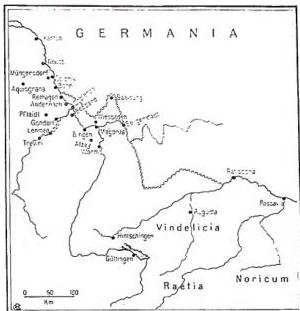
(Ese. Cott.)