GIANSENISTI, PEDAGOGIA dei: V. PORTOREALE.
GIAPPONE. - Il G. (dal cinese Jih pèn, localmente pronunciato Nippon, o Nihon) è costituito da
I. GEOGRAPHY
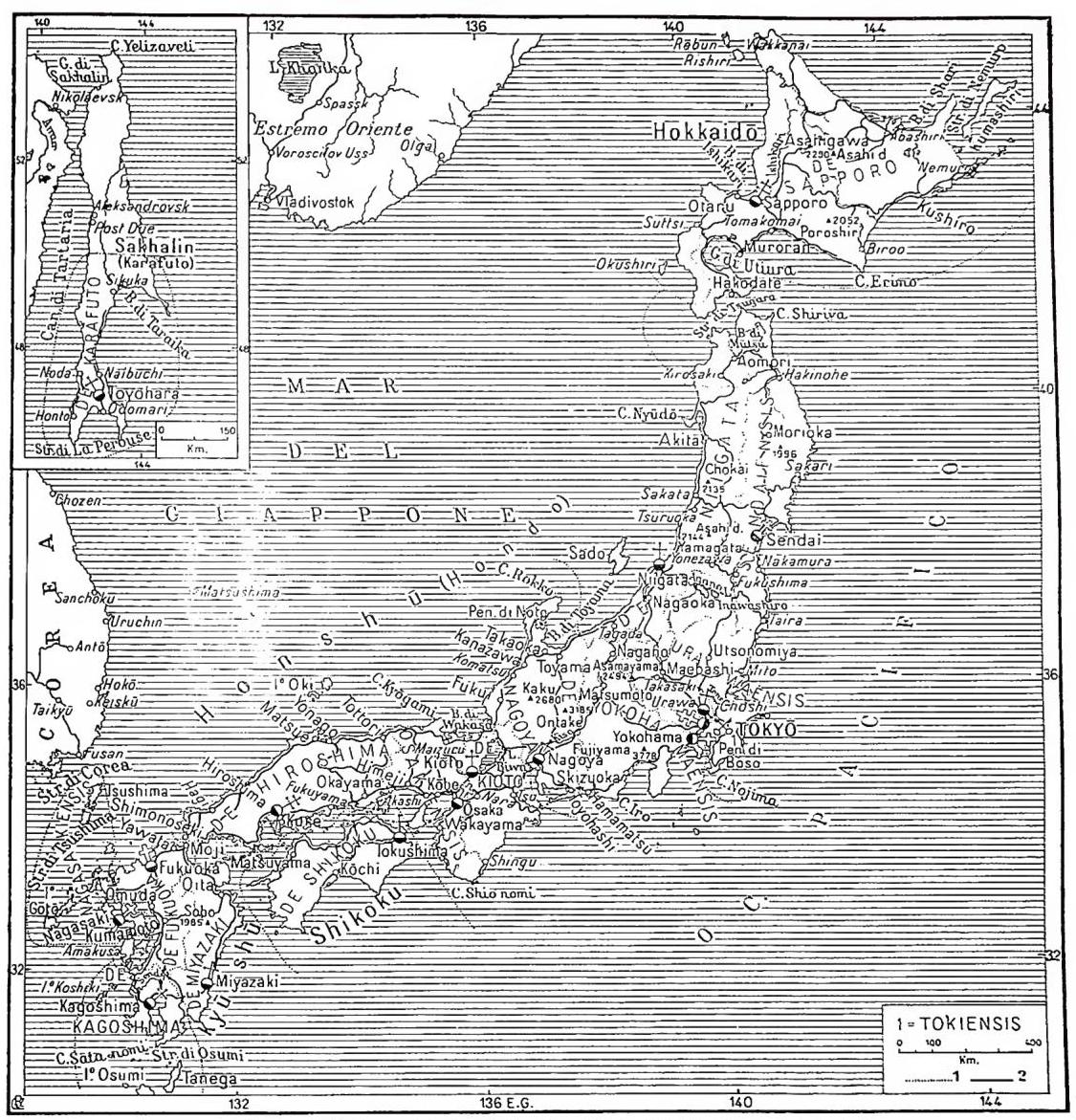
The territory has a markedly mountainous and volcanic character: plains are few and mostly of modest dimensions. More than three-quarters of the country consist of short, elevated bands of medium height. The highest peaks correspond to recent volcanoes (Fujayama, 3776 m); out of 165 of these, 60 are active, and their lava flows alone cover 1/5 of the surface of Japan. Seismic activity is intense (on average more than one earthquake per day), with a sad frequency of catastrophes (also due to the concomitant action of tidal waves and eruptions). The coastal perimeter is more rugged and indented with ports than that of Greece. The meeting of the two marine currents of Kuroshio and Oyashio (the one warm, the other cold), off the eastern coast, makes the coastal regions extremely rich in fish. The climate is rather varied: at the same latitude, winters are colder and summers hotter than in Europe, as a consequence of the monsoon regime (cold continental winds in winter; warm marine winds in summer). On the whole, these are healthy, temperate or warm-humid subtropical climates. Rainfall is everywhere copious and distributed across all seasons, but the rivers, given the conditions of the terrain, are short and torrential in character. The land is covered with magnificent forests of conifers and broadleaved trees (in the higher zones) in the north and center, while in the south a luxuriant subtropical vegetation develops, with cedar and bamboo groves, and patches of evergreens.The population of the archipelago, ethnically com-
The country's economy is centered on agriculture. Rice, which alone occupies half of the cultivated land, is the basis of the local diet. Among other crops (cereals, tobacco, sugar cane), those of soybeans and tea prevail. The scant importance of livestock farming is offset by sericulture, which has undergone enormous development throughout the country, and by fishing, which holds the world record for product quantity (3-4 million tons per year) and also feeds thriving industries (canning, fertilizers, fish meal and oils). Great is the benefit derived from the conspicuous forestry resources (timber, camphor, celluloid, essences).
Despite the inadequate availability of raw materials of mineral origin (except for copper, and, to a much lesser measure, for some metals, but not for iron), Japan had managed, before 1940, to create a formidable apparatus no less for the variety and capacity of its branches (especially textile, mechanical, chemical), than for the affordability of its products and the commercial organization designed to market them. On the other hand, modern large-scale industry has failed to suppress a craftsmanship that is equally active and highlighted by the exquisite artistic sense of production respectful of the best traditional forms. The war has roughly halved the capacity of industries and closed many prospects for them: an efficient recovery will also depend on the possibility of balancing the increased deficit in the trade balance.
Internal communications, rather than by the road (8,550 km) and rail network (24,400 km), are favored by
easy maritime transport. The Japanese merchant fleet, which before the war was the third largest in the world, is now reduced to a second-rate position (1.5 million tons).
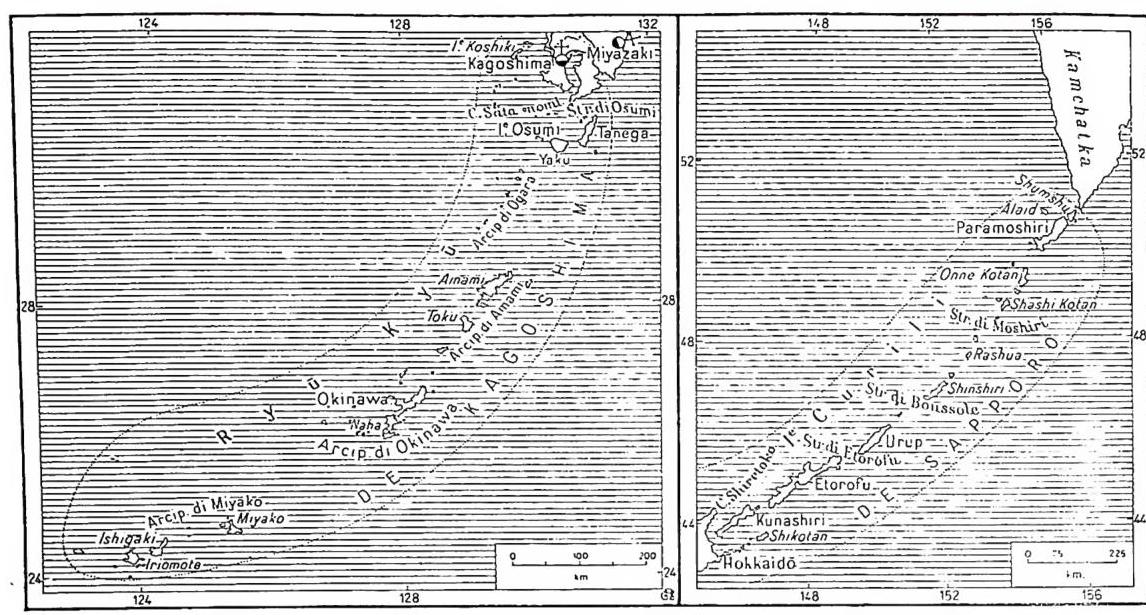
As a consequence of the defeat suffered in World War II, Japan lost its entire colonial empire, which in 1941 made it a State of 690 thousand sq. km with 110 million inhabitants: Korea has become independent, the southern part of the island of Sakhalin and the Kurils have passed to the U.S.S.R., Formosa has returned to China, the mandated oceanic territories (Caroline, Mariana, Marshall) were taken into trusteeship by the U.S.A., and the Ryū-Kyū are still of uncertain destiny.
Data concerning the major islands are summarized in the following table:
| Major islands (adjacent islands) | Area in sq. km. | Number of prefectures (Ken) | Population (1935 census) | Density inhab. per sq. km. | Main urban centers (population in 1,000 inhab. in 1940) |
|---|---|---|---|---|---|
| Hokkaido | 88,775 | 13 | 3,063,883 | 34 | Hakodate (207), Sapporo (197) |
| Hondo | 230,533 | 34 | 52,713,877 | 221 | Ōsaka (3,252), Nagoya (1,328), Kioto (1,089), Yokohama (968), Kōbe (967) |
| Shikoku | 18,772 | 4 | 3,357,282 | 179 | Kōchi (105) |
| Kyūshū | 41,800 | 6 | 9,520,005 | 227 | Hukuoka (291), Nagasaki (212), Kumamoto (187), Kagoshima (182) |
| Giappone | 379,880 | 57 | 68,655,047 | 186 | Capital: Tōkyō |
| 1950 Estimate | 80,697,000 | 219 | (6,789) |
According to the new constitution (1947), the Japanese State is a hereditary constitutional monarchy. The democratic government rests on an elective bicameral representation. Pending the peace treaty with the victorious powers, the United States military occupation continues.
II. CIVIL HISTORY
1. Origins. - The first nucleus of the Japanese people was formed by successive immigrations of peoples coming from the Asian continent and the islands of the South Seas. A group of tribes, identifiable by archaeological remains of the type called yayoi (Neolithic age), settled in the southern part of the island of Kyushu. The oldest literary sources, the Kojiki (712) and the Nihon-shoki (720), hint at a progressive extension of these tribes along the coasts of the Inland Sea and assign the founding of the Empire at Yamato to the 7th century B.C. by Jimmu Tenno, whereas historians move this date to the 1st century A.D. Literary and archaeological testimonies attest that, since the earliest centuries of the Empire, relations with China and Korea were frequent. Chinese chronicles of the 3rd century refer to the Japanese by the name Wa. The credit for having created the first territorial unity of Japan is generally attributed to Empress Jingō, who is also said to have intensified relations with the continent. Chinese culture penetrated Japan above all in the 4th century, when its ideographic characters were officially adopted. Its assimilation, which had long been favored by numerous immigrations of Chinese intellectuals and artisans, slowly but surely modified Japanese life, fostering the rise of a philosophy that prepared the ground for the future spread of Buddhism. The society of the time, of a patriarchal type, was constituted by family communities (uji) having the same origin and by groups of families practicing the same trade (be or tomo). Each community was ruled by a hereditary chief and its members inherited the social position of the community itself. During the Yamato period, political history was determined by the struggles of the great clans (Otomo, Mononobe, Soga) for the conquest of supremacy. These struggles, which began in the 5th century, led, with the predominance of certain families (6th century), to the stripping of power from the imperial dynasty. During the supremacy of the Sogas (536-645) the introduction of Buddhism took place, warmly supported by Prince Shōtoku.2. Nara and Heian Epochs (710-1191). - The fall of the Sogas led to the Taikwa reform (648), which aimed to strengthen imperial authority and to create a political and social order of the type implemented in China by the T'angs. The reform entailed the creation of a capital (Nara), the appointment of governors in the eastern provinces, and the abolition of hereditary offices. The lands, declared state property, were given in usufruct to the peasants who, removed from the authority of the elders, became taxpayers to the State. During this period, as the government was engaged in the struggle against tribes not controlled by central authority (among them those of the Ainu, among the most ancient inhabitants of Japan of proto-Caucasian origin), relations with the continent weakened. This gave the Japanese time to assimilate and to "Japanize," so to speak, the imported elements