
HERRAD OF LANDSBERG (LANDISPERG). - Abbess, b. ca. 1125-30, from the noble Alsatian family of the Landsberg; having entered the monastery of Hohenburg (Odilienberg, Alsace), she was a faithful disciple of the abbess Relinda, whom she succeeded in that office in 1171. Following in her footsteps, she was able to bring the monastery to a great flourishing.
Indeed, for its better religious service, she founded nearby the Convent of St. Gorgon, entrusting it to the Premonstratensians; and she founded another with a hospice at Truttenhausen for the Augustinians. For the instruction, moreover, and the edification of the nuns she composed the Hortus deliciarum, a kind of encyclopedia of all theological and profane knowledge from the 12th century: Holy Scripture, expounded especially in its mystical meanings then in vogue in the Middle Ages, theology, philosophy, geography, history, fine arts, etc. The title was chosen by the author (and it was common in Latin, especially medieval Latin) because the work gathered together as in a "garden of delights" all the "flowers" that could be collected from the works of the Fathers, of theologians, of philosophers and from the books of the Bible. There are found in it, in fact, cited sometimes verbatim, passages of authors ranging from the most ancient Fathers down to the contemporaries Anselm of Canterbury (d. 1109) and Rupert of Deutz (d. 1135). Of her own H. added some poetical works, accompanied by musical notes.
Bibliography5 works
ART
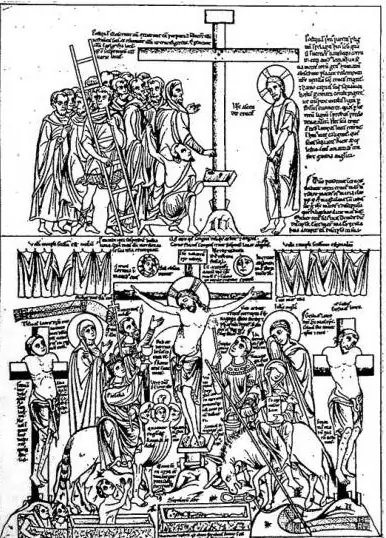
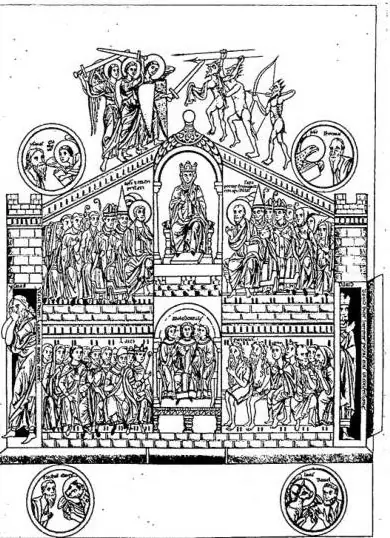
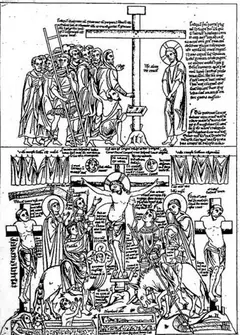
A manuscript of the Hortus deliciarum, precious for the miniatures that adorned it, was preserved together with the only existing copy in the Library of Strasbourg, and both were lost in the fire of the Library on 23 Aug. 1870. It has fortunately been possible to recover about 230 of the 336 miniatures of the original manuscript, thanks to the reproductions in studies preceding the destruction and to the casts made at the behest of J. de Bastard, now in the National Library of Paris. These reproductions have been collected and published by A. Straub and G. Keller (2 vols., Strasbourg 1901). It is from these, in particular, that one can form an idea of the originals, resplendent with vivid colors, with a wonderfully careful drawing that at times attains notable force of expression. Evident, however, is the presence of several illustrators, owing to the alternation of various influences in the different miniatures, where one passes from a Byzantine schematism to a majesty of composition of almost classical flavor, especially in the figures of Christ and the Apostles, or to a liveliness and expressive power typically Romanesque. Taken as a whole, moreover, the miniatures present a notable interest for Christian iconography and symbology: see, for example, the myth of Ulysses and the Sirens.
Gérard saw an intimate fusion between text and miniatures, for which reason he did not hesitate to attribute these as well to H. herself. Marignan, on the other hand, besides depriving the famous abbess of the honor of the composition, which he considers beyond the abilities of a woman, following a careful and detailed examination of the miniatures thinks that both the costumes and the iconography and the very character of the representations push the date of execution back to the beginning of the 13th century; he therefore draws the conclusion that it was not the original that was illustrated, but a second copy of about 1230. - See rav. XCI.