
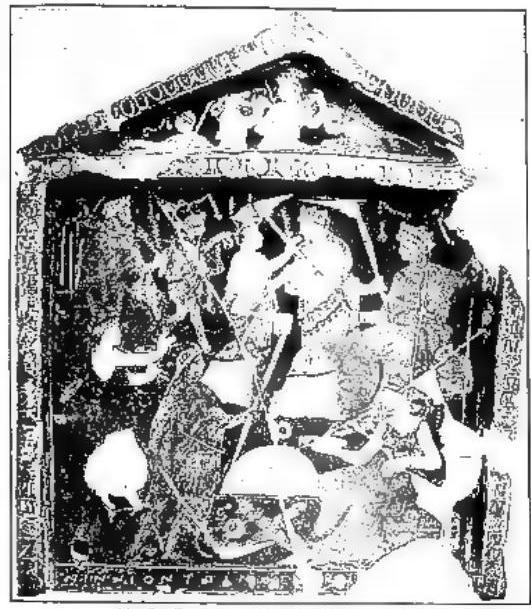
ELEUSINIAN MYSTERIES. - They were celebrated at Eleusis (today Lefsina), a village 22 km. north-west of Athens. They were dedicated to Demeter, the "mother earth" of crops, and to Kore the "maiden," that is, the vegetation, her daughter. Originally purely agrarian in meaning, like the other festivals celebrated there on the various recurrences of the agricultural year: Proerosia (sowing), Chloia (the sprouting of the grain), Kalamaia (the strengthening of the stalk), Haloa (ploughing), the Eleusinian festivals, through that intrinsic capacity that agrarian rites have to rise to a higher meaning, assumed, especially after the close union that came about between Eleusis and Athens, a spiritual meaning and opened to the initiates the hope and the vision of a better life.
The period of this transformation must be placed between the 8th and 6th centuries, the age of the great spiritual and social ferment of ancient Greece, religiously represented by the Orphic-Dionysiac current. That it was Dionysus, the god dear to the common people for his beatifying ecstasies, who provoked this transformation is inferred from the fact that Eumolpus, the eponym of the first Eleusinian priestly family, came from Thrace, the homeland of Dionysus; that the Lesser Mysteries, which were celebrated in Athens, were in part dedicated to Dionysus; that the great procession which carried the "sacred things" (τὰ ἱερᾶ) from Athens to Eleusis had as its mystagogue Iacchus, the youthful and enthusiastic form of Dionysus; that Pindar (Isth. 6, 3, 5) calls Dionysus paredros, that is, consort of Demeter, because he is associated with her in the mysteries.
The sanctuary goes back to Minoan times, as has been shown by the excavation which, beneath the present telesterion, the "hall of initiations," the only hypostyle hall of 12 columns built by Pericles (5th century), with orthogonal benches in a square arrangement cut into the rock on three sides, has brought to light another, much smaller one that likewise points back to the Minoan period. The whole sanctuary, which comprised chapels and minor shrines, was enclosed by a perimeter wall (peribolos) that concealed it from the eyes of the profane.
The priesthood was exercised especially by the two families of the Eumolpidae and the Kerykes. From the Eumolpidae the hierophant was drawn, so called from his own office of "showing the sacred things." From the Kerykes the "torch-bearer" (daduch) was drawn for the nocturnal ceremony of the mysteries. There were also minor priesthoods.
The celebration of the Great Mysteries, which fell in autumn, was preceded by the Lesser Mysteries, which must be considered a preliminary instruction for the Great ones and fell on the 19th-21st days of the month Anthesterion (Feb.-March). The Great Mysteries followed at a distance of six months, from the 13th to the 21st of the month Boedromion (Sept.-Oct.). Of these days the most notable were the 16th, on which the purification of the initiates took place at the sea of Phalerum with the sacrifice of a piglet; and the 19th, on which the great procession took place, led by the image of Iacchus, which carried in an ox-drawn wagon the basket with the "sacred things" and, skirting the bay of Salamis, arrived in the evening, amid dances and songs, before the peribolos of the sanctuary. What took place inside on the days from the 20th to the 22nd was secret (μυστήριον) and reserved for the initiates. The secret has been kept as regards the ceremonial; therefore only fragmentarily can one attempt a sketch of what were the most solemn mystery celebrations of Hellenism.
a) 21st of Boedromion. - Liturgical drama of Demeter and Kore: initiation of the first degree (μέτρας). Of two kinds were the secret celebrations that took place in the telesterion: liturgical dramas (δράμενα) and initiatory rites (τελεταί).
By drama here must be understood not a scenic representation, which the hypostyle construction of the telesterion would not have allowed one to see, but a ceremony of a liturgical type in which the officiant performs, in reduced form and with ritual garments, the sacred action whose protagonist is the being of whom he is the minister. The liturgical drama that unfolded in the telesterion had as its protagonists the two goddesses, Demeter and Kore. A fairly adequate idea of this drama is offered by the Homeric Hymn to Demeter (end of the 6th century B.C.), a kind of sacred praise, not liturgical, born in the Eleusinian milieu and directed at exalting the religious privilege of the city.
The hymn, of 495 hexameters, narrates the abduction of Kore by Pluto, who carries her off into Hades; the consternation of Demeter, who, having set out in search of her daughter, reaches Eleusis, where she meets the royal family, to whom she reveals her identity and orders King Celeus to build her a temple. As soon as this is finished, she shuts herself inside it until her daughter is restored to her, thus depriving the earth of the benefit of vegetation. Zeus orders Pluto to release Kore and establishes that the maiden shall stay for two thirds of the year with her mother and for one third with Pluto (a most transparent myth signifying the seed hidden for three months within the earth and for the rest sprouted as vegetation). Once Demeter's seclusion has ceased, the whole earth brings forth again.
This dramatic myth of the two goddesses consists of two parts: a sorrowful one, corresponding to the abduction of Kore, to Demeter's mourning and to the consequent sterility of the earth; and a joyful one, corresponding to the finding of Kore, to the mother's gladness and to the consequent renewal of vegetation.
That two moments, one sad and one joyful, were celebrated at Eleusis is evident in general terms from Plato (Phaedr., 250 B C), from Themistius (in Sodeo, Plut., 1, 107), from the rhetor Aristides (Eleus., 256); and, with direct mention of the two goddesses, from Clement of Alexandria (Protr., II, 12), from Apuleius (Met., VI, 2), from the grammarian Apollodorus (frg. 36, Müller), from Statius (Silv., IV, 8, 50-51), from Lactantius (Div. Inst. Epit., 18).
From these direct hints it is gathered that the mystic drama of the two goddesses reproduced at Eleusis must have been a liturgical procession in which the initiates ran breathlessly, shaking their torches behind the daduch in the role of Demeter, in search of the daughter. The procedures and formulas in use in this liturgical race have remained secret.
It is not possible to establish when the true initiatory rite took place; the formula preserved by Clement of Alexandria attests that it was preceded by a fast and by the taking of a potion of flour, water and mint (χυλεών, kykeon) and that it consisted in the touching and in the sacramental use of the sacred things.
Thanks to this rite the initiate came almost to be adopted into the spiritual family of the goddess.
Clement of Alexandria (Protr., II, 20) in fact, in a precious passage which Arnobius (V, 25) reproduces, gives us the initiatory formula of the mysteries which the mystes pronounced, declaring that he had performed the prescribed ceremonies. It is as follows: "I have fasted; I have drunk the kykeon; I have taken (the 'sacred things') from the basket, after touching them I have put them into the kalathos; and from the kalathos (I have put them back) into the basket."
The most recent and most probable interpretation (Koerte, Kern) sees in the "sacred things" a reproduction (in dough) of the sex (better, of the female womb), by touching which the initiate effected the union with Demeter, coming forth from her as a son.
Certainly, through this initiation the mystai effected the sacred union with the goddess, felt themselves assimilated to her in a wholly special way and capable, therefore, of participating in her vision and in her joys as they had been partakers of her fast and of her sorrow.
Thus the liturgical drama of the 21st of Boedromion came to a close and the initiation of the first degree was completed. Not all the mystai also received the second, and in any case this took place a year or even more later.
b) 22 Boedromion. - From numerous sources it is gathered that the night of the 22nd was dedicated to the celebration of the sacred marriage between Zeus and Demeter, represented respectively by the hierophant and by the priestess of the goddess. The scholiast on Plato's Gorgias (Schol. Plat., Gorg., 497, C) affirms this beyond doubt. The Fathers of the Church (Clem. Alex., Protr. 2,15; Tertullian, Ad nat., 2,7; Hippol., Ref. haer., 3,8,59; Greg. Naz., Orat., 39,4) show themselves scandalized by it and use it as a weapon to inveigh against the obscenities of paganism.
A very ancient tradition recorded by Homer (Odys., VI, 125) and by Hesiod (Theog., 669-71) narrates the coupling of Demeter with Iasion; the goddess is said to have lain with Iasion on the fallow land thrice plowed; or, according to another version preserved in the scholiast on Aristides (Schol. Arist., p. 22), she is said to have given herself to King Celeus in the territory of Eleusis in exchange for news of her daughter's disappearance.
This tradition must be considered as an echo of that ancient magical-agrarian practice whereby, among many primitive peoples, the sexual act is performed by an eminently representative couple, for the purpose of provoking and aiding the fertility of the earth.
It is understood that once the Eleusinian mysteries were constituted, with the corresponding elevation of their spiritual value, the magical value of that nuptial rite came to be obliterated, giving place to a mythical and mystical value, and Demeter, rather than coupling with a mortal, coupled with Zeus. To this evolution there may have contributed the development of philosophical thought, which in that hierogamy saw the fecundation of Mother Earth (Demeter) by Father Sky (Zeus) by means of the rain which, precisely in the autumn season in which the celebration of the great mysteries fell, was beginning to pour down upon Greece.
In the Eleusinian rite the divine couple was represented by the hierophant and by the priestess. The hierophant drew the woman aside, while all the torches were extinguished and those present remained silent in religious expectation. Then, all at once, the light was remade, and the hierophant solemnly announced that the divine Brimo (the "strong") had given birth to Brimo (the "strong"), showing as proof an ear of grain.
The showing of the ear of grain symbolically signified the rebirth of the initiate, who had become the "strong one" thanks to the rite. With the 22nd of Boedromion the series of Eleusinian celebrations came to a close. On the 23rd those assembled departed from Eleusis and each set off on his own.
One finds therefore at Eleusis a magical-agrarian nuptial rite that goes back to that very ancient epoch in which Eleusis was a poor village where women had, as among all primitive groups, charge of a crude agriculture. An essential part of this rite was the sacrifice of a pig, an animal particularly sacred to the divinity of the earth, and a coupling actually carried out on the field and directed at provoking from the earth a luxuriant vegetation. The poetry of Homer and of Hesiod knows this agrarian stage of the Eleusinian religion.
In an epoch that must be placed between the 8th and 6th centuries there also occurs at Eleusis, in correspondence with the great social and spiritual travail that wearied Greek society, a profound transformation of the old rite, due to the addition of a new element more spiritual, more universal, answering to the new religious current that goes under the name of Orphic-Dionysiac and to the new pan-Hellenic political order that was becoming centralized in Athens, a religious current represented by Dionysus.
The faith in blessed immortality was attained at Eleusis not through a dogmatic catechesis, but through an impression experienced especially at the sight and touch of the "sacred things" and of the representational rites: this is expressed quite effectively in a fragment of Aristotle (in Syn. Dion., 48) which affirms that one goes to Eleusis not to learn (χωδεῖν) but to receive a spiritual impression (χωδεῖν). This impression, reserved to the initiated, was a sure pledge of immortality. Hence, after the Homeric Hymn (vv. 485-89), Sophocles in a surviving fragment (no. 755 Nauck) calls thrice blessed those who have been able to attend the Eleusinian celebrations, since to them alone is reserved the privilege of living beyond the tomb.
The Eleusinian mysteries were in vogue throughout the entire imperial epoch and were venerated by Augustus and Claudius; certain emperors, Hadrian, Lucius Verus, Marcus Aurelius and Commodus, were initiated into them. The prohibition issued by Valentinian (364) of pagan nocturnal festivals excepted the mysteries of Eleusis. The sanctuary was destroyed in 394 by the Goths of Alaric.
Bibliography7 works
Nicola Tucchi