
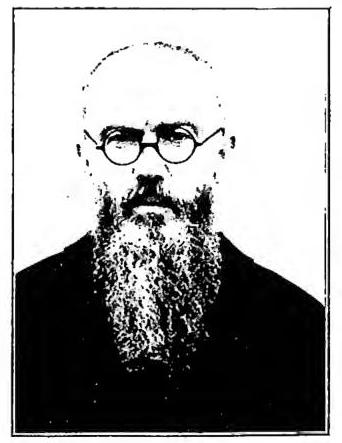
KOLBE, MAKSYMILIAN-MARIA. — Writer and Marian apostle of the Friars Minor Conventual, born at Pabjanica, in Poland, on 6 January 1894, died at Oświęcim there on 14 August 1941, in a reputation for holiness. He studied in Rome (1912–19), obtaining a degree in philosophy from the Pontifical Gregorian University (1915) and in theology from the Theological Faculty of S. Bonaventure at the Order’s International Seraphic College (1919).
There, with the counsel of his rector, Fr. Stefano Ignadi (v.), on 17 October 1917 he founded, together with six other confrères, the « Militia of the Immaculate » (v.), more an association of perfect devotion and Catholic-Marian apostolate, widely diffused throughout the world (approximately 2,100,000 members). Ordained a priest on 28 April 1918, he taught theology in Poland for several years, beginning his fruitful apostolate through the press in 1922 with the periodical Rycerz Niepokalanów (« The Knight of the Immaculate »), in Cracow, then in Grodno (1923), and in 1927 at Niepokalanów (« City of the Immaculate », 40 km from Warsaw).
In March 1930, with a special blessing from Pius XI, he went to Japan, founding near Nagasaki, in the following May, the second city or « Garden of the Immaculate » (Mugenzai-no-Sono), with the widely circulated Marian-missionary bulletin in Japanese, Seibo-no-Kishi. Because of external difficulties, the analogous Marian-missionary foundations planned in China, Korea, and India remained unrealized. From 1936 to 1939 he was once again superior and director at Niepokalanów, which in 1938 housed 762 Conventual religious and was known as the largest religious community in the world. Very well known in Poland, during the last war he was deported first to Germany (19 September–8 December 1939) and then definitively on 17 February 1941, following his painful Calvary from the Pawiak prisons in Warsaw to the camp at Oświęcim (28 May), where toward the end of July he evangelically offered his life to save that of a father of a family condemned in reprisal, with
M. K., Niepokalanów 1948; M. Winowska, Le fou de Notre Dame, Parigi 1948; C. Dobraczynski, Cantano nei vatteranei di Oświęcim, Brescia 1949; F. M. Rossetti, Cavalleria mariana, Padova 1949; B. De Wit, P. Max K., Ridder der Oubelekte, Roermond 1950; Author: various. Le père K., special issue of the journal Marie, 4 (1950), pp. 1-71.
Lorenzo Di Fonzo