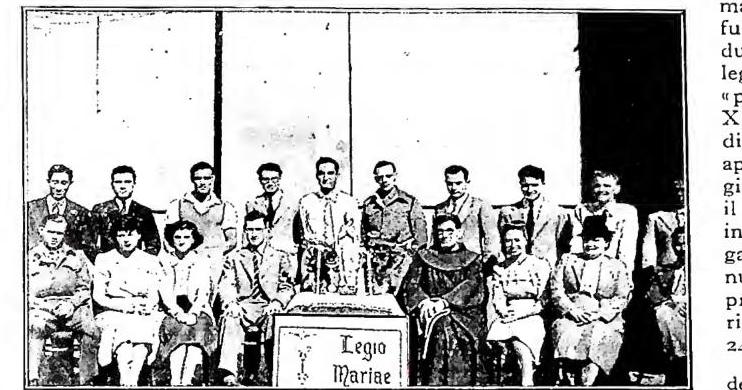
MILITIA OF THE IMMACULATA. – A Catholic-Marian association of prayer and apostolate, founded under the ideal of the Immaculata, in Rome, at the International Seraphic College of the Conventual Friars Minor at S. Teodoro, on 17 Oct. 1917, by the Servant of God Fr. Maximilian M. Kolbe (q.v.), a Pole, together with six other confreres, as a reaction against Freemasonry and socialism then dominant and against all enemies of the Church, of every age. Encouraged by Benedict XV on 4 Apr. 1918 and canonically approved as a “Pious Union” by the Vicariate of Rome on 2 Jan. 1922, it was enriched with indulgences and privileges and erected as “primary” by Pius XI (briefs of 18 Dec. 1926 and 23 Apr. 1927); praised by Pius XII on 12 Mar. 1942, it expanded its organization with a new statute approved by the Vicariate of Rome on 24 Mar. 1942.
The aim of the M.I., as an active and militant devotion of apostolate (such is the meaning of its name and its spirit of “marian chivalry”), is to promote the personal sanctification of its members (“militants” or “knights of the Immaculata,” divided into three degrees: simple soldiers, activists and organized zealots, apostles and missionaries; all, as an external sign, wear the Miraculous Medal [q.v.]) through perfect consecration and devotion to the Immaculata, and the conversion of sinners and all enemies of the Church, by every means of apostolate. The dogmatic foundations of the M.I. are the Mysteries, or Marian Offices, of the Immaculate Conception, spiritual maternity, mediation, and universal kingship. Its spirituality is based on the concept of love and chivalrous service to the Virgin Immaculata, understood as perfect interior consecration and personal activity, explicitly directed toward the broader Catholic and social apostolate, for the conquest of souls for the Immaculata and for Christ.
According to the “statute,” the M.I. is organized with a supreme moderator (who is always the Minister General of the O.F.M. Conv.), a general direction (in Rome), national and regional centers, local marian centers, simple branch seats, and propaganda centers (seats in formation). At the death of the founder (1941), it was spread across various nations, with 70 seats, of which 39 in Italy, and with important centers in Poland and Japan. As of 8 Dec. 1949, it has 4 national centers (Italy, Romania, Poland, Hungary), a special regional center in the United States of America (Carey, Ohio), and others elsewhere; it is spread across 12 nations in Europe and has approximately 2,100,000 members.
Of particular importance for the M.I. in these thirty years has been its press apostolate. Notable are the two “Cities of the Immaculata,” or large publishing centers founded by Fr. Kolbe in Poland (Niepokalanów, 1927) and in Japan (Mugenzai-no-Sono, near Nagasaki, 1930).
Among its most recent activities are the 1st National Convention of Directors of the M.I. of Italy (Assisi, Sept. 1948) and various regional congresses; marian preaching and missions, catechetical apostolate, visits to hospitals and prisons, various cultural and charitable activities of the circles and “researchers” of the Immaculata, workshops and schools of tailoring, embroidery, etc.; works of the consecration of families to the Immaculate Heart of Mary, and of the “Visit of Mary” in families, schools, institutes, and workshops; the “Living Rosary”; the Day of the Triumph of the Immaculate Heart of Mary (13 May, with a special “supplication” to the B.V. of Fátima); the “Azzurra Internazionale,” a work of fraternity and social assistance (founded in the centenary of the “manifesto” of C. Marx, 1948), with the two periodicals: *L’Immacolata e il suo Cuore*, since 1945, for consecrated families (12,000 copies monthly), and *L’Internazionale Azzurra*, since 1947 (Center of Genoa, with its own “Tipografia dell’Immacolata”).
Affiliated with the M.
I. are the two sodalities of the Piccoli militi and Piccoli cavalieri dell’Immacolata, founded in 1932 and 1934, for the marian formation of children, from about 7 to 15 years of age
See pl. LXVI.Logic is not a mere “codification of the laws or rules of thought.” It is “the science of the mental operations ordered to the appreciation of evidence” and to the validity of scientific inquiry; as such it is the common ground on which partisans of Hartley, Reid, Locke, and Kant (System, Introd., p. 13, § 7) can meet and shake hands. In treating of the categories, M. judges harshly Aristotle’s classification: “a mere catalogue of the crude distinctions of ordinary language with little or no effort at philosophical analysis” (ibid., I, ch. 3, vol. I, p. 50). His own classification, framed from a subjective-phenomenistic standpoint, distinguishes: a) states of consciousness, b) the consciousness or mind in which they inhere, c) succession-coexistence, equality-diversity among states of consciousness, d) bodies as real possibilities beyond consciousness (ibid., p. 83, § 15).
M.’s theory of the syllogism has remained famous for the acuteness of its analyses and criticism. Since every genuine reasoning proceeds only from experience, the syllogism is not “an instrument of reasoning” but “of proof.” That “Wellington never realized the reality of the general principle” such as “every man is mortal” is shown not by the principle but by the fact that Socrates, Plato… and Wellington’s contemporaries have died. The general principle contains all the particulars; once it is reached, inference is complete: every actual inference is from particular to particular, and general propositions are “mere records of such inferences already made” (ibid., p. 221, § 4). Reasoning is thus by M. reduced entirely to induction-by-analogy: the syllogism (a discovery he claims as his own) effects no real advance in thought and serves only as a method of verifying inductive processes.
The most original part of Mill’s logic is unquestionably his theory of induction. Induction is the mental operation “whereby we infer that what we know to be true of certain individual instances is true of all cases resembling them in certain definable respects” (ibid., I, III, ch. 1, p. 328, § 2); it is “the operation of discovering and proving general propositions” (ibid., p. 333, § 1). Elsewhere (v. INDUCTION) the essential elements of Mill’s doctrine have been set forth; here it must be noted how much stress M. lays on causality. Cause is “the invariable and unconditional antecedent of a phenomenon,” “a phenomenon or complex of phenomena conditioning a new fact” (ibid., III, ch. 5, pp. 367–77, § 2). The concept of cause therefore rests purely on empirical grounds (Hume): every phenomenon in the universe appears as having a necessary antecedent. This constancy of causality (to which M., despite some vacillations, does not except free will itself), attested by the most universal experience, is the valid and sole foundation of induction. Yet, drawn from experience, causality holds good only within its limits; its value is uncertain even outside our universe (ibid., I, III, ch. 21, vol. I, p. 108, § 4).
It is the same empirico-phenomenistic standpoint that led M. to define matter and bodies as “permanent possibility of sensations” or “groups of possible sensations” (Examination, ch. 10): the formula is his, but the concept is already substantially in Berkeley and Hume. From a phenomenistic viewpoint the definition is exact; yet M. completely evades the problem of the ground of “groups of possible sensations,” which can only be found in a permanent structure of material reality as the cause of the sensations themselves. On the subject of the ego he is nevertheless driven to acknowledge that it presents “grave intrinsic difficulties,” especially in relation to memory and the anticipation of facts not yet real, so that one must recognize in the ego, as a common and permanent element of psychic states, “a reality different from that conceded to matter” (Examination, ch. 12, pp. 262–63).
In ethics M. attempts to elevate Bentham’s and his father’s utilitarianism to a more fully human meaning. “Actions are right in proportion as they tend to promote happiness, wrong as they tend to produce the reverse” (Utilitarianism, p. 9). The proof: nothing is desirable except happiness; it is therefore the sole end of human action (ibid., p. 58). Utility, however, must not be confused with individual self-interest, and, as in all things, a qualitative discrimination must be admitted even in opinions. By a wholly extrinsic criterion M. appeals to the judgment of experts and, in case of conflict, to that of the majority (ibid., pp. 12, 15). He prefers the pleasures of the intellect and imagination (“better a dissatisfied Socrates than a satisfied fool,” ibid., p. 14) and the development of sympathetic feelings. Though in the end M.’s “utility” partly coincides with what is “conducive to human nature,” he lacks any absolute foundation of moral values. In particular, obligation is nothing but a feeling arising by association from the persuasion of the utility and necessity of a given action (ibid., ch. 3). Of religion M. had no serene vision. He finally granted it a certain positive value, but simply “as a source of personal satisfaction and elevated feelings” (Three Essays, London 1885, p. 104). As to the existence of God (as an ordering Mind of nature, not as infinite Being and omnipotence) and the immortality of the soul, he admitted no more than a doubtful probability (ibid., p. 174): the whole supernatural realm lies within the limits of a desire and a “hope” that, however slender, is not to be despised (ibid., p. 244).
In economics M. adopts and develops the system of Ricardo, Smith, and Malthus, yet is influenced by Saint-Simon, Fourier, and Proudhon, so that classical liberalism is tempered in him by marked socialist tendencies. Notable is his criticism of communism, in which he sees the danger of “obstructing all development of individuality, extinguishing sources of progress… and reducing everything to a uniformity of thoughts, feelings, and actions” (Principles, popular ed., London 1873, p. 130 A 3). On production, his four principles concerning capital deserve mention: 1) industry is limited by capital; 2) every increase of capital tends to produce an increase of industry; 3) capital is the result of saving; 4) every capital is consumed (ibid., p. 35 ff.). To remedy low wages M. defends birth control: “unchecked by prudent conduct on the part of individuals and the State, population is limited by hunger and hardship” (ibid., I, III, ch. 11, p. 712 B 3). Rich in original reflections are Books IV and V of the Principles, dealing respectively with the dynamics of political economy (M. trusted in a progressive improvement of social conditions and anticipated not a few later reforms) and with the intervention of public authority. M. had almost a cult of individual liberty (politically expressed in representative government through the vote, extended to women and plural). The fullest exercise of liberty in the speculative, scientific, practical, moral, and religious spheres was to him the indispensable condition for the control, progress, and truth of human opinions.
1° series, 12), ibid. 1851; Utilitarianism: E. Debenedetti, ibid. 1866; Representative Government (Bibl. of political sciences, 1° series, 2), ibid. 1885; On Socialism: O. Gnocchi-Viani, Milan 1880; The Subjection of Women: A. M. Mazzoni, Lanciano n.d., and G. Navelli, Turin 1883; Selected Pages, trans. and pref. by P. Carbonel, Milan 1923.
Studies: P. P. Alexander, Moral Causation or Notes on M.'s Notes to the Chapter on Freedom in 3rd ed. of Examination of Hamilton, London 1868; P. E. Goggia, The Mind of M.: Essays in Positive Logic Applied Especially to History, Leghorn 1869; J. Grote, Examination of the Utilitarian Philosophy, London 1870; L. A. Selby-Bigge, British Moralists, Oxford 1887; W. L. Courtney, Life of J. S. M., London 1889; Th. Gomperz, J. S. M., Ein Nachruf, Vienna 1889; S. Jevons, Examination of J. S. M.'s Philosophy, London 1890; L. Ferri, The Psychology of Association (part 2, ch. 3), Turin 1894; Ch. Douglas, J. S. M., A Study of His Ethics, Edinburgh and London 1895; id., The Ethics of J. S. M., ibid. 1897; J. Watson, M., Comte and Spencer, Glasgow 1895; L. Stephen, The English Utilitarians, III, London 1900; S. Saenger, J. S. M., Stuttgart 1901; A. L. Martinazzoli, The Theory of Individualism According to J. S. M., Milan 1905; E. Thouverez, S. M., Blond 1906; J. Morley, J. S. M., in Miserabilia, London 1908; F. W. Witaker, Comte and M., ibid. 1909; M. Taylor, M.'s Private Life, 2 vols., London 1910; A. Thue, M. D. S. Marig, 1912; A. Graziani, Ricardo and J. S. M., Bari 1912; E. Veutscher, The Problem of Empiricism in Society from J. S. M., Bonn 1922; G. Zuccante, J. S. M. and Utilitarianism, Florence 1922; A. Bernard, J. S. M. and the Advocates, Munich 1926; G. Morlan, America's Heritage from J. S. M., New York 1936; R. Jackson, Examination of the Deductive Logic of J. S. M., Oxford 1941; R. Vaysset-Boutbien, S. M. and Contemporary French Sociology, Paris 1941. Further indications of editions and recent studies in G. A. De Brie, Bibliographia Philosophica 1934–45, Brussels 1950, p. 479.