
MORTI, MONDO SOTTERRANEO dei. — The underground world of the dead, designated by the term “Inferi,” does not signify the idea of a dark place of punishment, as might be suggested by its Christian meaning, but rather, more generally, an underground realm where souls gather after death, whether deserving of reward or punishment. The Inferi are represented not only as a realm of darkness and suffering, but also as the radiant realm of the blessed: a characteristic common, to some extent, to nearly all ancient religions.
1. Among the Mesopotamians, Babylonians, and Assyrians, the underworld of the dead, a dark place where, nevertheless, the water of life flows, is called arallù. It is entered through seven gates and governed by the divine pair Ere'kkigal and Allatu. It is described in the poem of Gilgameš (v.).
2. The Egyptians embellished their vision of the world beyond the grave. From the primitive belief that made the tomb the dwelling of the deceased, who had to be provided with everything necessary for his shadowy existence, they came to conceive the underworld (amenti) as a place where the soul, once it had arrived in the sun’s boat, crossed the twelve divisions of the journey and undergone the judgment of Osiris with his forty-two judges, then passed into the fields of Yaru (Earu), where a happy and eternal dwelling was reserved for II.
3. Indo-Iranians
During the Vedic period of Indian religion, heaven was exclusively the world of pious men, heroes, and so forth, from which the reprobate were excluded (Rgveda, X, 17, 4). Alongside this belief there must also have existed, even if explicit evidence is lacking, a belief in a world beyond intended for the wicked. Indeed, while a Vedic ritual (Taiti, Arany, VI, 5, 13) says: “Before King Yama (the king of the dead)... are separated those men who here below were faithful to the truth from those who lied,” the following passages may provide some evidence for belief in an underground kingdom for the souls of the wicked: “May Indra and Soma hurl the evildoers into the covered and closed cavern (cāura), into the darkness...”; “May he dwell beneath the three earths... who plots treachery against us” (Rgveda, VII, 104, 3 and 11); and it is further said of those “who lead a dissolute life like women who deceive their husbands, who are wicked and false and without faith: they have created this deep place for themselves” (ibid., IV, 4, 5). Moreover, in the Atharva Veda (II, 14, 3), while the treacherous sorceress is wished “may she fall into the depths of the endless prison,” there is a passage (V, 19, 3) that lingers over the description of the sinner—who on earth has offended a brahman—seated among streams of blood and eating his own hair. This could demonstrate that India possessed a fairly well-defined underworld, perhaps very closely connected with the belief common to other Indo-European peoples (v. appresso).The Avesta, for its part (which preserves so many beliefs common to the Indo-Iranian period), has preserved a detailed description of the fate awaiting good and evil souls: “The wicked, the evil rulers... their souls shall receive filthy food, and they shall surely go to dwell in the house of Druj” (Yasna, 49, 11), and: “He who has deceived the righteous man, for him hereafter there shall be laments, a long dwelling in darkness, infected food, and words of insult. This is the world, O wicked ones, to which your deeds and your religion lead you” (ibid., 31, 20).
In addition, the Avesta preserves a detail that would later be developed extensively, above all in Greek religion: that of the crossroads which the soul must reach once it has arrived in the world beyond: “Across the Civat Bridge souls may proceed to heaven, or, if condemned to hell, to Druy” (ibid., 46, 11).
4. Greece
For the Greeks, the world beyond the grave, that is, the world of the Inferi, which they called Hades (Αἰδῶς = the invisible), was a real world. It even possessed a kind of geography, with descriptions of roads, regions, rivers, and so forth, which, according to tradition, had first been established by Orpheus on the occasion of his Catabasis (Olympiodorus, In Platonis Phaedonem comment., ed. W. Norvin, pp. 202–12), and which was undoubtedly made known to initiates in the Eleusinian mysteries as a provision for the journey beyond the grave (“O thrice-blessed among mortals are those who, after contemplating these mysteries, shall go to Hades: for they alone shall be able to live there; for the others everything will be torment”: Sophocles, frg. 348, ed. Didot).Hades, in turn, appears distinct from Tartarus, the prison of the dethroned gods (Il., VIII, 13 ff.), and from Ecebus, the actual prison of the dead (cf. loc. cit., 368).
This world of shadows was not, however, entirely inaccessible to the living; besides the already mentioned catabasis of Orpheus, one may cite the Nekyia of Ulysses in the Odyssey (Od., XI), which served as the model for later accounts. It could be reached through particular caverns or caves, such as those at Cape Taenarum in Laconia, Hermione in Argolis, Cumae in Italy, and so forth.
This realm of shadows consisted of an immense underground cavern situated in the West, at the boundaries of Ocean (Homer, Il., XX, 61; Od., X, 506 ff.); it was ruled by the pitiless Hades (or Pluto), later together with his wife Persephone (Il., IX, 457, 568).
It was separated from the world of the living by one or more great gates (also called the “gates of the Sun”: Od., XXIV, 12), immediately beyond which one reached the “asphodel meadow” (Od., loc. cit. and XI, 539). This meadow—which was like the vestibule of Hades, and where Ulysses, having descended to the Inferi, encountered Achilles (Od., loc. cit.)—was later, when the Greek mind had developed a clearer conception of the afterlife as a reward or punishment for souls (v. sotto), regarded as the place of those who in life had been neither good nor wicked (cf. Lucian, De luctu, 9).
According to tradition, Orpheus had spoken of only one infernal river: the Styx, which appears in the oldest strata of the Homeric epic; indeed, in the Iliad (VIII, 369), the underworld is invoked by swearing upon the river Styx. Later, however, the rivers that traversed or surrounded Hades became numerous, and in the Odyssey itself (VIII) one finds the Acheron, the Pyriphlegethon, and the Cocytus.
The ferryman of these rivers was the old Charon, grave and calm in appearance—whose first mention dates from the sixth century (cf. Pausanias, X, 28, 1)—to whom the soul owed an obol for the crossing.
Guarding the Inferi, at the gate, stood Cerberus, the dog, variously represented as having one hundred, fifty, or three heads, and certainly known from remote antiquity (the “hound of Hades” is mentioned in Il., VIII, 367; Od., XI, 623; he is first named in Hesiod, Theog., 311).
The psyche, or vital breath, leaves a person when he dies, but it is not extinguished by death; retaining the appearance of the deceased, it drifts without consciousness through the eternal night of Hades. It could, however, return to consciousness when it was offered the blood of a sacrifice performed by the living and poured into a pit connected with the underworld.
Nevertheless, at a later period the religion of Greece must have included the belief in Hades as a reward or punishment for the souls of the departed, both because in Homer himself (Il., III, 279; XIX, 260), in solemn oaths, alongside the supreme gods the Erinyes are invoked, who beneath the earth punish perjurers; and because already in Homer (Od., XI) mention is made of the three Titans: Tityus, Sisyphus, and Tantalus, condemned in Hades to ever-renewed punishments; but above all because already in Hesiod (Erg., 287 ff.) and in greater detail in Pindar (frg. 129, 130B, in Plutarch, Consol. ad Apoll. 35; cf. Pindar, Olymp., 2, 56) there is found the tradition of the two roads—that of Vice and that of Virtue—which, from the fork situated at the entrance to Hades, can lead, one (to the left), to the places of torment in the dark Tartarus, where the Erinyes rage among various monsters; the other (to the right), instead, to the pleasant and luminous Elysian fields, to an eternal enjoyment of banquets, dances, and flowers (cf. Aristophanes, in Koch, Comic. fragm., I, 517; the Elysian fields, at the boundaries of Ocean, already known to Homer: Od., IV, 563–89). Contemporary with this conception of Hades must have arisen that of the souls which, conducted to the underworld by Hermes (called, for this office, Φυγοσωμικός = guide of souls; cf. Od., XXIV, 1 ff.), appeared in order to be examined and assigned to the most appropriate place by an infernal judge.
5. Rome
Information concerning the most ancient Roman beliefs about the afterlife is extremely scant. An element that was in all probability genuinely indigenous and mundus (v.), which (cf. Festus, s. v.) was a pit dug in the ground, with a vaulted roof, into which only one person could descend. It was consecrated to the two infernal divinities Dis pater and Proserpina (corresponding to the Greek Pluto and Persephone), and the days on which it was opened were regarded as religious, that is, infasti, since then “it is as though the door of the gloomy and infernal gods were open” (Macrobius, Sat., I, xvi, 18–19). Thus, it is perhaps not rash to suppose that this mundus, a point of communication between the world of the living and the underworld, corresponded precisely to those caverns of Greek religion that gave access to the kingdom of the shades.However, similar places also existed elsewhere; near Cumae, in fact, on the shores of Lake Avernus, a cavern—which Virgil (Aen., VI, 126) calls “ianua Ditis”—led directly into the infernal region.
The Romans called this kingdom Orcus (= Orcus, which is also the name of the infernal god; cf. the Greek Hades), and its structure was described very late and almost entirely by reproducing Greek models (for the sources, V. Ennio, ap. Lucret., I, 117 ff. and ap. Lactant., I, 14; Lucretius, VI, 762 ff.; III, 1036 etc.; Apuleius, Metam., VI, 18 ff.; Silius Italicus, XIII lib.; but above all Virgil, Aen., VI and the little poem Culex).
From the Etruscans, on the other hand, the Romans seem to have drawn the concept of Acheron (Acherunt), which down to Lucretius had the meaning of the underworld, and only later became the name of the infernal river. The Roman Charon, too, was certainly inspired more by the corresponding Etruscan figure than by the Greek one.
6. Etruscans
Very little can be said about Etruscan conceptions of the afterlife. Of the Etruscans, the existence of the Libri Acheruntici is known only through an occasional citation by Latin authors; these books most probably contained all their beliefs concerning the world beyond.Nevertheless, judging from the archaeological evidence, they drew very extensively from the Greeks for their beliefs about the afterlife. Thus, first of all, the very name of the infernal world, which they probably called axrum, derived from the Greek Ἀχέρων (= Hades), Eita and Persipnai (= Hades and Persephone), Turmi Altai (= Etruscan psychopompos), who accompanies the hindial, that is, the psyche, and the demon Culfu (a type of Erinys holding a torch and a sword), guardian of the entrance to the kingdom of the dead.
Xaru, corresponding to Charon, appears quite different from the solemn Greek Charon because of his terrifying appearance, often winged and armed with a large hammer with which he strikes the souls. Beside him the other demon Tuxulxa often appears; among the other infernal divinities, Leind, goddess of death, and Mean, who in the Perugia mirror crowns Hercle as victor over Cerberus, should be mentioned. Krankru, on the other hand, an infernal animal, is a feline or wolf with long deer antlers.
7. Germans and Balto-Slavs
From Herodotus (IV, 94 ff.) it is known that the Thracians believed that their god Zalmoxis returned every three years to earth from the underground dwelling that he himself had built during his lifetime.Among the Germanic peoples one finds Hel, the gloomy underground place that received, for expiation, the souls of the dead and which was reached by a long journey; Hel was at the same time the goddess of death and of the underworld (cf. the Greek Hades and the Latin Orcus).
Tuonela was the underground kingdom of the Finns, and Porgu that of the Estonians, who believed that it could be reached through the opening of a cavern.
9. The Underworld in Ethnology
A very widespread belief, also among primitive peoples, is that of another infernal world,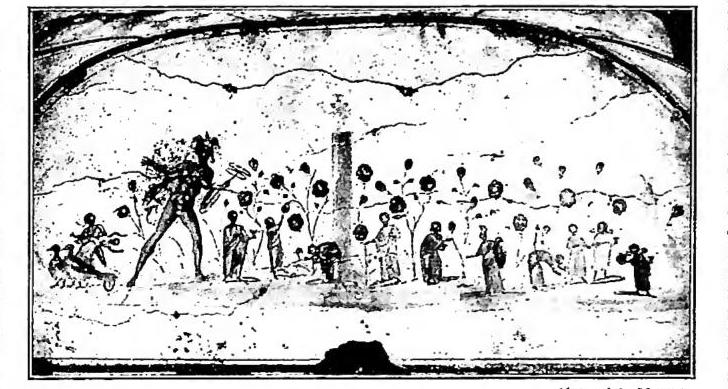
Finally, mention must be made of the widespread belief that the infernal world can be entered through the opening of certain caverns (among the Kai, the Tami, the Nilotic peoples, etc.). Thus, a Cushitic population of North Africa tells of an old woman who, taken by the hand by the divinity, was led before the mouth of a cavern, which was the entrance to hell; having descended into it, she saw various men and women expiating their punishments. Then, continuing on her way, she arrived at a land “where the sky was very close to the ground” and where everything was green, abundant, and serene.